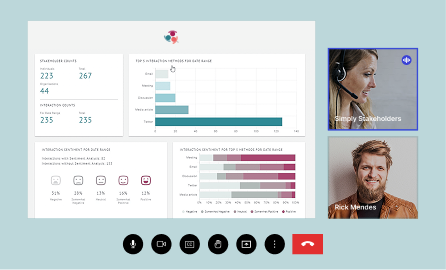
How a large mining company built one record of community engagement, grievances and government relations

A large mining company with a strategically important critical minerals project was relying on notebooks, Outlook folders and a spreadsheet to track its conversations with regulators, landowners and communities. Until it nearly came unstuck through unexpected opposition from key ranchers in the local area.
Simply Stakeholders gave it’s small community relations team one shared system to log every interaction, resolve grievances end-to-end, and keep the relationship history intact.
Project highlights
| 1
Shared record of community, government and investor-facing engagement |
4
Person team covering government relations, community relations and communications company-wide |
3 ways To capture engagement: web platform, Outlook add-in and an offline-capable mobile app |
“Continuity is key. I guarantee you in the next ten years I’m going to retire, and whoever takes over is going to want to know what I was working on. It needs to be there.”
– VP Government & Community Relations
Organization Background
The customer is a large mining and critical minerals company developing lithium projects across the Americas. A small, dedicated team of four handles government relations, community relations and corporate communications for the whole company – engaging regulators, landowners, communities and investors who all expect a consistent, defensible account of who has been told what, and when.
That combination of a lean team and a high-stakes, multi-decade project is exactly the challenge stakeholder relationship management software is built to solve, and it’s one of the reasons the company came to Simply Stakeholders. When an influential rancher led an unexpected opposition to one of their projects, threatening it’s progress, the team realised they needed a better way to manage these complex relationships and risks.
The Challenge: notebooks, spreadsheets and a growing list of people asking for proof
Before adopting stakeholder management software, engagement records lived in personal notebooks and notes apps, an ever-growing Outlook folder structure, and a spreadsheet for tracking complaints. It worked when the company was smaller, but as the need for accountability grew, it stopped being enough.
We need a program to catalogue all of our interactions, and that’s becoming more and more important. A few years ago, when we were a small company, just shooting from the hip, it was fine to keep those things in our heads. Now people are asking for specifics. If someone needs a list of every public official we’ve met with, being able to run that report quickly really matters.
– VP Government & Community Relations
The main challenges the team were looking to solve:
- No shared record. Interactions sat in personal notebooks, notes apps and individual Outlook folders—useful to the person who wrote them, invisible to everyone else.
- Grievances tracked in a spreadsheet. Complaints were logged with no reliable way to see how long they took to resolve or whether a pattern was emerging.
- Institutional memory tied to one person. A decade of government and community engagement history lived mostly in one or two people’s heads and inboxes.
The Solution: one system for interactions, grievances and reporting
- A dedicated grievance workflow. Every complaint gets a status, a priority and a due date, so the team can see what’s open, what’s overdue, and how long resolved complaints actually took.
- Tagging by theme. Complaints and interactions are tagged against a growing issues list—from site lighting to traffic speed to workforce facilities—so recurring themes surface instead of getting buried in individual records.
- AI sentiment scoring, with a human check. Each grievance can be auto-scored for sentiment, with a team member able to override it where the AI misreads context.
- The Outlook add-in. Emails to and from stakeholders save into the record automatically, so logging an interaction isn’t a separate chore.
In the first seven months of using the grievance module this way, the team logged and tracked 17 separate community complaints end-to-end—each carrying a theme, a sentiment score and a resolution time instead of a single line in a spreadsheet.
Field engagement, captured in the moment with the mobile app
A large share of engagement on a mining project happens away from a desk—on site visits, in the community, or in an unplanned conversation:
“I love the idea of the app—it’s really perfect for what I do. I would previously use a notes app and a pen to jot things down on the fly and never lose them. Having that organised is already good, but it’s even better once it loads straight into our stakeholder record.”
— VP, Government & Community Relations
The mobile app lets the team log an interaction on the spot using speech-to-text and work fully offline with no signal, syncing automatically once they reconnect.
Working through the friction points together
Adoption wasn’t friction-free. Slow load times in the Outlook add-in led the team to seriously evaluate other options ahead of a licence renewal:
“We’re not committed to making a change. We’re just taking a look to make sure we’ve got the right system. But the add-in going through a five-to-ten-minute check every time I log on—we can’t have that.”
— VP, Government & Community Relations
The account team diagnosed the root cause—a backlog of historical emails syncing on every login—put a workaround in place immediately, and logged a permanent fix on the roadmap. The account renewed, and the relationship deepened from there: “Anytime I reach out, I get a response right away and get the help that I need,” as the Community Relations Manager put it.
Outcomes: a searchable record, faster reporting, and institutional memory that survives staff changes
The team now has what it set out to build—a single, searchable record of who has been engaged, about what, and with what outcome, standing in for the notebooks, spreadsheets and scattered inboxes it replaced.
- One system of record across the company for community, government and investor-facing engagement.
- Grievances tracked end-to-end—status, due date, theme and sentiment—so response times and recurring issues are visible at a glance.
- Institutional memory that outlasts any one role, so a new team member can pick up a relationship exactly where it left off.
- A renewed, growing partnership: a near-miss on renewal turned into deeper day-to-day use of the platform.
“When we first had this training, I was brand new and I didn’t have a clue. Now I’m getting into it—and it’s all in one place for whoever comes next.”
— Community Relations Specialist
Book a Personalized Demo Interested in seeing what you can do with Simply Stakeholders? We’re here to help!