STAKEHOLDER AI


Institutional intelligence

Stakeholder AI is institutional artificial intelligence built for stakeholder relationship
management. It turns scattered conversations into organisational memory, helps teams spot risk earlier, and preserves relationship knowledge when people move on.
Core capabilities
Core capabilities

What is Stakeholder AI?

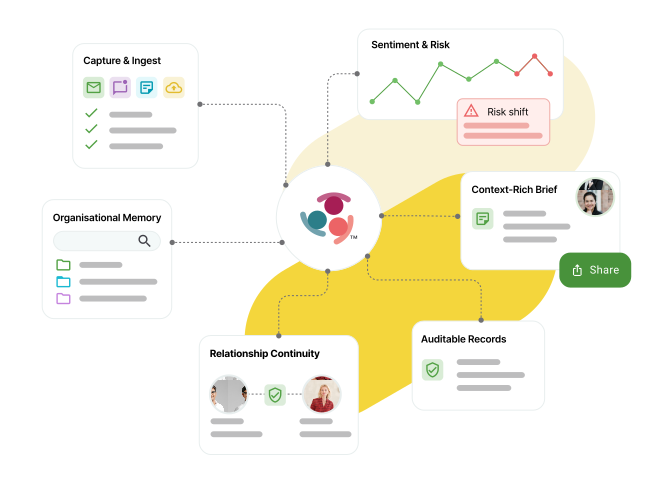
Stakeholder AI is designed for the long-running, multi-team, non-transactional relationships your organisation depends on for trust, approvals, and social licence. Stakeholder AI helps you:

  • Capture relationship intelligence automatically
  • Turn unstructured data into structured organisational memory.
  • Surface sentiment and risk shifts
  • Prepare context-rich briefs
  • Preserve relationship continuity when staff leave, protecting your organisation from knowledge loss.
  • Create auditable, defensible records for reporting, compliance, and regulatory scrutiny.
Relationship intelligence engine

AI for Relationship Management

Since 2018, Simply Stakeholders has been embedding AI into stakeholder management workflows, learning what works in mining, renewable energy, local government, infrastructure, and utilities.

  • Organisation enrichment that auto-fills organisations from email domains and public records, saving hours of manual data entry.
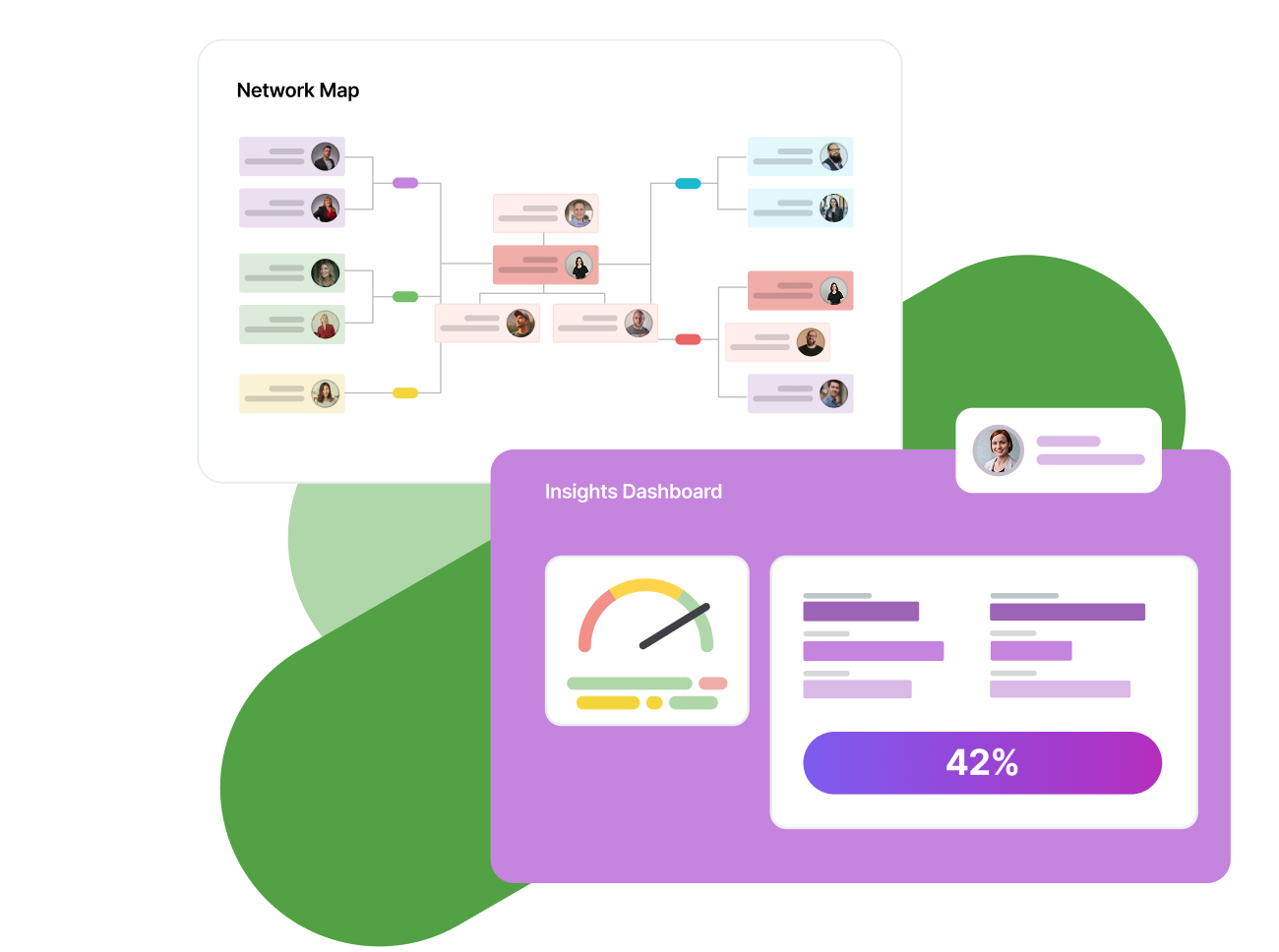
  • Stakeholder network mapping that identifies hidden connections across people and organisations, visualised in a 3-D network map.
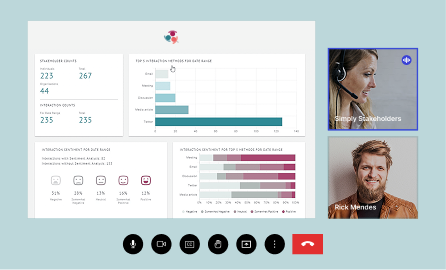
  • AI insights and reporting that surface what matters across each relationship, with proactive dashboard insights.
  • Sentiment analysis that detects nuance, scepticism, advocacy, and urgency.
  • AI governance with per-field controls, full audit trails, and privacy statements per setting.
  • AI stakeholder mapping that surfaces influence, interest, and risk fields from your data (coming soon, 2026 roadmap).
  • Meeting intelligence that structures meeting capture and links conversations to stakeholders and commitments (coming soon, 2026 roadmap).
  • Risk and opportunity synthesis that generates project-type-aware risks and opportunities (coming soon, 2026 roadmap).
Automated engagement workflow

How Stakeholder AI works

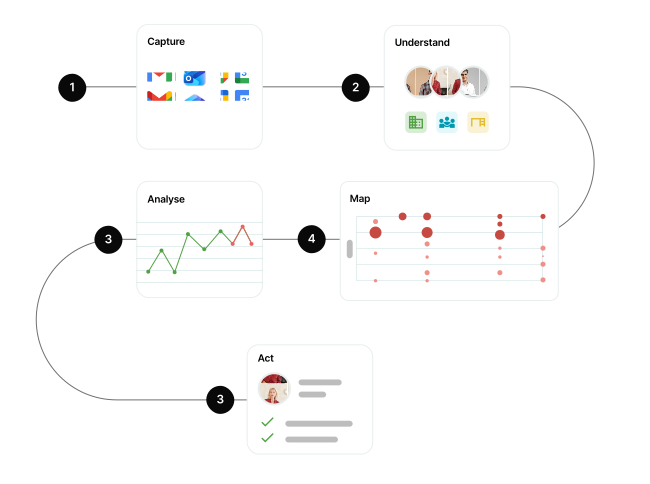
Stakeholder AI operates using workflows designed around real stakeholder engagement practice:

  1. Forward an email or sync your calendar. Stakeholder AI identifies the people and organisations involved, classifies the context, and updates your engagement history automatically.
  2. Detect sentiment beyond simple positive or negative signals. It reads tone across interactions to surface shifts early.
  3. Map the network you didn’t know you had. Hidden influences, bridge stakeholders, and relationship patterns become visible in a 3-D network map.
  4. Brief leaders in seconds. Ask what a stakeholder knows, what has been promised, or what remains unresolved, and get one defensible answer

This is the “automagic” workflow: AI working invisibly to turn messy reality into structured organisational memory.

Trust & Governance by design

Governance and ethical AI: your data is never the product

Stakeholder AI is designed with governance built in. You can choose:

  • No AI for human-only fields.
  • AI suggestions where a person approves the output.
  • Auto-applied with confirm and undo where AI enters the data and humans review it.

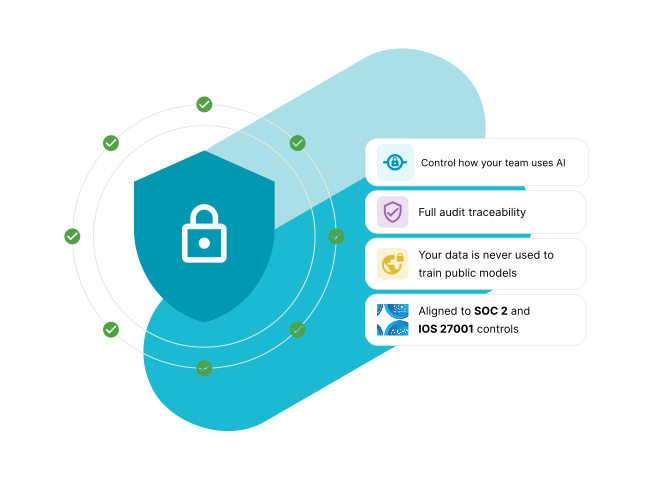
Privacy statement on every setting. Each AI capability tells you what data is sent, where, and what is not.

Auditable history. Every AI-driven change is logged, who turned it on, what was suggested, what was approved.

Walled-garden architecture. Your data is never used to train public models. Aligned to SOC 2 and ISO 27001 controls.

purpose-built for impact

Built for organisations where stakeholder relationships have consequences

Stakeholder AI is purpose-built for organisations whose stakeholder relationships affect governance, compliance, approvals, or social licence. This includes:

  • Mining and resources: Traditional Owner relationships, IBA obligations, Native Title, IFC Performance Standards.
  • Renewable energy: landowner negotiations, community consultation, development approvals.
  • Local government: resident groups, business chambers, statutory community engagement requirements.
  • Transport and infrastructure: corridor stakeholders, property acquisition, multi-phase project handovers.
  • Utilities: concurrent infrastructure programs, environmental advocates..
  • Health: community advisory groups, clinical advocates, multi-jurisdiction policy stakeholders.

Frequently Asked Questions About Stakeholder AI

What is Stakeholder AI?

Stakeholder AI is institutional artificial intelligence built specifically for stakeholder relationship management. It captures relationship intelligence across teams, summarises engagements, detects sentiment and risk shifts, and prevents knowledge loss when staff leave. Developed by Simply Stakeholders, it embeds eight years of AI implementation and deep stakeholder engagement sector knowledge. 

How is Stakeholder AI different from Copilot, Claude, or ChatGPT?

Personal AI tools serve the individual. Each user gets their own private answer, with no shared mental model, no audit trail, and no continuity when staff leave. Stakeholder AI is institutional, providing one shared view, full audit trail, knowledge that stays with the organisation, and governance controls the organisation sets.

This article explores the reasons why a personal AI tool is not a replacement for a stakeholder management software with AI embedded.

How is Stakeholder AI different from CRM AI?

CRM AI optimises sales pipelines, quarterly cycles, and transactional customer relationships. Stakeholder AI optimises for trust, continuity, and social licence over multi-decade, multi-team, non-transactional stakeholder relationships. Different jobs. Different tools. Different AI. 

Can Stakeholder AI replace our existing engagement platform?

No, and it isn’t meant to. Online engagement platforms run public consultations. Stakeholder AI runs the organisational intelligence underneath – who you have spoken to, what was committed, who knows whom, and how relationships are trending.

Does it work with messy data?

Yes. It is designed to extract structure from notes, emails, spreadsheets, and other real-world sources.

Is Stakeholder AI suitable for organisations under regulatory scrutiny?

Yes. It is built for sectors with stakeholder governance obligations such as mining (IFC Performance Standards, Native Title), renewables (development approvals), local government (statutory community engagement), and infrastructure projects. Per-field AI controls, full audit trails, and explicit privacy statements support regulator-ready record-keeping.

Is our data used to train public AI models?

No. Stakeholder AI runs in a walled-garden architecture aligned to SOC 2 and ISO 27001 controls. Your client data is never used to train public models.

How does Stakeholder AI handle staff turnover?

Relationships, commitments, and context stay attached to the organisation, not the departing employee. When a project lead resigns, the institutional record of meetings, sentiment history, promises made is preserved and immediately accessible to whoever picks up the relationship.

What is institutional AI?

Institutional AI is artificial intelligence governed at the organisation level rather than the individual level. The organisation controls what AI does, what data it sees, who can override it, and what gets logged. Stakeholder AI is institutional AI applied to stakeholder relationship management.

How is it different to Chat GPT or similar tools?

Personal AI assistants serve the individual. Stakeholder AI serves the organisation.

Dimension Personal AI (Copilot, Claude, ChatGPT) Stakeholder AI
Audience Individual user Whole organisation
Mental model Private to each user Shared across teams
Audit trail None Full audit trail
Compliance  Not designed for it Purpose-built
Data scope Whatever the user can access  Curated stakeholder and project data
Continuity when staff leave Knowledge is lost Knowledge stays with the organisation
Governance controls Limited control Per-field, configurable controls
Best-practice methodology Depends on the user’s prompt skill Built in
Aligned action across teams No Yes

The result is a shared view of stakeholder relationships that does not disappear when people leave.

GET STARTED

See Stakeholder AI with your own data

Bring in a few messy meeting notes, stakeholder spreadsheets, or an email thread. We will show you how they can become a live slice of organisational memory in a short demo.