Why Microsoft Copilot Won’t Replace Stakeholder Management Systems

Why Microsoft Copilot Won’t Replace Stakeholder Management Systems
Microsoft Copilot is now part of everyday work for many organisations. It can draft emails in seconds, summarise long documents, and pull context from across Microsoft 365. For stakeholder managers, that sounds like a dream.
But there’s a problem.
Copilot is not a stakeholder management system. It is an AI assistant that works over your existing data – not a structured, central system of record that keeps your stakeholder relationships, commitments, and history safe over time.
In this article, we’ll explain:
- What Microsoft Copilot does well for stakeholder engagement.
- Where Copilot falls short compared to dedicated stakeholder management software.
- Why organisations need a stakeholder system of record like Simply Stakeholders, especially in AI-led workplaces.
- How to combine Copilot and Simply Stakeholders for the best results.
What Microsoft Copilot does well in stakeholder work
Copilot is genuinely useful in stakeholder management when it is used for the right tasks.
Here’s where Copilot delivers immediate value
- Pre-meeting context: Quickly summarises emails, Teams chats, and documents so you can walk into stakeholder meetings prepared.
- Post-meeting summaries: Drafts summaries, action items, and follow-up emails based on your notes or meeting transcript.
- Content drafting: Helps you write emails, reports, proposals, and briefing notes faster, especially once it has enough context.
- Information retrieval: Surfaces relevant files and conversations from across Outlook, Teams, OneDrive and SharePoint, reducing manual searching.
- Zero-friction adoption: Works inside existing tools (Outlook, Teams, Sharepoint), no behaviour change required.
These are meaningful gains. In many cases, they reduce hours of manual effort per week.
Used well, Copilot improves individual productivity. A single person can move faster, do more, and access information with less friction.
But stakeholder management is not just about individual productivity. It is about organisational reliability, continuity, and trust.
The core limitation: Copilot is not a system of record
Copilot works by reading and generating content, not by maintaining a structured, authoritative record of your stakeholders and interactions.
That means it:
- Does not store stakeholder records in a dedicated database.
- Does not manage stakeholder profiles, influence, interest, or issues over time.
- Does not create a single, reliable engagement history across projects and teams.
- Does not enforce stakeholder engagement processes or compliance rules.
In short: Copilot helps you use your information. It does not become your information system.
Stakeholder management is not just about communication. It requires preserving what was said, who said it, what was promised, who owns the next step, and whether that commitment was completed. This is not a search problem or a drafting problem. It is a record-keeping and coordination problem.
Stakeholder management, especially in high-stakes or regulated environments, needs:
- A complete, auditable engagement history.
- Clear ownership of actions and commitments.
- Reporting that can stand up to internal or external scrutiny.
- Continuity when staff, projects, or priorities change.
That is the role of a stakeholder management system, not a general-purpose AI assistant.
That is why Copilot cannot replace a stakeholder management platform. Even if it can surface fragments of history from SharePoint, Outlook, or Teams, it does not provide a dedicated, longitudinal, stakeholder-specific system of record. It also does not enforce engagement workflows or create an auditable trail of decisions and commitments in the way a purpose-built platform does.
The deeper organisational point is that a tool that helps individuals work faster does not automatically create a better operating model. In the absence of shared records, institutions often end up with “local intelligence” trapped in inboxes and “personal productivity” that disappears when people move roles or leave the organisation.
The hidden risk: relationship debt and lost knowledge
Copilot can quickly summarise whatever it can see, which creates a feeling of control, even when the underlying records are patchy or fragmented.
Copilot reconstructs. Simply Stakeholders remembers. That’s not a gap in Copilot’s design, it’s Copilot working exactly as intended. The problem only appears when an inference engine is asked to do the job of a record system.
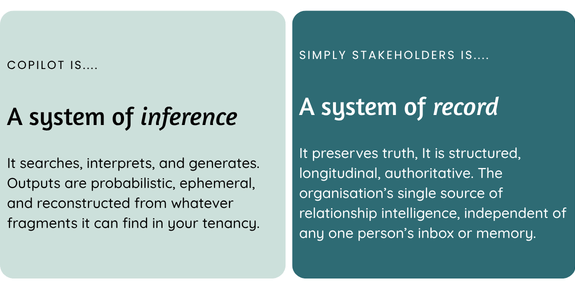
The decision is not Copilot vs stakeholder relationship management (SRM). It is whether you are willing to replace a system of record with a system of inference.
They are fundamentally different categories, and confusing them introduces a subtle but compounding risk for organisations: relationship debt.
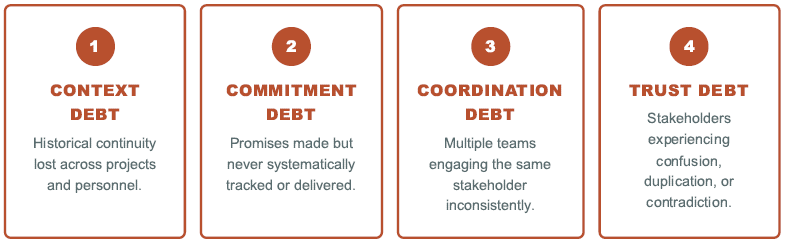
These debts do not appear immediately. They surface later as project delays, escalations, regulatory scruiting and reputational damage.
The offboarding problem Copilot can’t solve
When key people leave your organisation, a huge amount of stakeholder knowledge often leaves with their email account. While Microsoft 365 does offer options like inactive mailboxes and retention policies, these still depend on IT configuration and governance.
Copilot can only read what still exists and what the current user is allowed to access. It cannot:
- Recreate missing engagement history that was never stored centrally.
- Guarantee continuity if stakeholder information is spread across personal inboxes.
- Replace a proper offboarding process for stakeholder relationships.
Simply put: if your stakeholder history lives in people’s inboxes, you are one resignation away from losing it.
Copilot cannot reconstruct what no longer exists.
It can only summarise what remains, and what the user is permitted to access.
Individual productivity vs organisational productivity
Copilot is excellent at improving individual productivity. But higher individual productivity does not automatically create a more productive or resilient organisation.
If engagement data is fragmented:
- Copilot helps each person work faster in their own silo.
- The organisation as a whole still struggles with consistency, reporting, and risk.
- Leadership cannot see the full picture across projects, regions, or portfolios.
Organisational productivity improves when:
- Everyone works from the same system of record.
- Data is structured, searchable, and reportable.
- AI enhances the quality and usability of that shared data.
That is where Simply Stakeholders comes in.
What a stakeholder system of record does (that Copilot cannot)
A modern stakeholder management platform like Simply Stakeholders is designed from the ground up as relationship infrastructure, not just another database.
With Simply Stakeholders you can:
- Maintain complete stakeholder profiles including influence, interest, impact, relationship health, sentiment and issues.
- Capture every interaction emails, meetings, notes, webforms, surveys, and more – in one place.
- Track commitments and outcomes so promises do not get lost or forgotten.
- Analyse sentiment and issues with AI automatically detect tone, emerging topics, and risk signals.
- Generate stakeholder reports in minutes using structured data designed for reporting, not free-form AI summaries.
- Share a single truth across teams so projects, regions, and senior leaders see the same information.
This is the difference between “using AI on top of scattered data” and “using AI inside a structured stakeholder system.”
Yes, Simply Stakeholders uses AI too (but differently)
Some teams ask: “If we have Copilot, do we still need stakeholder software?” It helps to know that Simply Stakeholders already has its own, purpose-built AI features.
Simply Stakeholders uses AI to:
- Analyse stakeholder sentiment over time.
- Automatically detect and classify issues and themes.
- Automatically detect stakeholders and link them to interactions and other stakeholders
- Generate summaries of interactions so teams can scan long notes quickly.
- Enrich records by suggesting organisations and relationships to complete your data.
In other words, AI is embedded directly into your stakeholder system of record, not bolted on top of unstructured content.
The result: AI doesn’t just make individual users faster; it makes your stakeholder data better, richer, and more reliable.
Where Copilot Falls Short for Stakeholder Management
1. No System of Record Copilot cannot provide:
- Complete engagement histories
- Structured stakeholder profiles
- Cross-project continuity
2. Probabilistic Outputs AI-generated summaries:
- May omit critical details
- May introduce inaccuracies
- Are delivered with high confidence
In stakeholder contexts, precision is non-negotiable.
3. No Coordination Enforcement Copilot cannot:
- Prevent duplicate outreach
- Enforce engagement protocols
- Align teams across departments
4. Compliance Limitations It does not produce:
- Auditable records
- Defensible engagement histories
- Tamper-evident logs
5. Data Exposure Risks Copilot surfaces whatever users have access to, often more than expected. This introduces risk around:
- Sensitive stakeholder information
- Internal negotiations
- Personal data
6. Emergence of “Shadow Records” Employees increasingly rely on AI as informal memory. Result:
- Fragmented understanding
- Inconsistent narratives
- No single source of truth
A Balanced View: Where SRMs Fall Short
A credible strategy must also acknowledge the limitations of traditional stakeholder systems.
Adoption Friction
- Requires disciplined usage
- Competes with inbox-driven workflows
Data Quality Dependency
- Value depends on consistent input
Perceived Duplication
- Often overlaps with CRM or internal tools
Slower Time-to-Value
- Benefits compound over time rather than instantly
These challenges are real, and must be addressed in any modern SRM approach.
Copilot vs Simply Stakeholders: Key Differences
Here’s a simple way to understand the roles of Copilot and Simply Stakeholders:
| Aspect | Microsoft Copilot | Simply Stakeholders |
|---|---|---|
| Primary role | AI assistant across Microsoft 365 | Stakeholder relationship management system |
| Data model | Works over existing emails, files, chats | Structured stakeholder records and interactions |
| System of record | No. Depends on underlying apps | Yes. One source of truth for stakeholder engagement |
| AI focus | General-purpose drafting & summarising | Stakeholder-specific sentiment, issues, summaries, insights |
| Continuity & offboarding | Only as good as mailbox retention & access | History persists beyond individuals and projects |
| Reporting & compliance | Limited to whatever you can query or export | Designed for stakeholder, issue, and sentiment reporting |
| Coordination | Helps individuals; no built-in stakeholder workflows | Supports multi-team coordination, ownership & governance |
The winning approach: Copilot + Simply Stakeholders
The strongest organisations are not choosing between Copilot and stakeholder management software. They are combining them.
A practical model looks like this:
Use Copilot to:
- Draft emails, reports, and meeting notes faster.
- Summarise long documents and threads before stakeholder meetings.
- Help individuals find what they need inside Microsoft 365.
Use Simply Stakeholders to:
- Capture the definitive record of stakeholder interactions and commitments.
- Track sentiment, issues, commitments, and risks with AI built for engagement data.
- Coordinate stakeholder engagement across teams and projects.
- Produce consistent, defensible stakeholder reports when it matters most.
Copilot compresses time. Simply Stakeholders preserves reality.
Copilot won’t replace stakeholder management systems. You need both if you want AI to accelerate your work without compromising your institutional memory, stakeholder relationships, and organisational reputation.
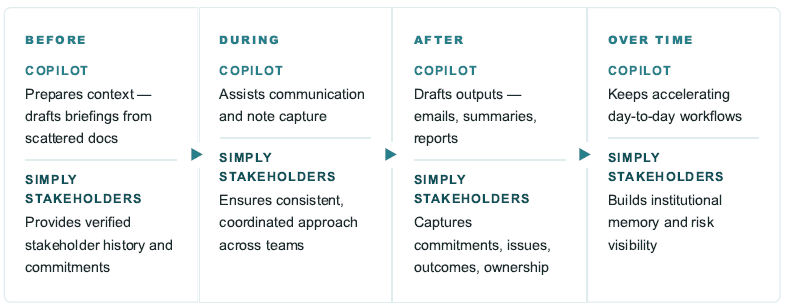
How This Works in Practice
“Why not just build it in Power Platform?”
It’s a fair question, and the answer is: you can, but you’d be building exactly what Simply Stakeholders already is. You’d take on the data modelling (stakeholder profiles, commitments, consents, issues), the worflow design, the governance framework (audit logs, retention, access) and the ongoing maintenance burden.
Purpose-built systems exist because this problem is structurally compex, and because the internal build-and-maintain cost rarely beats the specialist alternative once you account for opportunity cost
Purpose-built systems like Simply Stakeholders exist because this problem is structurally complex.
When should you consider a stakeholder system of record?
If any of these feel familiar, it’s time to look beyond inboxes and AI summaries:
- You can’t easily see a complete history for a key stakeholder across projects.
- Reporting for executives, boards, or regulators is slow and manual.
- When people leave, you worry about what knowledge goes with them.
- Different teams sometimes “double contact” or contradict each other.
- You want to use AI on stakeholder data, but you need reliable, structured inputs.
That’s exactly the problem Simply Stakeholders was built to solve.
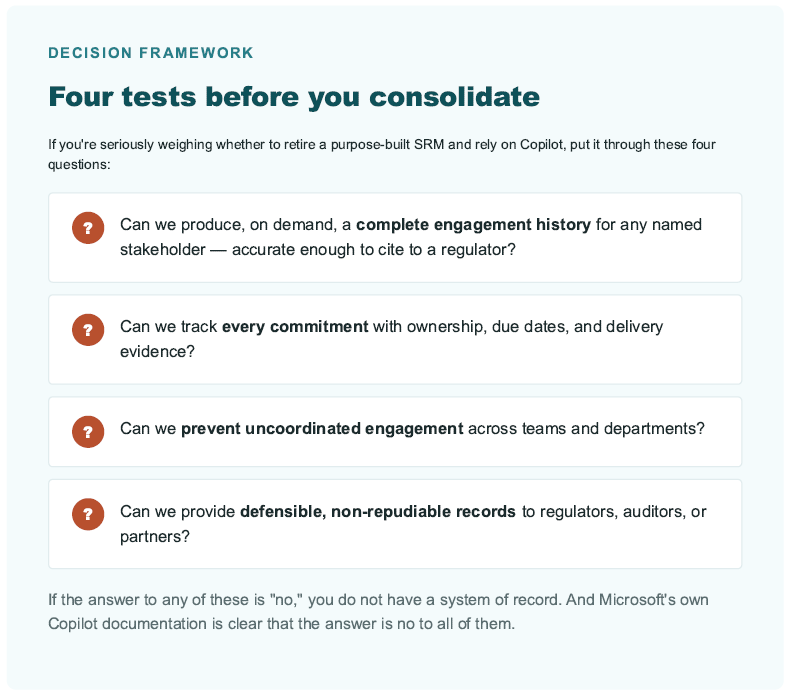
Decision Framework for Leaders
Take the next step
If you’re exploring how Microsoft Copilot fits into your stakeholder engagement strategy, the question is not “Copilot or stakeholder management systems?” It’s “How do we combine Copilot with a proper stakeholder system of record?”
Simply Stakeholders helps you:
- Turn scattered interactions into a structured, searchable history.
- Use AI to understand sentiment, issues, and risks – not just to write faster.
- Protect your stakeholder relationships from staff turnover and information loss.
- Move from individual productivity to true organisational capability.
If you’d like to see how Simply Stakeholders and Copilot can work together in your environment, book a demo with our team today.
About Simply Stakeholders
Simply Stakeholders is a purpose-built stakeholder relationship management platform designed for organisations operating in complex, high-stakes environments.
It acts as:
- A system of record for stakeholder engagement
- A coordination engine across teams
- A memory layer for stakeholder ecosystems
Enabling organisations to:
- Maintain accurate engagement histories
- Track commitments and outcomes
- Coordinate communication across departments
- Provide defensible records for compliance and reporting
Final Thought
AI will transform how stakeholder work gets done.
But it will not replace the need for:
- Structured memory
- Coordinated engagement
- Accountable commitments
Those are not AI problems. They are system design problems.
And solving them is what separates organisations that move fast
from those that move fast and don’t break trust. Microsoft Copilot won’t replace stakeholder management systems, but working in tandem with a system like Simply Stakeholders, it can deliver extraordinary organisational value.