An ESG Compliance Guide: Standards, Steps, and Stakeholder Benefits

ESG Compliance in 2026
In 2004 the UN published the Global Compact, Who Cares Wins and sharpened the focus on issues around environmental, social, and governance (ESG) issues and responsibilities. ESG has been a hot (and sometimes divisive) business topic ever since. That said, the ideas (and events) fueling ESG have been gathering momentum since the 1970s and 80s.
In this article, we’ll look briefly at the history of ESG and what’s motivating companies to make sustainable, human-driven changes in the ways they work.
We’ll also unpack:
- Mandatory regulations
- The benefits of ESG compliance
- The steps involved in gaining an ESG rating.
ESG’s Origin Story
Two major events — one environmental, the other political — triggered action on ESG.
The first was the Shell oil blaze in the Gulf of Mexico on December 1st 1970. This disastrous spill raised questions about prioritizing profit over the environment. Shortly afterwards, the idea of socially responsible investment (SRI) gained momentum. Investors took greater interest in aligning their portfolios with their values.
The second event was the growing public outcry against companies doing business in apartheid South Africa. There were calls for divestment in companies and organizations profiting from the system.
Both cases prompted widespread community demands for companies to take responsibility for their actions. And investors, sensing and seeing the change, began moving towards SRI.
Companies responded to this shift in attitudes by trying to reassure consumers and stakeholders that they were taking responsibility for:
- Protecting the environment
- Engaging proactively with their people and the surrounding communities
- Delivering fair and ethical management of the company.
ESG is an evolution of SRI. And today, whether you love it or hate it, ESG can make or break your business’s bottom line and reputation.
International companies know this. It’s why the likes of Microsoft, Unilever, and Salesforce demonstrate their commitment to ESG frameworks and regulatory compliance. And sure, it would be nice to think they do this for the warm and fuzzies, but the corporate truth is this: Being ESG compliant brings investment and financial benefits. More on those benefits shortly. And why maintaining focus on them matters.
Despite rhetoric suggesting ESG is on the way out and only for ‘woke business’, these standards aren’t going anywhere. Understanding compliance obligations, as well as how ESG affects your stakeholders, is part of running a modern business.
If you’ve still not set any environmental, social, or governance plans in motion, then now is a good time to do it. And this guide will show you how.

Breaking Down the Acronym
ESG stands for environment, social, and governance. Becoming ‘ESG compliant’ involves a business or organization lodging its intention to meet goals in each pillar, then making proactive changes.
E is for Environmental Compliance
This criterion assesses a company’s sustainability standards and practices, evaluating its:
- Carbon and greenhouse gas emissions
- Approach to energy and water conservation
- Ability to manage waste product responsibly
- Actions towards protecting biodiversity and minimizing impact on the surrounding area
- Supply chain management and the ability to balance efficiency and environmental impact.
A huge shift in consumer consciousness may explain why the ‘E’ in ESG is where companies first focus their attention. A 2024 Australian consumer survey found that 64% of people say they “always or often” try to buy some environmentally sustainable products. And a Forbes 2025 State of Sustainability Report found that of the 1,100 global executives surveyed, most are working towards net-zero goals, with 80% aiming to achieve that by 2050. There’s clear evidence of an executive response to market changes.
A company’s environmental efforts might translate in the real world as
- Using renewable energy to power their offices or factories
- Reducing waste, including the volume sent to landfill
- Working with local suppliers to reduce carbon emissions.

S is for Social Compliance
Social compliance covers the ethical treatment of employees, suppliers, customers, and the communities that a business or organization serves. In short, it involves stakeholders, which is why stakeholder engagement is often referred to as the ‘S’ in ESG.
Social compliance includes assessing if the business:
- Offers fair wages
- Provides equal opportunities
- Commits to protecting human rights
- Commits to protecting employee rights
- Respects a person’s privacy and the ethical use of their data
- Engages with the communities that come into contact with the company
- Provides employees with a positive working environment and safe working conditions.
So when we talk about social compliance, we’re really crossing into business-critical areas such as:
- Health and safety
- Human rights
- Diversity, equity, and inclusion (DEI)
- Fair labor.
ESG often plays second fiddle to environmental compliance and governance. The ESG Blind Spot: Why the ‘S’ is Essential to Business Success by Social Traders argues that a lack of mandated legislation allows companies to think of social issues as less important. But that’s set to change.
The introduction of directives such as the EU’s Corporate Sustainability Due Diligence Directive, Australia’s Sustainability Reporting Standards, and the broadening of Social License to Operate (SLO) will force companies to take the ‘S’ in ESG more seriously.
| The maturing of Social License to Operate (SLO)
The influence and urgency of SLO is no longer confined to the industry where it began — mining. Today, companies in renewable energy, tourism, and agriculture are implementing SLO frameworks. While earlier approaches to SLO focused on meeting criteria in specific grant programs, today SLO is a centrally important strategic process in securing approvals/”license”. Companies adopting a more mature approach to this sensitive process are seeing success, while those that overlook it face delays, costly investment losses, and abandonment. |
A company’s social efforts might translate in the real world as
- Supporting LGBTQIA+ rights
- Finding ethically sourced produce
- Offering the same parental care policies to all caregivers.

G is for (Corporate) Governance
This covers the structure of the company, its ethics, and how it’s managed. (Ideally, fairly and in the best interest of all stakeholders.) Achieving the ‘G’ in ESG involves:
- Being financially transparent
- Promoting shareholder rights
- Appointing a well-structured, diverse board
- Demonstrating robust anti-corruption policies that prevent fraud and bribery.
A company’s reputation is shaped by governance. Strong corporate governance leads to better business decisions — decisions that meet the interests of all stakeholders and grow the business.
A company’s governance efforts might translate in the real world as
- Publishing financial reports and making them available to all stakeholders
- Avoiding a conflict of interest by appointing a chairperson who isn’t also the CEO
- Addressing corruption and misconduct head-on, rather than engaging in crisis management when the news becomes public.

ESG Regulations and ESG Frameworks: The Differences
So far, you might be under the impression that ESG compliance is a nice-to-have. And up until 2023 this was the case. Businesses could choose whether or not to adopt these principles. But the world and the way it’s governed have changed.
Globalization, increased connectedness, and the explosion of consumerism in ways that we would have never imagined 40 years ago have impacted the environment and the global community. Consequently, the role of ESG has evolved (and strengthened) too.
Today, there are ESG Regulation Standards (the must-dos by law) and ESG frameworks (the nice-to-haves).
ESG Regulation Standards
These are the environmental, social, and governance standards set by a government. A company operating within that government’s jurisdiction must comply with the mandatory ESG regulations.
Non-compliance can lead to serious consequences, including fines, legal action, and the company’s name being dragged through the mud. (A headache no public relations team wants to deal with.)
These are the ESG regulations currently in place.
SEC Climate-Related Disclosure Rules (United States)
The US-based Securities and Exchange Commission protects investors, maintains fair markets, and promotes capital formation. Companies operating in North America must disclose climate-related risks, either:
- As a result of their operations and processes
- As a result of climate change and environmental challenges that affect their work.
The climate-related disclosure rules exist to ensure greater transparency and accountability. However some recent changes have led to ambiguity regarding the information that needs to be disclosed. As a result, some companies may encounter misunderstandings between stakeholders and investors, and the organization’s corporate leaders.
Read more on this topic: The SEC’s climate rule pause: What happens next?
Corporate Sustainability Reporting Directive (European Union)
The EU’s Corporate Sustainability Reporting Directive (CSRD) was introduced in 2022. A change in February 2025 altered which companies had to comply. Only those operating within Europe, having 1,000+ employees, and making a €50 million turnover have to produce an annual CSRD report.
The report must:
- Detail the risks and opportunities arising from social and environmental issues
- Declare social and environmental impacts as a result of their business activities.
Non-EU companies operating within the block can still be subject to CSRD regulations. But the thresholds are different. And it’s different again for UK-based companies that have branches in the EU, or supply goods or services to European-based businesses.
Read more on this topic: What the New CSRD Omnibus Update Means for Businesses.
Corporate Sustainability Due Diligence Directive (European Union)
The Corporate Sustainability Due Diligence Directive (CSDDD) is similar to the CSRD — they both relate to the social, human rights, and environmental workings within a business. You can see here how they overlap. But for all their similarities, there is a core difference.
The CSDDD is about showing material, real-world actions taken by a business that meet the directive’s threshold.
Read more on this topic: An overview of the EU’s CSDD.
The Sustainable Finance Disclosure Directive (European Union)
Introduced in combination with the EU’s Taxonomy Regulation and the Low Carbon Benchmarks Regulation, the Sustainable Finance Disclosure Directive (SFDD) is in place for EU-based financial market institutions with 500+ employees.
It mandates that the institution or advisory company disclose all projects and investments that they finance. This helps consumers and investors make informed choices about who to bank with or where to open their pension fund.
For the environmentally-conscious consumer, this directive is the antidote to greenwashing. By mandating that all EU-based financial institutions declare which companies and projects they invest customers’ money into, consumers can choose if the business aligns with their values.
Read more on this topic: What is the Sustainable Finance Disclosure?

Sustainability Disclosure Requirements (United Kingdom)
The UK’s Sustainability Disclosure Requirements (SDR) are similar to the EU’s SFDD in providing specific requirements for the finance market. But as it’s UK legislation, the regulations only apply to issuers of bonds and shares listed on a UK-regulated market and UK-based investment managers.
The disclosure requirements should build trust, combat financial institution greenwashing, and encourage sustainable investment. The mandatory reporting also supports the UK’s desire to become the world’s first Net Zero Aligned Financial Centre.
Read more on this topic: What Are the Sustainability Disclosure Requirements?
ESG Compliance Frameworks
Unlike regulations, ESG frameworks are voluntary and, depending on the parameters of the framework, can be adopted by SMEs, large corporations, and international companies.
Each framework is written and managed by well-established industry organizations or government departments. For example, the Financial Reporting Council in the UK oversees the UK Stewardship Code, while a consortium of businesses and environmental NGOs oversees the Climate Disclosure Standards Board.
Businesses choose which ESG frameworks to follow, signing up to the ones aligned with their business priorities and stakeholder interests.
Compliance is ensured by ongoing evaluations and the regulatory board offering assistance and advice to companies. The combination of periodic assessments and help when it’s needed makes it easier for organizations to stick to the framework.
Here are outlines of some of the most popular ESG frameworks, along with notes on who governs them.
| Framework name | Overview | Governance |
| Carbon Disclosure Project | Encourages the corporate sector to disclose risks, opportunities, and impacts related to the environment, leading to earth-positive businesses. | A global non-profit led by a collective of C-suite executives from a range of industry backgrounds. |
| UK Stewardship Code | Principles designed to guide UK-based investors and asset managers in fiduciary duty best practices | The UK-based Financial Reporting Council. |
| Global Reporting Initiative | A flexible sustainability framework, tools, and training designed to help businesses of all sizes and advance the practice of sustainability reporting. | A global consortium of boards, committees, and groups working voluntarily. |
| Bloomberg Terminal ESG Analysis | Companies are scored against the ESG framework using publicly available data from Congressional Research Service reports. | Bloomberg Professional Services, a corporate big data, research, and analytics company. |
| Morningstar Sustainalytics’ ESG Risk Rating | With a focus on ESG best practices for financial institutions and corporations, scores are based on media reports and public findings to identify risks and opportunities. | Morningstar Sustanalytics is an independent ESG data provider, working with asset managers and pension funds. |
| International Sustainability Standards Board (ISSB) | A national framework for Australian-based companies to use when reporting on greenhouse gas emissions, energy production, and energy consumption. | Australian Government – Clean Energy Regulator |
| National Greenhouse and Energy Reporting Scheme | A national framework for Australian-based companies to use when reporting on greenhouse gas emissions, energy production, and energy consumption. | Australian Government – Clean Energy Regulator |
Using a Framework To Get an ESG Score
By following an ESG framework, an organization hopes to be declared compliant and awarded an ESG score. In addition to complying with mandated ESG legislation, this score shows the organization’s commitment to a sustainable future and positive working conditions. Once verified, these commitments can attract would-be investors and stakeholders.
Each framework’s governing body establishes key ESG metrics for evaluating and scoring an organization’s performance. Sounds simple. But variations in how these metrics are determined have presented a challenge that’s threatened to undermine the framework system’s legitimacy.
Multiple frameworks set by different governing bodies mean a lack of scoring consistency. It’s a hurdle. But steps are being taken to overcome the challenge, including the introduction of mandatory ESG legislation.
Enshrining national and international standards in law puts every organization on a level playing field. And voluntary frameworks seem to be going down this route, with efforts to standardize assessment criteria. To achieve this, some ESG organizations are amalgamating.
Standardizing benchmarks to create a fair scoring system is one challenge. The other is giving companies fair, equitable (not to mention doable) means for providing the information demonstrating they can meet those standards. That requires reporting. And reporting can be complex, too.
ESG Reporting: The Challenges And Changes
To demonstrate compliance, an organization must compile an ESG report. Most companies publish their ESG reports and directives alongside their quarterly or annual updates, summarizing the data that shows how well the company is fulfilling its environmental, social, and governance commitments.
Simple enough, right? But creating these reports involves managing a large amount of data and sensitive information. (Workplace conditions, human impact, environmental impact.) While some areas can be easily measured, analyzed, and quantified, others are more abstract. Conclusive data on whether or not targets and commitments are being met hasn’t always been easy to come by. And some of the criteria may be hard for some businesses to reliably measure and quantify.
This lack of accessible and convincing data can lead to accusations of greenwashing or queerwashing. A company with every intention to become ESG compliant feels they’re doing the right thing. But they have little solid evidence to back that up.
Some examples of greenwashing might be Coca-Cola’s World Without Waste campaign, yet refusing to stop using plastic bottles. Or Banana Boat’s sunscreen packaging, claiming to be reef-friendly, despite containing ingredients that risk harming reefs.
Reporting aims to encourage company transparency and promote improvement. But if greenwashing is rife and 67% of sustainability professionals doubt the accuracy of their ESG reporting, there’s clearly an issue in the way both data and reporting are handled.
The Technologies Improving ESG Reporting
The ease of tracking reportable ESG data is changing thanks to AI and blockchain. Both significantly improve reporting efficiency, data accuracy, and financial performance.
Blockchain’s ability to create a permanent, verifiable record of ESG activities and performance leads to greater data integrity and trust. AI enables automated data collecting, removing the potential for human error, as well as:
- Pattern analysis
- Spotting potential risks
- Identifying challenges
- Predicting outcomes.
All factors that are useful during strategic ESG planning and reporting.
7 Benefits of ESG Compliance
The complexities of managing variable metrics and meeting reporting challenges to comply with mandatory ESG regulations can be a headache. And for some companies, it’s a deterrent to following voluntary frameworks.
And yet tens of thousands of businesses around the world sign up to the frameworks and directives in a bid to prove their commitment to ESG. So what’s driving them? Well, we’ve discussed one of the benefits of ESG compliance already. But there are six more.
- Increased investor confidence: Companies that are ESG compliant and transparent about ESG reporting are less of a financial or reputational risk.
- Better brand reputation: Committing to responsible, ethical business practices can improve brand reputation and win favor with increasingly ESG-conscious consumers.
- Advantage over competitors: Adhering to ESG regulations can give you a competitive edge and be the deciding factor between someone working with you over a competitor.
- Increased stakeholder engagement: ESG compliance is an opportunity to involve stakeholders across a wide range of topics.
- Better risk management: Ongoing operational analysis and dialogue with stakeholders uncovers potential ESG risks early on, leading to a proactive, mitigation-focused approach.
- Operational efficiency and cost savings: Identifying ESG risks, challenges, and opportunities may present new possibilities for streamlining and refining how the organization works and lead to budget adjustments.
- Increased innovation: ESG compliance encourages the adoption or development of sustainable products, new technologies, and operational processes, which can result in opportunities to explore new markets.
As an ESG-conscious company, we’d love to paint compliance as a purely rosy picture. But where there are benefits, there are often drawbacks too. (Very few things in life are perfect.) And ESG compliance has its downsides.
The Downsides Of ESG Compliance
The most obvious drawback, and a point we’ve touched on already, is the volume of work required to meet the standards of some ESG frameworks and legislation. Consulting stakeholders, creating policies, setting goals, compliance reporting, and submission will take up company resources. Becoming ESG compliant means either diverting the workpower and time of existing employees, or allocating a budget to fund a dedicated team or outside consultant.
Getting ESG up and running can also be challenging. While regulatory bodies provide as much information and support as possible, it’s still up to your organization to work out how to align and integrate your existing systems and processes with what’s needed to measure and monitor ESG metrics.
ESG legislation and frameworks are also prone to change. Only recently, for example, the EU Parliament voted to revise the CSRD and CSDDD mandates. The result was (perhaps) a sigh of relief for the number of businesses no longer needing to adhere to the directive. But it undermined the work that many companies will have been scrambling to complete.
Keeping on top of the changes — particularly the legislative ones — is vital to avoid last-minute confusion and non-compliance.
7 Steps to Becoming ESG Compliant
The path to ESG compliance can look different for each organization and business. The size of the company, the types and numbers of stakeholders involved, and the framework being followed will affect the project. But there are some general stages every business will go through as they move from ESG, What? to ESG, all over it.
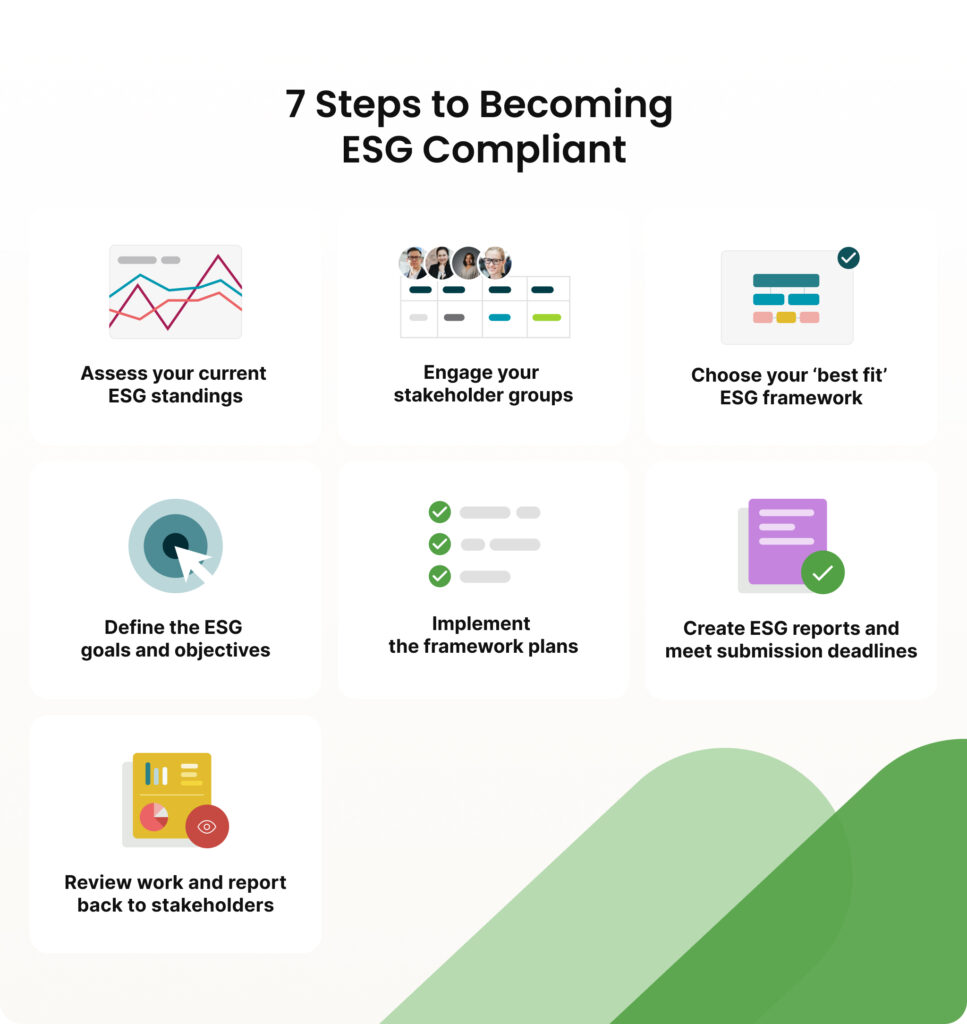
Step 1: Analyze your Current ESG Status
Before you can work out where you want to go and what you want to achieve with ESG compliance, it’s helpful to understand where your organization currently stands regarding ESG topics. This gives you benchmark data.
Look for good ESG opportunities — criteria you can easily fulfil — as well as identifying any potential risks or compliance mountains you may have to climb.
Evaluate ESG considerations specific to your industry. Are there any particular areas with the potential to impact your business and the people it serves?
Step 2: Engage Stakeholders
Get everyone who comes into contact with your organization on the same page. Consensus around how to prioritize ESG topics is going to lead to a smoother compliance process. So before setting any policies and forging ahead, engage all stakeholder groups on what they think are the most business-critical ESG issues.
Unsure of the best way to engage stakeholders? Download our short ebook: 7 Strategies for Effective Stakeholder Engagement.
Step 3: Choose a Framework
Legislated ESG is non-negotiable. You’ve just got to do as the governing bodies say. But when it comes to frameworks, you have choice and flexibility.
Gather information on the different frameworks. Shortlist the ones that best align with the ESG issues and priorities raised by your stakeholders.
Step 4: Define ESG Goals and Objectives
Once you’ve chosen a framework, you can begin to set ESG goals and objectives. The goals you set should:
- Lead to framework compliance
- Be in-line with your business aims and values
- Be measurable so you can track progress.
Step 5: Implement The Framework
Allocate staff and financial resources to work on meeting your ESG goals. Plan for the possibility that you may need to implement new processes and technologies to achieve the compliance criteria and enable you to collect, track, and analyze the relevant ESG data.
Step 6: Reporting and Deadlines
The bodies overseeing ESG compliance set reporting and directive deadlines. In short, your company has to have disclosed the relevant information by that date so the organization’s compliance can be assessed.
Take a temperature check every quarter, before these deadlines. That way, you’ll be able to catch any potential hiccups early — data gaps, for example — and fix them before they become a major headache.
Step 7: Review, Reassess, and Report Back
After submitting a report (and once the dust has settled and everyone is feeling a little calmer) review the work done to achieve compliance. Assess how you might build on the strategies you’ve put in place or refine them if there are any challenges.
Send the report to your stakeholders, so they’re informed about (and hopefully impressed by) what’s going on. You might also reopen the dialogue, welcoming any innovative ideas or ways to improve in time for the next set of reports.
Simply Stakeholders: Assisting With Your ESG Journey
Becoming ESG compliant might feel like a massive task. The ramifications of missing the mark can be huge, but get it right and the benefits to your business or organization will be warmly welcomed by all stakeholders.
Making sure you have the right software to support your ESG journey is a simple first step. The Simply Stakeholders platform enables you to:
- Create custom reporting fields – Track sustainability development goals for multiple initiatives and interactions.
- Tag ESG topics – Automatically organising key interactions and data related to ESG reporting speeds up the collation of report information.
- Set up custom dashboards and reports – A dedicated dashboard accessible to all relevant stakeholders, shows the key metrics for ESG reporting, simplifies project tracking and speeds up report creation.
With the support of Simply Stakeholders you can track, analyse, and comply with ESG regulations confidently. It starts with a demo.