Management, Engagement, and Alignment: The Trinity For Setting Stakeholder Goals

How do you set workable stakeholder goals when you’re engaging with competing groups or communities?
‘You scare them with the doom and gloom of a failed project.’
‘Get them around a table, arguing for a couple of hours until they’re hungry, then say “OK, so in summary [your own idea for a path forward],” and they’ll all be too weak to argue.’
‘Aligning expectations? You’re kidding, right? Just tell them what they want to hear and hope for the best.’
We don’t recommend trying the above-mentioned suggestions taken from Reddit threads and stakeholder management forums that offer some pretty bogus ideas when it comes to setting generally accepted stakeholder goals.
That said, while these answers may be tongue-in-cheek, they touch on some common challenges organizations face in finding common ground and aligning stakeholder goals. These include the potential to delay or undermine a project’s success, meetings that morph into arguments, and the temptation to be less than transparent about goals that may be ill-formed or poorly articulated.
So, moving on more logically, how do you set stakeholder goals that everyone can at best agree on or at least live with? And how can you make sure said goals deliver the desired outcomes?
In this article, we’ll define what stakeholder goals are and suggest ways to set up relevant and workable objectives. We’ll also look at the strategies and software available that can enable success. Let’s start by understanding what we’re working towards.
Finding Alignment
Aligning strategic, stakeholder, and internal organizational processes and objectives boils down to three things.
- Strong stakeholder management
- Positive stakeholder engagement
- Pinpointing the sweet spot where managing and engaging with stakeholders merge to create strong alignment.
Achieving alignment starts with understanding each stakeholder’s individual goals.
Stakeholder Goals: What Drives Them?
Stakeholder goals — sometimes referred to as stakeholder motivations — are driven by beliefs, feelings, and underlying experiences. These are the forces that shape the outcomes stakeholders are seeking and how they engage with and make decisions about your project.
When an organization speaks to an individual’s, group’s, or community’s feelings or beliefs directly, engagement is productive and helpful. In turn, this values-based engagement fosters the trust and connectedness essential to ongoing collaboration and engagement. In short, it lays the groundwork for setting stakeholder goals everyone can get behind.
Stakeholder goals that speak to what matters most to the individuals, groups, and communities you’re working with can be the difference between project success and one that stalls or fails completely.
Before you can set a goal, you must understand what your stakeholders care about.
What’s Motivating Your Stakeholders?
Stakeholder motivations can be varied and wide-ranging depending on their role in the organization or project, their relationship with the organization, or their level of influence over outcomes.
National Training is an Australia-based organization, and has identified three divisions of stakeholder motivation.
- Personal motivations: Career promotions, job security, work flexibility, entitlements, etc.
- Organizational motivations: Company growth, ROI, brand reputation, KPIs, etc.
- Values-based motivations: Ethics and beliefs, community impact, environmental impact, etc.
These are valid and (for the most part) tangible motivations. But strong, empathetic stakeholder goal management involves taking a deeper look at what’s driving the ways stakeholders respond to what you’re asking of them — getting on board with shared goals and participating in the work it takes to achieve them. Broadening your understanding of some fundamental needs motivating human engagement can help you select and calibrate your stakeholder management methods.

The Need Theory
American psychologist Dr David C. McClelland, known for his work on human motivation, found that there are three distinct motive needs:
- The Need for Affiliation: These stakeholders act based on their positive interest in and concern for others. They’re typically social, empathetic, and may make decisions based on what others think and feel.
- The Need for Power: These stakeholders lean towards strong and forceful actions, offering help, advice, and support to others while thinking about how to shape situations. They tend to be in leadership positions.
- The Need for Achievement: These ‘failure-conscious’ stakeholders are driven by a need to succeed and hold themselves to high standards. They may have an entrepreneurial spirit, making them takers of both the initiative and calculated risks.
There’s a case to be made for one or other of these three needs being what really motivates stakeholders. Managers who understand and identify those needs in play — and how they may change during a project — are equipped to negotiate competing motivations that might impede setting well-aligned stakeholder goals.
Stakeholder Goal Setting in 6 Steps
Setting stakeholder goals that align everyone’s interests and motivations takes planning, empathy, strategic engagement, and leadership to consolidate and communicate the relevance and importance of each goal. Here’s how you might approach this important task.
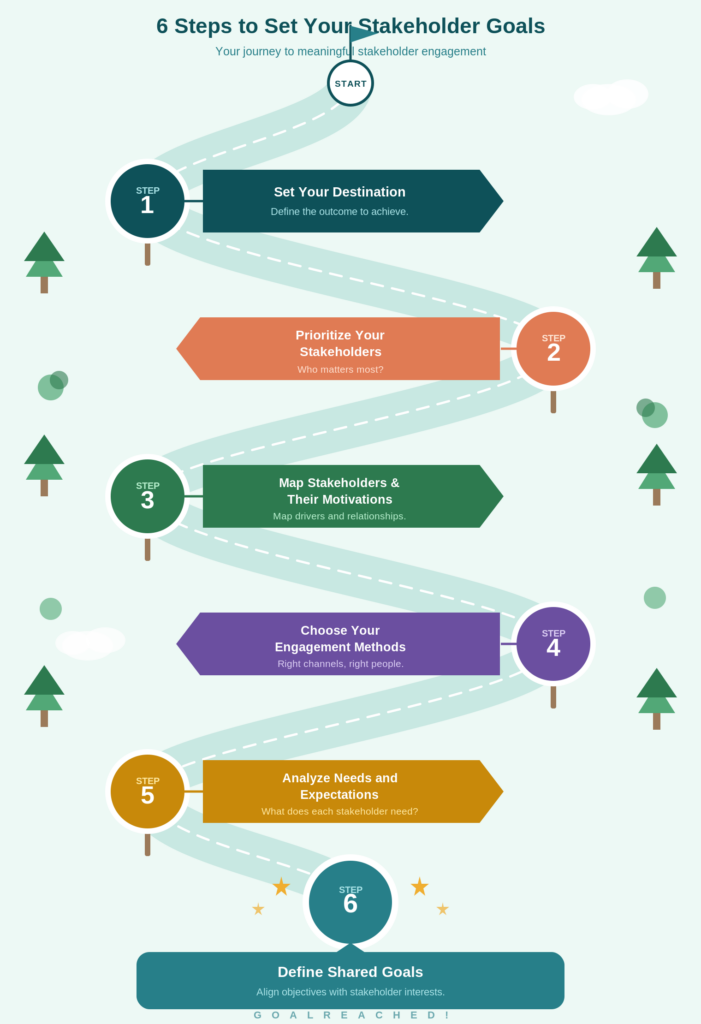
Step 1: Set Your Destination
And help your stakeholders set theirs. When you’re clear on the outcomes you want to achieve, it’s much easier for stakeholders to define theirs, and play their roles in achieving them.
Psychologist and MD of SACS Consulting Andrew Marty, refers to this as ‘goal destination setting.’ To help chart the path, he suggests doing this simple perception-checking exercise. Gauge how closely (or otherwise) stakeholders’ views of your project and organization fit with how you’d like to be seen, by:
- Writing down five words or phrases describing how you’d like stakeholders to view your organization or project
- Rate how close you are to that ideal today on a scale of 1-10. (Or 1-5 if you want to focus on it.)
- Set a benchmark score for what you want that ideal to be and give yourself a timeline.
Make working towards your benchmark score a part of setting your stakeholder goals — here’s where we are and here’s where we want to be. When you choose your engagement methods further down the path, you’ll need to make sure you ask stakeholders about how they view your project or organization to establish if your perceptions align with theirs.
Step 2: Prioritize Your Stakeholders
Next, identify which stakeholders will influence, impact, or affect those goals. This means identifying key stakeholders and, more importantly, working on stakeholder prioritization.
Efficiently but delicately, prioritize the relationships of some stakeholders over others. Focus your engagement efforts on these individuals or groups to advance the specific outcomes you want to achieve.
Step 3: Map Stakeholders and Their Motivations
Stakeholder mapping gives you the big picture — literally. A highly visual diagram is your ‘who’s who’ of everyone involved. It shows their impact, influence, and position within the project.
Map what you discovered from your initial work on stakeholder motivations. Piece together:
- What matters most to each stakeholder or group
- Where organizational goals and stakeholder goals might align
- What flexibility there might be on either side to achieve goal alignment.
Step 4: Choose Your Engagement Methods
Create your stakeholder engagement plan and tailor it to the priority stakeholders you want to consult. Then maximize engagement by choosing a format that works for your stakeholders: interviews, online surveys, stakeholder meetings, picking up the phone, etc.
Step 5: Analyze Stakeholder Needs and Expectations
When you analyze your stakeholder feedback, record and weight stakeholder needs and expectations against the needs and expectations of the organization.
Anticipate that some stakeholder motivations might be at odds with project or organizational non-negotiables. Don’t ignore these. Plan your response, acknowledging the feedback but being clear on the reasons why they can’t be incorporated.
Incorporate the stakeholder needs and expectations that you can work with into the goals. When people see their feedback influencing real work and outcomes, they’re more inclined to support the goal and contribute to its success.
Step 6: Define Shared Goals
This is the moment that organizational, strategic, and stakeholder goals align. And defining shared goals brings unity and opportunity for greater collaboration.
Document and circulate the shared organizational and stakeholder goals to all relevant stakeholders.
Getting It Wrong Is Risky Business
Aligning stakeholder and organizational goals is, at times, a complex process. Following the logical steps we’ve just talked about should foster collaboration, build trust, and minimize risk. But even then, things can still misfire.
Goal misalignment can lead to challenges such as:
- Disengaged and uninterested stakeholders
- Higher employee turnover
- Mistrust and resistance
- Reputational damage
- Financial loss.
It’s not possible to please everyone all of the time. But there are strategies managers and leaders can use to improve the chances of setting goals that your stakeholders want to back.
Strategies for Successful Goal Alignment
Exercising empathy, clarity, timing, and flexibility can make a world of difference when setting stakeholder goals that everyone can support.
Remember the Human
Like all of us, stakeholders are emotional and occasionally irrational. Sometimes they can simultaneously hold and act on seemingly contradictory views. Taking the complexities of human nature into account makes it easier to manage emotions when they run high. Work on discovering someone’s underlying motivation and understanding how it’s shaping the way they think or feel about a particular goal.

Have a Clear Communication Plan
Participating in goal-setting exercises can take quite a bit of your stakeholders’ time and energy. Acknowledge and respect this by having a stakeholder communication plan that favors clarity, conciseness, and transparency. Not only will you feel more confident when approaching priority stakeholders, but the stakeholders in question will feel valued, understood, and respected.
Set Timeframes and Celebrate Successes
Completing, seeing, and sharing the benefits of the outcomes will always boost morale and motivation. But more importantly, it encourages stakeholders to re-engage. Whatever their motivation might be for engaging, people get a kick out of seeing their feedback affect real-world outcomes and they’ll want to do it again.
Setting deadlines and timeframes manages expectations around seeing those outcomes and when goals are likely to be achieved. Practically, timeframes help employees in managing the workload attached to achieving the stakeholder goal, and this clarity can help minimize work delays.
Be Flexible
Different people may have different ways of thinking about a given goal, its outcome, and how both of these might be achieved. Be prepared to be flexible and creative around resolving issues that aren’t non-negotiables. Being open to trade-offs may be the way to secure everyone’s blessing and get a goal over the line.
Monitor and Refine Goals
Some stakeholder goals may come with unknowns that only become apparent once work has begun. For example, a health organization may have the stakeholder goal to recycle more of their waste, but find out the sole designated regional facility for processing the proposed waste no longer accepts it. This change leads the organization to choose alternative products that can be processed by the facility, so the goal can still be achieved.
Monitoring and refining goals motivates organizations to adapt what they can do rather than dwell on what they can’t. Then, even if the goal looks a little different, the focus is still on maintaining progress and momentum. And this is infinitely preferable to abandoning a goal completely and dismissing stakeholder motivations.
Keep Listening
The issues and objectives that motivate people and organizations evolve and change. Staying attuned to your stakeholders’ motivations and how they develop is crucial to setting and achieving shared goals.
Regular contact and feedback loops in formats that suit stakeholders help keep those hard-won stakeholder goals aligned.
Simply Stakeholders: Software That Supports Goal Setting
Setting stakeholder goals involves collecting data and information that captures stakeholder motivations and sentiments. Depending on the project, this information may be:
- Sensitive: Including confidential details that must be protected
- Massive: Including large volumes of stakeholder data for analysis
- Diverse: Representing the divergent needs and views of a range of stakeholders.
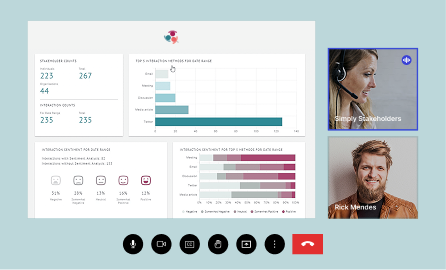
Stakeholder management software, such as Simply Stakeholders, helps organizations plan, collect, and analyze the information needed to set grounded, realistic, and (importantly) aligned stakeholder goals that lead to tangible outcomes.