


How Simply Stakeholders Uses AI
Simply Stakeholders (a trading name of Darzin Software Pty Ltd) uses artificial intelligence to help your team get more from the stakeholder data you already collect — without giving up control of it. This AI Policy explains where AI is used in the platform, what data it touches, and the rules we hold ourselves to.
A copy of our full Artificial Intelligence Policy & Approach is available on request. Contact us at [email protected].
Where AI appears in the platform
AI in Simply Stakeholders does a few jobs related to data entry, analysis and reporting: it analyses the interaction notes and correspondence your team records, and offers suggestions that save you manual work. The current AI features are:
- Interaction analysis — reads the content of an interaction and suggests sentiment, a summary, and the key people, organisations, and topics mentioned.
- Automatic tagging — suggests organisation names and tags for interactions based on their content.
- Interaction summaries — produces a short summary of longer notes and correspondence.
- Data enrichment — suggests the organisation a stakeholder belongs to, based on their email domain.
- Automatic stakeholder detection – identifying stakeholders mentioned in interaction text
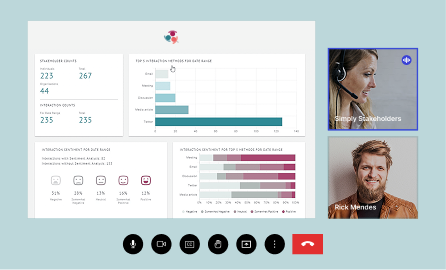
- Reporting and insights
That’s the current list, and we are continuing to ehance and expand our AI capabilities in the platform. Any new AI feature goes through our governance process (described below) before release.
The rules every AI feature follows
AI suggests. You decide. Every AI output in Simply Stakeholders is advisory. No AI result modifies a record, creates a tag, or takes any action until a user confirms it (unless you have explicitly chosen the option to allow this). If your organisation ever wants an AI output applied automatically, that requires explicit permission from your own administrators — it is never our default.
You can always tell what came from AI. AI-assisted fields are flagged in the database, so your team can distinguish AI-suggested content from human-entered data. In-platform guidance explains where and how AI is used, right at the point of use.
You can change or reject anything. Users can accept, edit, or reject any AI suggestion. Manual sentiment and tagging work exactly as they always have.
Everything is logged. Every AI model call is audit-logged, the feature used, the timestamp, and the nature of the request.
What data is sent to the AI — and what never is
Before anything is analysed, content is pre-processed to minimise what leaves the platform: email and letter headers are stripped, signatures and footers are removed, URLs are excluded, and each request is capped at 5,000 characters.
Only these categories of data may be sent for analysis: the content of an interaction record, person and organisation names associated with it, physical addresses mentioned in the content, and email domains (never full email addresses).
These are never sent to any AI model: stakeholder structured data (demographic fields, custom fields, relationship data), passwords or credentials, financial data of any kind, or anything outside the content of individual interaction records.
Your data stays in your region — and is never used for training
All AI processing runs on Microsoft Azure (Azure OpenAI Service and Azure AI Language), within your designated regional boundary. For Australian customers, all AI processing occurs within Azure Australia and does not cross international boundaries. The same applies in each of our production regions: Australia, Canada, the United States, the United Kingdom, and the European Union.
Your data is not used to train Simply Stakeholders, Microsoft, OpenAI, or any third-party AI models. This is contractually enforced through Microsoft’s Data Processing Addendum. Microsoft retains processed content for a maximum of 48 hours for abuse monitoring, after which it is automatically and permanently deleted.
Microsoft Azure is our sole AI provider. We do not operate our own AI infrastructure, we do not use consumer-grade AI endpoints, and we have no AI integrations with Anthropic, the OpenAI direct API, Amazon Bedrock, or Google Vertex AI.
How we govern AI
AI at Simply Stakeholders is governed by a formal structure with accountability at chief executive level. Every AI feature has a designated Use Case Owner who monitors it for accuracy, bias, and data minimisation in day-to-day operation, and every use case is recorded in an AI Use Case Register with an assessed risk rating.
We have completed a Privacy Impact Assessment covering all active AI features, assessed against the Australian Privacy Act 1988 and our customer contractual obligations. The assessment is reviewed whenever a new AI use case is introduced, whenever an underlying model changes, and at minimum annually.
All engineering and product staff who build or maintain AI features complete our internal Responsible AI training programme, covering data minimisation, bias awareness and mitigation, privacy obligations specific to stakeholder management, and escalation procedures for AI-related incidents.
Our AI features operate within the same certified environment as the rest of the platform: ISO/IEC 27001 and SOC 2 Type II. Microsoft Azure additionally holds an IRAP assessment under the Australian Government information security framework.
Questions
If you have questions about how AI works in Simply Stakeholders, or want a copy of the full policy, contact us at [email protected]. Privacy and data handling questions go to the same address, and our security posture is published at our Trust Centre.
This page reflects version 1.0.0 of the Simply Stakeholders Artificial Intelligence Policy & Approach and is updated whenever AI features, providers, or regulatory requirements change.