AI Stakeholder Engagement Reporting: From Activity Data to Strategic Intelligence

AI is changing what organisations should expect from stakeholder engagement reporting.
For years, stakeholder reports have largely focused on activity: how many stakeholders were engaged, how many meetings were held, what issues were raised and whether sentiment was positive or negative.
Those measures are useful. But they don’t necessarily tell leaders what they most need to know:
What is changing? Why is it changing? What matters most? What risks are emerging? And what should we do next?
This is where AI stakeholder engagement reporting fundamentally changes the how, what and why of reporting.
Rather than simply making existing reports faster to produce, AI can help organisations move from reporting engagement activity to generating stakeholder intelligence.
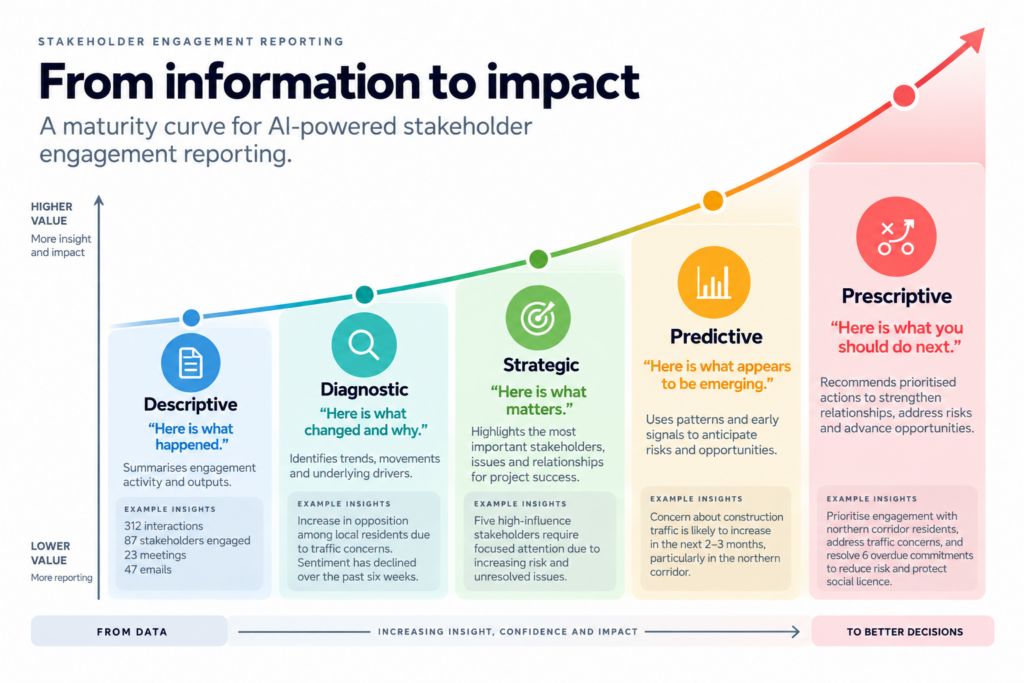
We can think about this evolution as a five-stage maturity curve:
Descriptive → Diagnostic → Strategic → Predictive → Prescriptive
Each step increases the value organisations can extract from their stakeholder engagement data.
What is AI stakeholder engagement reporting?
AI-powered stakeholder engagement reporting uses artificial intelligence to analyse stakeholder data — including interactions, issues, sentiment, relationships, commitments and stakeholder characteristics — to identify patterns, changes, risks and opportunities.
At its simplest, AI can summarise large volumes of engagement data.
At more advanced levels, it can help organisations understand why stakeholder attitudes are changing, which relationships require attention, which issues may be emerging and where engagement resources should be focused next.
The goal isn’t simply to use AI to produce reports faster.
The real opportunity is to produce better stakeholder intelligence.
The five levels of stakeholder engagement reporting maturity
1. Descriptive: What happened?
Most stakeholder reporting starts here. Descriptive reporting tells us what engagement activity has taken place.
For example:
- 312 stakeholder interactions recorded
- 87 stakeholders engaged
- 23 meetings held
- 47 emails received
- 18 issues raised
AI can make this considerably easier by summarising meeting notes, correspondence, emails and interaction records. This is useful operational information, but it is fundamentally backward-looking.
It answers: “What happened?”
The problem is that more reporting does not necessarily create more insight. An executive looking at 300 interactions still needs to understand what those interactions mean.
2. Diagnostic: What changed and why?
The next level moves from counting activity to identifying patterns and change. Instead of reporting simply that stakeholders raised concerns about traffic, for example, AI can analyse engagement over time and identify that:
Opposition among residents in the northern corridor has increased over the past six weeks, with construction traffic becoming the primary driver of negative sentiment.
This requires more than interaction counts.
The AI needs access to longitudinal engagement data such as:
- stakeholder sentiment
- issues and themes
- stakeholder position
- relationship health
- interaction history
- geography
- stakeholder groups and segments.
The question changes from:
“What happened?”
to:
“What changed, and why?”
This is where AI starts turning engagement records into useful management intelligence.
3. Strategic: What matters?
Not everything appearing in stakeholder data deserves the same level of attention. A frequently mentioned issue may have relatively little consequence for a project, while a concern raised by a small number of highly influential stakeholders could represent a significant strategic risk.
Strategic reporting therefore adds context.
AI can consider factors such as:
- stakeholder influence
- level of project impact
- stakeholder position
- relationship health
- issue severity
- relationship networks
- change over time
- unresolved commitments.
The result is a very different type of report. Instead of telling management:
“Traffic was mentioned in 42 interactions.”
the analysis might conclude:
“Construction traffic requires strategic attention because concern is increasing among northern corridor residents, two influential community representatives have shifted from neutral to opposed, and several related commitments remain unresolved.”
This answers the much more important question: “What matters?”
It also allows engagement teams to move beyond traditional stakeholder matrices and make more nuanced decisions about where to Protect, Repair, Influence, Mobilise, Understand or Monitor stakeholder relationships.
4. Predictive: What appears to be emerging?
Once sufficient historical data exists, AI can start identifying patterns and early signals that may indicate emerging stakeholder risks or opportunities.
For example:
Concern about construction traffic appears likely to increase over the next two to three months, particularly in the northern corridor.
Or:
Engagement with local suppliers is becoming increasingly positive, suggesting an opportunity to strengthen advocacy around the project’s local economic contribution.
This is an important shift. Stakeholder reporting moves from explaining the past to helping organisations anticipate what could happen next.
Predictive stakeholder intelligence might identify:
- emerging issues
- accelerating negative sentiment
- deteriorating relationships
- stakeholder position changes
- clusters of related concerns
- influential stakeholder networks
- declining engagement
- unresolved commitments associated with increasing dissatisfaction.
However, predictive reporting needs to be treated carefully. AI should not present uncertain outcomes as facts. Good reporting should distinguish clearly between observed evidence, interpretation and prediction, with users able to trace conclusions back to the underlying engagement data. This aligns with broader frameworks for trustworthy AI, including the NIST AI Risk Management Framework.
The appropriate question is therefore:
“What appears to be emerging?”
—not “What will happen?”
5. Prescriptive: What should we do next?
This is potentially the highest-value application of AI in stakeholder engagement reporting. Prescriptive reporting doesn’t stop at identifying a risk. It recommends a response.
For example:
Prioritise engagement with northern corridor residents over the next four weeks. Address construction traffic concerns, resolve six overdue commitments and strengthen relationships with the two community representatives showing the greatest decline in relationship health.
The system could recommend actions based on combinations of stakeholder influence, impact, sentiment, relationship health, emerging issues, engagement history and outstanding commitments.
The fundamental question becomes: “What should we do next?”
At this level, stakeholder reporting becomes a decision-support capability rather than simply a reporting function.
What does AI need to produce high-quality stakeholder reporting?
Reaching the higher levels of the maturity curve requires more than adding a generative AI tool to an existing stakeholder database. AI is only as useful as the stakeholder context available to it.
There are several foundations that become increasingly important.
Structured stakeholder data
AI needs to know who stakeholders are and why they matter.
Useful attributes can include stakeholder type, organisation, role, location, interests, influence, impact, position, relationship health, priority and internal relationship owner.
Rich interaction history
Meeting notes, emails, correspondence, phone calls and engagement records provide the evidence base for analysis.
Capturing the substance of interactions — not simply that an interaction occurred — is critical. This is where CRMs and older consultation management platforms really fall short when used for stakeholder relationship management as they are not designed to focus on the content of interactions, merely that they took place.
Consistent issue management
Interactions should be linked to issues and themes.
This allows AI to identify which issues are increasing, which stakeholder groups are raising them and whether sentiment around particular issues is changing.
Longitudinal data
To detect change, AI needs history.
Where appropriate, organisations should retain historical information about stakeholder sentiment, position, relationship health and issues, even across multiple projects, multiple departments/teams and multiple years.
Relationship intelligence
Stakeholders do not operate independently.
Understanding relationships between people, organisations, communities, issues and internal relationship owners can reveal influence and risk that a conventional stakeholder register may miss.
Commitments and actions
What an organisation promises stakeholders can be as important as what stakeholders tell the organisation.
Connecting commitments to stakeholders, issues, owners and deadlines allows AI to identify where unresolved obligations may be contributing to relationship risk.
Defined analytical frameworks
AI should not simply be given thousands of engagement records and asked to decide what is important. Organisations need defined methodologies for assessing stakeholder priority, relationship health, engagement risk and social licence.
This makes analysis more consistent, explainable and defensible.
Evidence and traceability
Perhaps most importantly, significant AI-generated findings should be supported by evidence. If an AI report concludes that a relationship is deteriorating, users should be able to understand why.
For example:
Relationship risk: Increasing. Negative sentiment increased from 22% to 41% over eight weeks, six commitments remain unresolved, and four stakeholders have shifted from neutral to opposed.
Users should then be able to investigate the underlying interactions, stakeholders, issues and commitments.
Good AI stakeholder reporting should be explainable, not a black box.
Transparency and explainability are particularly important when AI-generated insights may influence stakeholder engagement decisions. The UK Government’s Data and AI Ethics Framework, for example, emphasises the ability to understand and communicate how an AI system arrived at an outcome.
AI reporting maturity at a glance
| Maturity level | Core question | Typical output | Organisational value |
|---|---|---|---|
| Descriptive | What happened? | Activity, interactions, engagement summaries | Visibility |
| Diagnostic | What changed and why? | Trends, sentiment and issue analysis | Understanding |
| Strategic | What matters? | Priority stakeholders, relationships, risks and opportunities | Focus |
| Predictive | What appears to be emerging? | Early-warning indicators and emerging patterns | Anticipation |
| Prescriptive | What should we do next? | Prioritised engagement actions | Decision support |
The important progression is not simply an increase in analytical sophistication. It is an increase in decision value.
The future of stakeholder engagement reporting
The biggest opportunity for AI in stakeholder engagement isn’t generating a 30-page report in seconds. In fact, the future may involve shorter reports. Executives don’t necessarily need more information. They need to know what deserves their attention.
An effective AI-powered stakeholder report might therefore focus on:
What changed → What matters → Why it matters → What may happen next → What we should do
Supporting data can remain available for investigation, audit and detailed analysis. This changes the role of stakeholder engagement reporting. Instead of being primarily an account of engagement activity, it becomes an early-warning and decision-support system for stakeholder relationships, project risks and opportunities.
From stakeholder data to stakeholder intelligence
Most organisations already possess valuable stakeholder intelligence. It exists across meeting notes, emails, consultation records, stakeholder assessments, issues, commitments and years of relationship history. The challenge has traditionally been turning all of that information into timely insight.
AI makes that increasingly possible. But the objective shouldn’t be to put AI on top of a stakeholder database and ask it to write a report.
The objective should be to create a reliable progression:
Stakeholder data → relationship context → analysis → insight → action.
That is the difference between using AI to report on stakeholder engagement and using AI to improve stakeholder engagement.
And that is where the real value lies.
About Simply Stakeholders
Simply Stakeholders is a purpose-built stakeholder relationship management platform designed for organisations operating in complex, high-stakes environments.
It acts as:
- A system of record for stakeholder engagement
- A coordination engine across teams
- A memory layer for stakeholder ecosystems
Enabling organisations to:
- Maintain accurate engagement histories
- Track commitments and outcomes
- Coordinate communication across departments
- Provide defensible records for compliance and reporting
Simply Stakeholders helps you:
- Turn scattered interactions into a structured, searchable history.
- Use AI to understand sentiment, issues, and risks – not just to write faster.
- Protect your stakeholder relationships from staff turnover and information loss.
- Move from individual productivity to true organisational capability.
If you’d like to see how Simply Stakeholders AI Insights and Reporting function is leading the way for next generation stakeholder reporting, get in touch and book a demo with our team today.
Get a Demo Curious to see how Simply Stakeholders AI Insights & Reporting function works?
Frequently Asked Questions
1. What is AI stakeholder engagement reporting?
AI stakeholder engagement reporting uses artificial intelligence to analyse stakeholder interactions, issues, sentiment, relationships, commitments and other engagement data. It can help organisations move beyond reporting activity to identify what is changing, why it is changing, what matters most, what may be emerging and what actions should be taken next.
2. How can AI improve stakeholder engagement reporting?
AI can analyse large volumes of stakeholder data much faster than manual reporting processes. It can identify trends in sentiment and issues, detect changes in stakeholder relationships, highlight emerging risks and opportunities, identify stakeholders requiring attention, summarise engagement activity and recommend priority actions. This can turn stakeholder reporting from a retrospective exercise into a strategic decision-support capability.
3. What data does AI need for effective stakeholder analysis?
Effective AI stakeholder analysis requires more than meeting notes or interaction counts. Ideally, AI should have access to structured stakeholder information, interaction history, issues and themes, sentiment, stakeholder position, influence and impact, relationship health, commitments, actions and relationship networks. Historical data is particularly valuable because it allows AI to identify changes and emerging patterns over time. Quality data can ensure better analysis and provide better evidence to support that analysis.
4. Can AI predict stakeholder risks and emerging issues?
AI can identify patterns and early signals that suggest a stakeholder risk or issue may be emerging, particularly when there is sufficient historical engagement data. However, these insights should be treated as indicators rather than certain predictions. High-quality AI reporting should clearly distinguish between observed evidence, interpretation and prediction, and allow users to trace conclusions back to the underlying stakeholder data.
5. What are the five stages of AI stakeholder reporting maturity?
The five stages are Descriptive, Diagnostic, Strategic, Predictive and Prescriptive. Descriptive reporting explains what happened. Diagnostic reporting identifies what changed and why. Strategic reporting determines what matters. Predictive reporting identifies what appears to be emerging. Prescriptive reporting recommends what should be done next. As organisations progress through these stages, stakeholder reporting moves from measuring engagement activity toward providing actionable stakeholder intelligence for better decision-making.
Final Thought
AI is already transforming how stakeholder work gets done. The OECD has recently explored the growing role of AI in citizen participation, including its potential benefits as well as the need for appropriate governance and safeguards.
But AI does not replace the need for:
- Structured memory
- Coordinated engagement
- Accountable commitments
Those are not AI problems. They are system design problems. And solving them is what separates organisations that move fast from those that move fast and don’t break trust.