7 Signs Your Stakeholder Management Software is a Roaring Success

You’ve just implemented your best-fit stakeholder relationship management software (SRM). It took months of meticulously comparing software systems that seem to have little separating them.
But you’ve done the hard yards — and management, the stakeholder team, project management team, and IT all agree that Simply Stakeholders is the preferred choice.
Phew! Now, as a forward-thinking professional, you’re getting ready to answer that final, sticky question.
How will we know we’ve made the right choice?
Gathering the ROI evidence proving you made the right choice starts at the moment of installation.
7 SRM Software Success Indicators and Metrics
Seven trackable indicators help you understand whether the SRM platform has met your stakeholder team’s specific goals and your organization’s wider aims.
1. Team Adoption Rates and Active Use – Are your teams becoming fluent, confident, curious users?
SRM systems must be embraced by those tasked to use them if they are to be deemed a useful asset. This means onboarding and ongoing vendor support are crucial.
Whole team buy-in and their commitment to consistently use the SRM system results in a reliable shared resource. One that delivers process cohesion and an accurate and up-to-date stakeholder record of stakeholder lists and histories.
Signs of Success:
- Your entire team adopts and uses the software
- A steadily increasing volume of stakeholder data stored in the SRM
- A smooth and complete transition away from your previous stakeholder management systems or processes
- A curious team keen to do more with the functions and capabilities of the new SRM software.

2. Clear and Timely Reporting – Are your reports more accurate, more complete, better received, and fast?
A single project can generate multiple stakeholder reports for the different stakeholder groups. High-volume reporting for diverse groups can run the risk of being inconsistent, inaccurate, non-compliant, and late. SRM software can minimize these risks and save you these potential reputational and operational headaches.
Drawing on a single source of truth simplifies the entire cycle of creating, circulating, and evaluating accurate, timely reports.
Signs of Success:
- Reporting cadence and content are consistent and high-quality
- Positive feedback from report recipients
- Confidence knowing that only accurate, relevant, and timely data is used
- A decrease in the time invested in creating reports
- An increase in success and approval rates for regulatory reports
- No missed report deadlines.
| Using Simply Stakeholder for Report Creation The reporting capabilities within Simply Stakeholders are a priority consideration for many of our clients. It’s often a key reason they choose us. Once initial implementation is completed and the system is populated with stakeholder data, teams progress to explore the reporting function by creating project-specific reports or using one of the pre-made report templates. |
3. Original Data Quality – Is our data complete, current, and duplicate-free?
Clean stakeholder data is free from duplicate entries and incomplete records. It’s a solid base for reliable reporting, minimizes stakeholder management risks, and saves staff time spent weeding out errors.
Simply Stakeholders rids systems of poor-quality data by using the AI data enrichment feature. An analysis of stakeholder interactions and data identifies discrepancies and incomplete interactions. It not only highlights the issue, but suggests how to resolve it.
Signs of Success:
- The team trusts the SRM system to manage stakeholder data and uses it consistently
- There’s an increase in complete stakeholder interaction records
- Increased stakeholder material output due to efficiency
- Increased stakeholder trust and regulatory compliance thanks to error-free reports.
4. Strong Decision Making – Are our decisions strategically stronger and better communicated?
The right SRM software supports project-critical decision-making. It ensures the right stakeholders have relevant and accurate information on time and in a format they can use. Decision-making is easier and simpler to explain and justify. The result? Increased support from the stakeholders that matter. And when you’re making strong strategic decisions, project success rates increase, and outcomes are simpler to predict.
Signs of Success:
- Streamlined decision-making process — key stakeholders are involved from the start
- A decrease in roadblocks or project delays
- Data-backed decisions with greater support
- An increase in project success rate.

5. Consistent Correspondence, Task Tracking and Process Cycle Time – Are we more responsive to our stakeholders?
Software features such as stakeholder registers, task tracking, and automated workflows ensure no stakeholder slips through the gaps and no complaint or commitment is overlooked.
Signs of Success:
- An increase in triggers and rules to enable automated workflows
- Anecdotal feedback from staff regarding time saved
- The volume and cadence of stakeholder correspondence is smoother
- Shorter task completion times
- A decrease in incomplete tasks
- Positive stakeholder sentiments.
6. Risk Identification and Resolution – Are we managing risks more preemptively and positively?
Early, efficient identification makes risks easier to avoid or manage if they occur. Centralized stakeholder data backed by AI insights can make it easier to spot potential challenges and form an appropriate next-step response to problems.
Signs of Success:
- A decrease in project delays
- Fewer resources and less time needed to resolve challenges
- Early risk identification compared to projects pre-SRM system
- Positive reputational feedback
- Strengthened stakeholder relationships.
7. Stakeholder Relationship Strength – Are our stakeholders more engaged and onside?
A community may not be happy with the overall outcome or aims of a project, but if they’re positive about the engagement process, this is an indicator that the SRM platform is doing its job.
Signs of Success:
- Positive stakeholder sentiment analysis
- Strong relationship health scores using health tracking
- Complete, comprehensive stakeholder mapping showing all involved stakeholders.
The Methods and Tools That Track Success
The Simply Stakeholders software has over 20 years of stakeholder engagement expertise baked into its methodology and design. It makes it easy to gather stakeholder data and gives you the tools to understand how well the system is working for your organization.
Qualitative and quantitative data combine to reveal how successfully your SRM software is working within your organization, and how it’s strengthened your stakeholder management.
Product capabilities such as:
- Stakeholder mapping
- Commitment tracking
- Stakeholder communications
- Task management
- AI-backed data insights
- Reporting
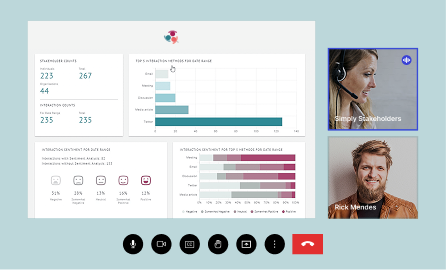
Can be created and stored securely in the Simply Stakeholders platform. When it’s time to evaluate these capabilities, a customizable stakeholder dashboard makes it possible to see how the team uses these features on a day-by-day or project-by-project basis.
Pulling information and data from the SRM system will only deliver one part of the story. Crucial evidence that the platform is a success must come directly from the people who are using it.
Real-time data from the platform should be coupled with productivity measurements and assessments that come straight from the stakeholder management team.
You may ask them to:
- Track their time: To compare task completion rate pre- and post-SRM system implementation
- Note the resources they need and use: Do they need more or less budget, time, materials, etc., since system implementation?
- Monitor their planned-to-done ratios: Are they crossing off more daily or weekly task list items than before?
- Provide feedback: In a survey or meeting to understand user satisfaction and how they’re adapting to the new platform.
Installing a new SRM system is an exciting move that can bring much-needed clarity and efficiency to stakeholder management. It can also give your team more curiosity about and confidence in streamlining and enhancing the engagement process.
Is Simply Stakeholders The Best-Fit SRM System For You?
The simplest way to get a feel for whether Simply Stakeholders will be a success within your organization is to book a free demo. You can ask to see features that interest you, get a tour of the platform, and hear about the pre- post-, and ongoing support you’ll get as a Simply Stakeholders client.