Do More With Your Stakeholders: Scoring Executive Buy-In for Stakeholder Software

Your current stakeholder management systems and processes aren’t working. They cost the organization time and money, frustrate the teams who use them, and damage valuable stakeholder relationships.
With the right systems and processes — with the right software — you know you can improve stakeholder engagement, strengthen relationships, and do more with the data collected from your stakeholder work.
In short, it’s time to upgrade to a dedicated stakeholder management platform. But first, you’ll need executive buy-in for stakeholder software implementation.
3 Reasons for Securing Executive Buy-In for Stakeholder Software
Executives are decision-makers. They may not use the stakeholder relationship management (SRM) software directly, but they have the power to drive change and influence other key groups, such as the board and investors. Securing their approval is essential for:
- Team morale: Changes supported by the executive team show a willingness to encourage innovation, share ideas, and feel valued at work.
- Reducing road blockers: Slow approvals or complete rejection are more likely if the executive team doesn’t buy in
- Project success: Executives who are invested in the successful integration of the SRM platform increase the odds of project success.
Planning, open communication, and fresh thinking are crucial to gaining the approvals you need. And we’ll discuss these points in more detail shortly. But the first step towards executive buy-in for stakeholder software is encouraging the leadership team to share in your excitement.

Selling Executives on the Benefits of Stakeholder Software
Executive buy-in for stakeholder software happens when the leadership team can see the benefits for stakeholders and the overarching strategic goals of the organization. If an executive can see a personal benefit, that’s a bonus. (Think along the lines of report presentation, reduced use of resources, and freeing up more of their working day.)
If you’re pitching Simply Stakeholders to an executive, focusing on these three benefits can help generate some of the buzz and excitement you feel at the thought of having an efficient, data-backed, and technologically sound SRM system at your fingertips.
1. Early Risk Identification and Management
The Project Management Institute’s Pulse of the Profession 2026 pointed to increasing project complexity. Eighty-one percent of participating professionals say their projects have become more complex in recent years. The overall project failure rate is 13%, and within that, around 31% of complex projects fail. Those that don’t fail are still subject to budget blowouts and delays as a result of unforeseen issues that take time and money to resolve.
Risk mitigation starts with identifying the stakeholders that care about your project, understanding their interests and the outcomes they’re hoping for. From there, it’s possible to evaluate and prioritize project risks arising from stakeholder engagement and devise a strategy to minimize them.
The Simply Stakeholders software enables a proactive approach to stakeholder risk management using:
- Stakeholder registers and risk profiles: Generate secure lists of up-to-date stakeholder contacts and add information regarding risk management strategies and tolerance.
- Stakeholder mapping and geographical mapping: Create detailed relationship network maps or geographical maps to visualize, segment, and prioritize stakeholders in relation to your project phases.
- Task, communication, and commitments tracking: Record stakeholder correspondence, actionable tasks, and commitments so the team has a single source of truth and nothing falls through the gaps.
Whether you centralize your data manually or using Simply Stakeholders’ AI data enrichment feature, this streamlining process supports early risk identification and effective risk management. As a result, project budgets are less likely to suffer, efficiency increases, and the organization’s reputation remains intact in the eyes of its stakeholders.
2. Clear Opportunities and Strategic Decision-Making
Opportunities get missed when your stakeholder management tools are ill-designed and when sporadic, incomplete stakeholder data is scattered across spreadsheets and buried in inboxes. Coping with this dispersed and often inconsistent information adds friction to any decision-making processes that rely on data to back one choice over another.
Replacing a data tangle with a single source of truth, which is possible when using Simply Stakeholders, increases opportunities and smoothes decision-making.
The platform supports this by:
- Identifying potential collaborations: Stakeholder mapping tools find relationship links and shared stakeholder interests.
- Providing clear stakeholder data and enabling communications: Clear, consistent, and transparent stakeholder records and management strengthen trust, leading to social licence to operate, greater opportunities and improved decision-making.
- Improving processes and workflows: Automated workflows set up on the SRM platforms reduce the risk of errors and increase efficiency.
Combining readily available data with deep-dive capabilities generates targeted and meaningful insights. This leads to better decision-making that benefits the organization’s project goals while balancing stakeholder needs.
3. Compliance Clarity and Commitment
Incorrect or incomplete regulatory submissions, missed compliance reports, and weak auditable data lead to delays, fines, legal action, reputational damage, or complete project failure. (Not a pretty list.)
Compliance lapses also erode stakeholder trust and trigger questions regarding the organization’s abilities and ethics. Stakeholders may worry about whether the organization can deliver on promises and commitments.
The Simply Stakeholders platform has several specific features to assist with compliance and stakeholder trust-building, including:
- Securing data: Control measures such as role-based permissions, encrypted storage, and backup logs keep stakeholder records secure and organizations compliant.
- Commitment tracking: A centralized commitments register connected to stakeholder interactions, records, and projects helps ensure that nothing gets lost or mislaid, and promises are kept.
- Topic tagging: Tag goals, interactions, and data specific to regulatory compliance reporting for easy retrieval and report generation.
Automated alerts and workflows support compliance and commitment work. Reminders can be set and tasks assigned, minimizing the risk of non-compliance or broken promises.

Supporting Confident Stakeholder Management
A confident, well-managed approach to stakeholder engagement can lead to greater business opportunities and enhanced organizational health.
Organizations with a string of completed projects, up-to-date compliance obligations, and a positive reputation are more likely to attract like-minded investors. Safeguarding the stakeholder engagement and management process helps ensure that these benefits keep flowing.
When important stakeholder information and knowledge are retained in Simply Stakeholders, it remains within the organization. Its integrity and accessibility can withstand any team, managerial, or larger organizational changes. Impeccable, accurate data is there for whoever needs it.
Approaching Executive Buy-In: 5 Strategies
Having looked at some of the most appealing benefits to pitch when seeking executive buy-in for stakeholder software, let’s consider some of the practical strategies for creating an executive-level proposal.
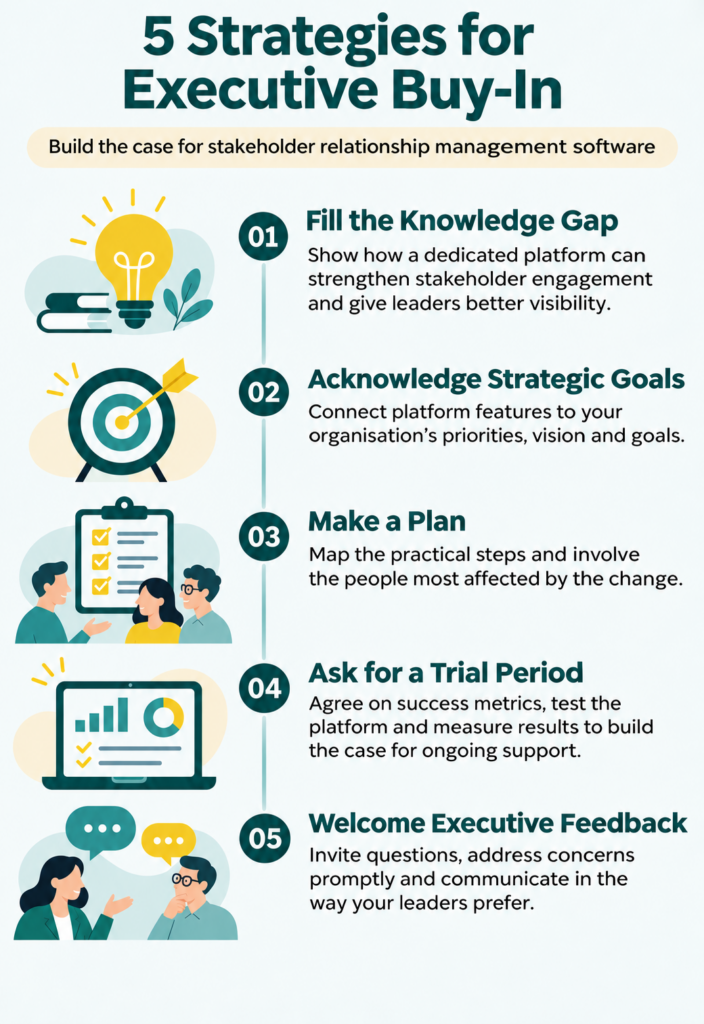
1. Fill the Knowledge Gap
Executives may be unaware of the stakeholder management challenges posed by the current systems and processes. It’s worth raising how long the present setup has served the organization and the efforts that may have gone into keeping it relevant and workable.
Avoid rubbishing what’s already there, but present a shift to a dedicated stakeholder management platform as an opportunity to strengthen stakeholder engagement — for now and for the future.
2. Acknowledge The Organization’s Strategic Goals
Identify and explain the features and capabilities of the SRM platform that align with the organization’s vision and overarching strategic goals. Indicate the ways the platform can enable the organization to meet those goals.
For example, if the organization is looking to increase ESG stakeholder engagement, you may highlight how task tagging, custom reporting fields, and customized reporting dashboards on Simply Stakeholders can support that goal.
3. Have a Plan Ready To Go
A change management and implementation plan offers a clear vision and reassurance, and should include:
- The expected deliverables from the vendor
- KPIs once the software has been implemented
- Each project milestone and anticipated timeline
- The resources needed to implement the change.
A complete plan should combine the practical steps to make the change happen and the voices of those who will be most impacted by the introduction of an SRM platform.
4. Request a Trial Period
If you anticipate resistance, suggest a trial period to help secure executive buy-in for stakeholder software.
At Simply Stakeholders, we offer a paid pilot trial. Clients use their own existing stakeholder data within the Simply Stakeholders platform and test out the product for around 3 months. (Although the length of time can be adjusted to suit the organization’s needs.)
Tracking and measuring everything during a paid pilot is critical. By the end, you’ll be equipped to show executives how stakeholder management software delivers ROI, so you can gain their well-informed and enthusiastic buy-in.
5. Welcome Executive Feedback
Software changes and process transformations can raise concerns. Allay those qualms with timely responses to your executive team’s questions and worries, via the most effective approach. (A meeting, an email, a phone call, etc.)
Depending on the feedback, you may need to tweak the implementation plan and define the benefits of moving to a dedicated SRM platform more clearly. Alternatively, arranging a demonstration or vendor presentation may be the best way to get executive buy-in over the line.
Simply Stakeholders: Supporting Executive Buy-In
From costs to team adoption rates, day-to-day disruption to security fears, Simply Stakeholders understands the concerns leadership teams may have when it comes to implementing stakeholder management software.
The Simply Stakeholders software has over 20 years of stakeholder management expertise baked into its methodology and design. Centralizing stakeholder data on a dedicated SRM platform can put many of those concerns to rest by ensuring that data is kept securely, and the tools needed to work more effectively with that data are available to those who need them.
Booking a free demo is the simplest way to get a feel for whether Simply Stakeholders is the right fit for your organization and to help you prepare your case to gain executive buy-in for stakeholder software.