Keep It Clean: Stakeholder Data Tidy-Up Tips

Avoid the Dangers of Dirty Data: Run Regular Stakeholder Data Audits
Strong, reliable stakeholder data drives decisions, builds trust, maintains relationships, and leads to project success.
In short, clean stakeholder data is something to cherish.
The problem is that it’s easy for data to get muddy.
Staff come and go. Tasks get abandoned. Corners are cut to meet deadlines. And on top of all that, stakeholder data management systems evolve — sometimes smoothly and successfully and sometimes through gritted teeth.
Whether the organization faces one of these challenges or all of them, the risk is the same: a potential dip in the quality of the stakeholder data to those who rely on it.
In this article we’ll cover what constitutes stakeholder data and evaluate why keeping it clean matters. We’ll also address the importance of starting with accurate, relevant, and reliable data when implementing new stakeholder relationship management (SRM) software.
Defining Stakeholder Data
Stakeholder data is any and all information about or provided by internal and external stakeholders. Over the course of a project, that is a lot of information .
So stakeholder data can include:
- Feedback, such as interviews, surveys, or discussions
- Stakeholder register information
- Sentiment or grievance tracking
- Data analysis and reports
- Stakeholder mapping.
This data may have been used for regulatory and compliance purposes, to ensure the project delivers on its engagement promises, or simply to progress the work from one phase to the next.
Projects of all sizes generate stakeholder data. But larger projects (think megaproject stakeholder management) can result in tens of thousands of stakeholder entries and records. Centralizing all of the data in an SRM system supports accurate data input and storage, which keeps the stakeholder data clean and minimizes risks.
Why Clean Stakeholder Data Matters
There are several reasons why maintaining the health of your data matters. But let’s start with the big one — the financial costs.
Clean Data Minimizes Financial Blowouts
A 2023 Data Culture and Literacy Survey by Forrester’s revealed that a quarter of organizations estimate they lose USD $5 million annually due to poor data.
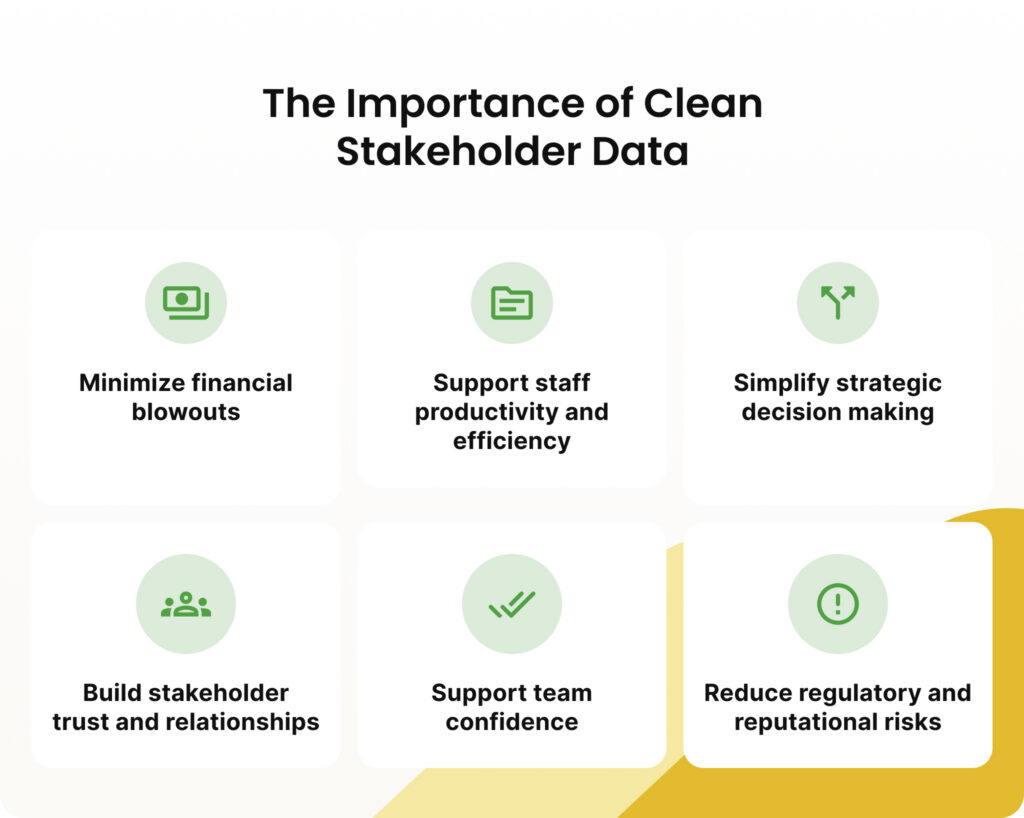
Admittedly, that financial cost reflects organization-wide data management. Not only stakeholder or project data management. But it hits hard. The takeaway is this: dirty data eats into budgets, messes with bottom lines, and impacts revenue. And the effect of a financial hit will inevitably seep into other departments, processes, and resources.
It Supports Productivity and Efficiency
Employees whose work is blocked or slowed by bad data become frustrated. Clean stakeholder data is simply easier to work with — for manual analysis and for automated processes using rule-based programming. And there are three reasons for this.
When the data is accurate and formatted correctly:
- It removes the need to cross-check absolutely everything
- It saves time — staff aren’t delayed or distracted by having to fix errors
- It’s easier to search for and find the information needed.
Accurate Data Simplifies Strategic Decision Making
Not every stakeholder will agree with the decisions or direction of a project. And accurate data can help manage this.
During difficult, contested moments, or when several options are available, data can deliver a clear line of action or support your reasons for taking a particular strategic decision. But this is only possible if the analysis is based on accurate data. The risks to accuracy and completeness increase for organisations using AI to assist in stakeholder management decision making.
Gartner’s 2026 strategic predictions report believed that “death by AI” legal claims will run into the thousands as AI models are increasingly used for decision making processes. Mitigating that risk means clean data is non-negotiable.

It Builds Relationships, Trust, and Team Confidence
Organizations that proactively share information, data, and findings with their stakeholders build positive relationships and earn stakeholder trust. But the data needs to be accurate and consistent.
Should stakeholders discover that the data they’re provided with is regularly inaccurate or full of falsehoods — whether intentional or not — that trust erodes. And this can have a knock-on effect, impacting team morale and confidence.
Clean Data Reduces Risk
Regulatory compliance and conflict resolution may rely on the accuracy of stakeholder data and records.
Clean data and an organized SRM system:
- Helps identify missing stakeholder data
- Makes it easy to pull the information needed for regulatory reports
- Ensures organizations meet regulatory compliance to avoid fines, penalties, or delays
- Supports conflict or dispute resolution, limiting the risk of reputational damage.
4 Tips For Cleaning Stakeholder Data
Whether you’ve just wrapped up a project or you’re preparing existing data for a new SRM system, here are five data cleaning tips that may help as you trawl through what should stay and what should go.
Tip 1: Archive or Delete Decayed Data
Data decay or data degradation, is information that’s out of date and can cause anomalies, outliers, and inaccuracies in your analysis and reporting. Archive or, if appropriate, delete any data that’s no longer accurate or relevant.
Tip 2: Check for Duplicate Records
Data duplication eats into storage space.It can also affect efficiency, decision making, and data quality. By removing doubled-up records you maintain a single-source of truth and avoid further data management confusion.
Tip 3: Standardize Data Formatting
Consistent formatting and data-entry conventions bring time and sanity-saving data uniformity. It makes filtering and searching much easier, and eliminates ambiguity and confusion for team members responsible for data entry.
Standardized formatting also supports automated workflows. Rule-based programming may misfire if there are typos and other formatting glitches and these process disruptions can trigger bigger problems.
Tip 4: Identify Inconsistent, Missing, or Outlier Data
Data that appears incorrect, is missing, or delivers outlier results don’t necessarily need deleting. Nor should it be filled in with ‘what feels right.’
During your stakeholder data cleaning, try to identify the cause for the missing or incorrect data. If it’s not possible to track back through the information and remedy the data, then evaluate the impact. An agreed, standardized placeholder value might work as a temporary fix.
Cleaning Stakeholder Data Is a Team Effort
How long you need to spend cleaning your stakeholder data will depend on how regularly it’s done, the size of the organization, and the number of stakeholder records in the SRM system. Before making changes, anyone who works with stakeholder data should be informed an audit is taking place.
When it comes to doing the audit, you may take a whole team approach. Elect someone to lead the data cleaning project but give each team member ownership of organizing and standardizing their data.
Set a deadline for completing the data cleaning, so the updated, squeaky clean data can be collated, centralized, and rolled out to everyone who needs it.
From Data Cleaning to Data Migration
Clean stakeholder data is important if your organization is implementing new SRM software. Having an up-to-date data set, formatted in a uniformed way can help when testing the data migration from your current SRM system to the new platform.
This is just one step in the SRM system update journey though.
Use our new system pre-implementation checklist to ensure the smoothest switch over possible.