Scaling Up: How to Manage 10,000+ Megaproject Stakeholders Without Losing Sleep
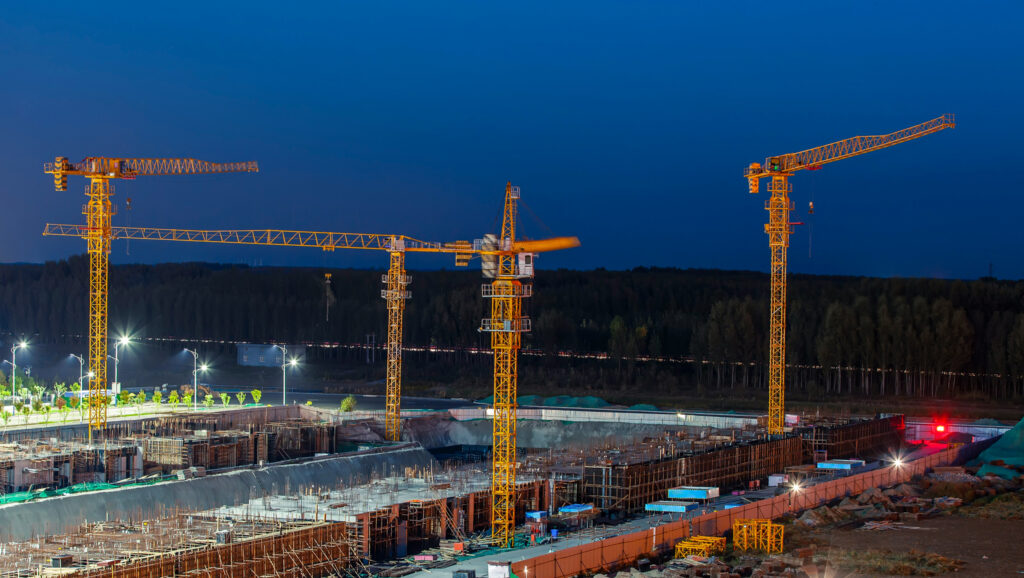
Stakeholder support can make or break any project. But when it comes to large-scale, multi-billion dollar projects in infrastructure, large construction, energy, and mining projects that can involve tens of thousands of stakeholders, there’s a lot more on the line.
Projects of this size are often called ‘megaprojects’: high-investment, politically sensitive ventures that can involve 10,000 or more individual and group stakeholders. Those stakeholders represent very different communities, with diverse (and often competing) priorities and needs. For complex, high-investment, and often politically sensitive ventures, the risks of mismanaging stakeholder engagement in megaprojects can be huge.
By unpicking real-world examples of successful megaprojects and analyzing the strategies used, along with the fundamental stakeholder principles, it’s possible for organizations and local governments that have previously managed smaller projects to scale up their engagement approaches to megaproject stakeholder levels, all without losing (too much) sleep.
The Core Stakeholder Management Process
Every project, whatever it’s size, works through these six core stakeholder management processes.
- Key stakeholder identification and segmentation
- Setting stakeholder goals and needs
- Stakeholder and relationship mapping
- Engagement and communication planning
- Risk assessment and management
- Ongoing monitoring and reporting
On small-scale projects with only a handful of stakeholders and short turnaround times, it’s possible to manage these processes manually. Legacy systems to track interactions and commitments still hold up. The engagement team can call a meeting at relatively short notice and still get a good turnout. And when you have one person managing one stakeholder group, the risk of double-handling work or people slipping through the net is small.
Scale up to managing megaproject stakeholder numbers, and everything changes.
Managing these processes without the support of stakeholder relationship management (SRM) software becomes unfathomable. (And impossible.) And those six vital stakeholder processes are at a higher risk of breaking down.
So how do megaprojects handle huge numbers of stakeholders and the gargantuan volume of work that inevitably comes with engaging and supporting them?
The Eye-Opening Reality of Megaproject Stakeholder Management
Let’s start by looking at two successful mega infrastructure projects — one in India and one in Australia. Public project reports show how the developers scaled up core stakeholder management processes to meet the needs of their megaproject.
An Indian Rail Project
The first megaproject case study is a large-scale metro rail project planned for construction in a city that’s home to approximately 5 million people.
The project had a budget of USD $2.2 billion and (at the time of planning and construction) the political backing of the State government and the Government of India.
According to a post-project analysis of external stakeholder management, the rail infrastructure project’s overarching goals were:
- to reduce pollution
- boost local economic growth.
The railway had a large footprint that required land purchasing or landowner permissions for work to progress. Land-owning external stakeholder groups included private owners, businesses, taxpaying citizens, government agencies, and religious groups. In short, the project developers had a complex financial, administrative, and cultural landscape to navigate.
The Melbourne Metro Tunnel
Nicknamed ‘Victoria’s big build,’ the Melbourne Metro Tunnel in Australia is a 9km rail tunnel connecting South Kensington to South Yarra.
The project cost AUD $13.4 billion and was widely seen as a much-needed upgrade to Melbourne’s rail network — delivering five new underground stations and better connections between key education, health, and business districts.
A review of the project’s chapter on community and stakeholder engagement suggests there were as many as 15 stakeholder groups, each with subsets of individuals, groups, or communities. They included (amongst others) schools, the federal government, residents, and landowners.

Personalized Relationships Always Matter
Projects at any scale must not lose sight of the need to engage all stakeholders in deep, personalized relationships. And, regardless of volume, it’s up to the organization, project management team, and stakeholder engagement team to ensure this human-to-human level of contact happens.
Methods for Managing Enterprise-Level Stakeholder Ecosystems
So, what practical steps did these two mega rail projects use to successfully manage their megaproject stakeholder ecosystems?
Method 1: Phased Engagement Frameworks
To ensure the right stakeholders got the right information at right points in the project, the Melbourne Metro Tunnel engagement team took a phased engagement approach.
Using the IAP2 Spectrum of public participation, the project team assigned segmented stakeholder groups to one of five engagement phases. This allowed them to plan tailored engagement and communication strategies that met each group’s specific information and engagement needs in timely, sensitive ways.
Method 2: Feedback Loops
Both projects used feedback loops to ensure ongoing stakeholder collaboration and support throughout the project. By maintaining transparent two-way communication that gave, gathered, and responded to information, opinions and queries, engagement adapted and evolved to meet stakeholder needs as the project progressed.
Method 3: Power Theory
The review of the Indian rail project highlighted the use of power theories to gain and maintain stakeholder support. Persuasion — no doubt carefully negotiated, framing the project in a positive light — and hegemonizing the work resulted in ‘greater stakeholder satisfaction’ and ‘community support.’
An example of persuasion: Developers negotiated with the city’s airport to provide extra car parking in return for permission to work on their land and to compensate for disruption.
An example of framing: Press and public discussion focused on positive aspects of the project, such as the project’s solar capabilities and the launch of an interconnected ticketing system.
An example of hegemonizing: Largely through social media, the project celebrated national festivals and cultural events, and highlighted corporate social responsibility work. Linking the project to acts of social and community good and powerful cultural moments embedded its advantages in the minds of the targeted populations.
Method 4: Ongoing Community and Stakeholder Engagement
The Melbourne Metro Tunnel report highlights the importance of staying present and visible after project completion. The work of stakeholder engagement and support doesn’t stop as soon as the ticket offices open. With so many stakeholders affected, new small projects were needed to work through teething problems.
The Complexities of Stakeholder Management at Scale
The core processes of stakeholder management are the same for small and large-scale projects. But megaproject stakeholder management can encounter complexities unique to the size of the work. Here’s how that might look.
Geographic Distribution
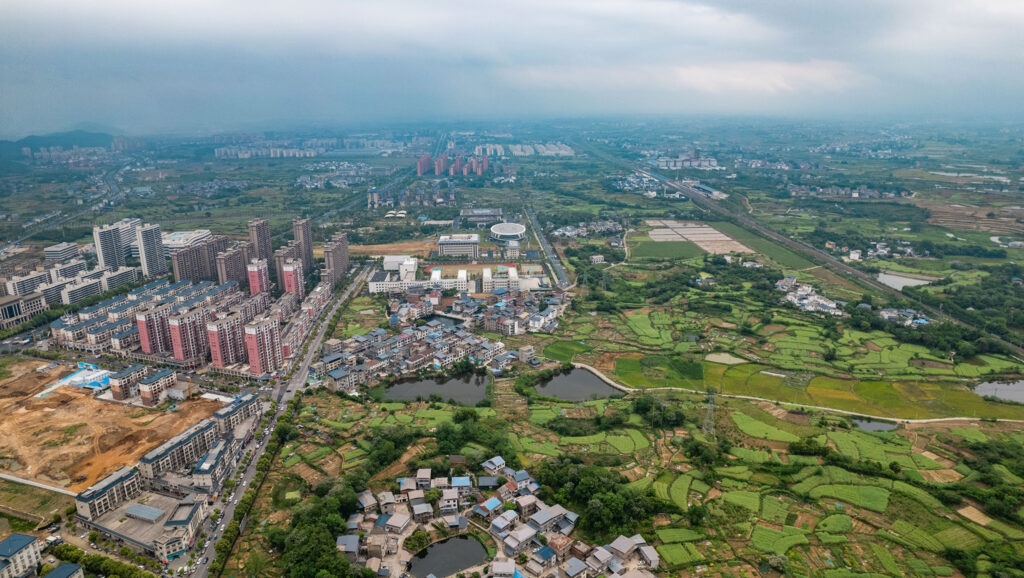
Stakeholders associated with the project or organization may live and work in widely dispersed areas. Reaching stakeholders over large distances can impact both the ease and the cost of engagement.
Projects spanning a large geographic area may also have to consider diverse cultural and ideological beliefs of stakeholder groups.
Volume Breakdown
Detailed stakeholder analysis can help shape strong decisions. But analyzing megaproject stakeholder data at a granular level becomes difficult and time-consuming. Extracting and classifying detailed information to guide mega stakeholder management may need different processes and greater focus.
Stakeholder Types
The number and makeup of different stakeholder groups extend beyond internal, external, primary, secondary, direct, and indirect.
Different Depths of Relationship
Understanding, building, and managing appropriate levels of interaction and relationships for informing, consulting, involving, etc, is important but complex. Relationships that are too shallow or too fleeting may affect engagement.
Communication Frequency
Establishing and maintaining the best-fit communication methods and the rhythms needed to keep each stakeholder group appropriately informed.
Failing to understand and address these complexities early can increase risk.
Common Painpoints That Accompany Large-Scale Stakeholder Management
Pain points that can blight megaprojects involving thousands of stakeholders include:
Information Overload
Data overwhelm is a danger for the stakeholder management team and the stakeholders.
In either case, feeling swamped by information, even if it’s useful and well-intentioned, can have a negative effect — people disengage to avoid getting bogged down by detail.
Neglected Relationships
Stakeholders can easily slip through the net during megaprojects. When this happens, people feel left in the dark or think that their ideas and opinions don’t matter. This can lead to resentment and frustration.
Team Coordination Chaos
With so many moving parts and a huge number of people working on the project, keeping track of who is managing what and by when becomes a risk. As does double-handling tasks or relationships. This can be embarrassing and cred-damaging all around when stakeholder managers contact a stakeholder only to find the task has been done or the conversation had.
Manual Process Breakdown
Keeping up with manually processing gargantuan amounts of data and complex sentiment tracking, or even mailing out communications or making phone calls, becomes so time-consuming that they’re impossible to maintain.
Team Burnout
The stakeholder management team wilt under the weight of juggling too many tasks for a large number of people, while meeting expectations. The result? Burnout, leading to increased risk of illness and staff shortages.
Regulatory Risk
Without efficient tracking, regulatory obligations are overlooked or not completed. Deadlines are missed, causing delays to the project or resulting in complete project failure.
Minimizing the threat or impact of these pain points comes down to taking a strategic approach.
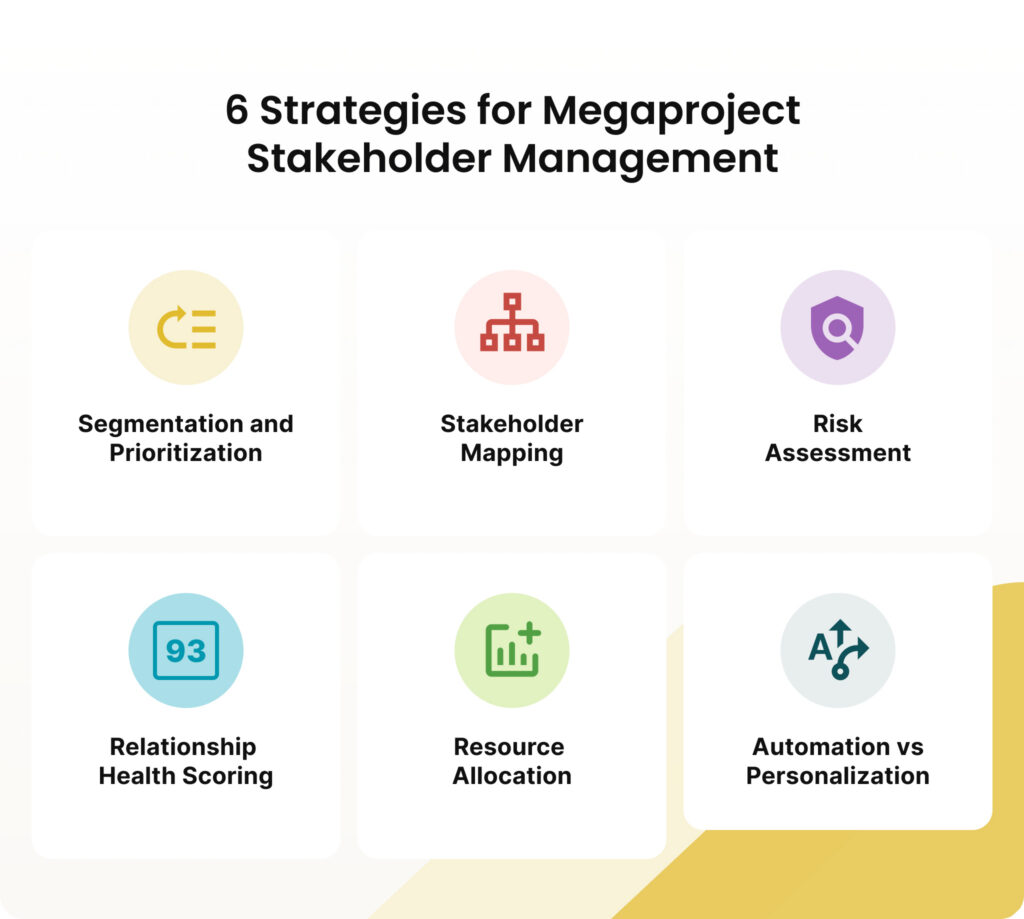
6 Strategies and Key Metrics When Scaling Stakeholder Management
So far, we’ve defined the core stakeholder management processes, seen how real-world projects have used them at scale, and acknowledged the added risks and complexities of megaproject stakeholder management.
Now let’s look at practical ways to scale up to enterprise-level without you and your team losing sleep, or your stakeholders losing interest.
Added bonus: For each strategy or metric, we’ve highlighted the feature within Simply Stakeholders SRM software that enables stakeholder engagement at scale.
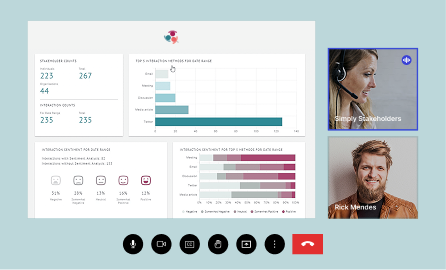
Stakeholder relationship management software digitizes manual tasks, which supports stakeholder management at enterprise level.
1. Segmentation and Prioritization
What it is: Stakeholder registers list all relevant stakeholders. For megaprojects, these lists may be huge. Data-driven stakeholder analysis and segmentation make them easier to prioritize and manage.
Why it’s important: Segmentation and prioritization are critical when working with large volumes of stakeholders and stakeholder data. This approach delivers clear direction so the organization can focus energy and resources on those stakeholders most crucial to the development and eventual success of the project.
Relevant SRM software features:
- Centralized stakeholder register
- Easy contact import
- Automatic contact tracking – linking to data, existing records, etc.
2. Stakeholder Mapping
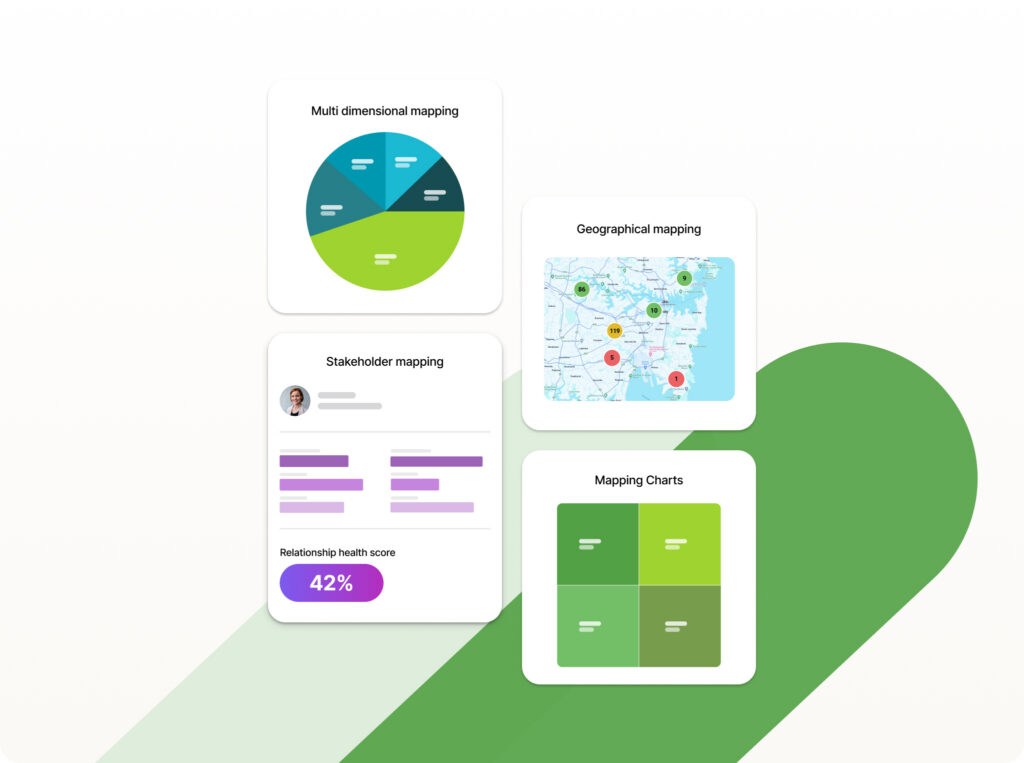
What it is: Mapping stakeholders’ attributes onto a chart lets you visualize the data, compare the position of different stakeholders, and analyze your stakeholders based on their respective attributes. You can see where one stakeholder sits compared to others, organize stakeholder groups based on shared attributes, and identify trends.
Why it’s important: Tracking relationships is complicated at scale. Using different forms of stakeholder mapping helps the team understand the links between stakeholders, their relationship to each other, and to the project. Effective tracking ensures the right individuals and groups are prioritized and nurtured. Mapping may also reveal potential collaborations.
Relevant SRM software features:
- 3D Relationship network maps to better understand complex relationship webs
- Connected stakeholder maps for geographical location and relationships.
3. Risk Assessment
What it is: Stakeholder risk management refers to managing the human responses, often relating to controversial aspects of the project. Managing risk in this context means pre-empting or mitigating the threat of undesirable events, conditions, or situations.
By identifying aspects of the project stakeholders care deeply about, organizations can plan the action they may take in response to necessary changes, consider how the project might be impacted, and how to mitigate any potential negative impacts.
Risk assessment should be viewed as an ongoing process. It involves feedback loops, open communication, regular process reviews, and expert consultants to assist with any regulatory risk.
Why it’s important: Early identification and intervention minimize the impact of these risks on project credibility and momentum
For megaprojects, the risks are likely to relate to financial, operational, legal, or environmental factors. Look closely at stakeholder groups associated with each of these areas and establish a risk assessment plan (SWOT analysis, PERT charts, etc).
Relevant SRM software features:
- Sentiment analysis
- Qualitative data analysis
- Commitment tracking
- Grievance tracking.
4. Relationship Health Scoring
What it is: Self-regulated and internally managed, relationship health scoring involves monitoring, evaluating, and scoring the wellbeing and equilibrium of different stakeholder relationships.
The team needs to choose the most appropriate tools for evaluating the health of the relationship (through surveys, feedback loops, or interaction analysis) and create a scoring framework.
A basic scoring framework might look at:
- How trusting the relationship appears
- Whether two-way communication is working effectively
- If there’s a mutually valuable exchange between the organization and the stakeholder.
Why it’s important: Relationship health scoring helps organizations overcome the risk of relationships souring, slipping through the net, or falling off a madly beeping radar. Setting up milestones for relationship health scoring makes sure project-critical relationships are scrupulously cared for.
SRM software speeds up this process. It adjusts the relationship health score by analyzing interactions and data entered into the system. You have a reliable, ongoing health score without the burden or risk of doing massive amounts of manual work. And you can easily see how relationships improve (or decline) over time.
Relevant SRM software features:
- Data insights and reports
- Stakeholder mapping
- Stakeholder analysis
- Communication tagging
5. Resource Allocation
What it is: This covers tracking the time, energy, and money spent on stakeholder management. Done well, it will tell you exactly when, how, where, and how much resource allocation has been used.
Why it’s important: Resource needs vary during the life of your project. Initially, allocating stakeholder management officers and a significant budget to elicit and encourage engagement is vital. But these needs may look very different as the project progresses. Being responsive and flexible is important. Adjusting allocations to fit current conditions enhances stakeholder trust and engagement as everyone’s needs evolve.
Use significant project milestones to review how and where resources are being used. This helps ensure they’re deployed efficiently and thoroughly, and minimizes the chance of budget blowout.
Relevant SRM software features:
- Data insight and reports
- Communication centralization
- Task tracking and management.
6. Automation vs Personalization
What it is: This is about deciding which megaproject stakeholder engagement tasks can be automated for speed and accuracy, and which ones require a human touch.
Why it’s important: Automation prevents potential team burnout during large projects and ensures issues are dealt with promptly.
Striking the right balance between automated and handled-by-humans tasks minimizes the risks of double-handling, miscommunication, and appearing impersonal.
Relevant SRM software features:
- Sentiment tracking
- Communication and feedback
- Workflow automations.
Having the technology architecture, operational processes, and advanced intelligence insights to support these strategies can turn them into workable realities.
Technology Architecture Requirements
Scaling these stakeholder strategies involves the use of SRM software and connecting it to an existing system’s technical components (existing software, hardware, and networks), while staying aligned with the organization’s protocols and approved systems.
Scaling up so your system can handle megaproject volumes of stakeholder data and information means you need the technical capabilities to support it.
Technology architecture considerations for mega projects include:
- Assessing database performance and operational efficiency
- Being able to set up and support concurrent users working across multiple projects
- Scaling storage capacity to meet changing data demands and project growth
- Allowing for global access that meets stakeholder needs, regardless of geographical location
- Implementing advanced search and filtering to deliver accurate data and timely reports
- Assessing existing software, hardware, and systems to ensure relevant integrations
- Determining which backend actions and functions would benefit from API workflow automation
- Determining which front-end actions are managed by RPA
- Sourcing sophisticated tools for advanced analytics — identifying patterns and providing actionable insights within a large volume of data
- Being able to set role-, device-, or location-based user permissions.
When it comes to planning for and implementing the operational processes for a large-scale project, having the correct technology architecture makes a huge difference.
Operational Processes for Scale
A 2022 report by the Project Management Institute (PMI) found that there were 18 causes for poor megaproject performance. Arguably, all of them are avoidable by using the systems and processes you already have.
The operational processes that work for your small-scale projects can still work at scale. They just need reimagining and redesigning to accommodate the increased volume of data and extra cooks in the kitchen.
Scaling operational processes for megaproject stakeholder management may involve looking carefully at all critical workflows and identifying where automation can lighten the team’s load. It could also mean setting up systems that identify duplicate entries to help avoid double-handling or task repetition. Or it could be setting up stakeholder mapping and digitizing tasks to encourage cross-team coordination and task completion.
Above all, operational flexibility is essential to scaling processes, according to The Virtual Hub, a company that specializes in helping organizations scale. It’s also vital to build in time to audit and evaluate your new-look processes.

Successfully Navigating Stakeholder Management at Scale
Managing a huge number of stakeholders will, inevitably, be stressful at times. But by adapting the guiding principles of stakeholder management to make the core strategies work at scale, it’s possible to build and maintain relationships and ensure stakeholder management doesn’t become a megaproject headache.
If You’re Working On a Megaproject
You need to ensure you have the right stakeholder management tools and software for your needs.
The Simply Stakeholders SRM software already includes the features needed to manage stakeholders at scale. But we’re also proficient at adapting the platform for each individual client’s needs.
When you’re ready.