Stakeholder Management: The Ultimate Guide (2026)

Stakeholder management is the systematic process of identifying, understanding and building relationships with people and organisations that can affect, or who are affected by, a project, policy of work of an organisation. It involves analysing stakeholder needs, interests, influence and relationships; planning appropriate engagement; recording the engagement including monitoring issues and sentiment; and adapting your strategy as circumstances change.
Stakeholder management is an important process for governments and organizations all over the world. In this guide, we share stakeholder management definitions, why it matters, processes, best practices, and more.
Effective stakeholder management isn’t about controlling stakeholders; it’s about developing the understanding and relationships required to make better decisions, manage risks and achieve better outcomes.
Whether you’re just starting to take a strategic approach with managing stakeholders or you’re an executive or consultant with decades of experience, we hope you’ll come away with plenty of value in the form of clarity, ideas, and resources you can explore further.
What is Stakeholder Management?
Stakeholder management is defined as the process by which you organize, monitor, and improve your relationships with your stakeholders. Usually this involves identifying stakeholders, analyzing their needs and expectations, and then planning and implementing various tasks to engage with them. This will allow you to coordinate your interactions and assess the quality of your relationships so that you can achieve an outcome, legal requirement, or strategic benefit.
You might also hear stakeholder management referred to as stakeholder engagement, community engagement, public consultation, civic engagement, public participation, and several other terms. There are some subtle differences between these terms, how they’re used, and preferences in different jurisdictions, but they each have very similar processes.
Learn more about what stakeholder management is.
Stakeholder management vs stakeholder engagement
Stakeholder management is the broader organisational process of identifying, analysing, mapping, recording and monitoring stakeholder relationships.
Stakeholder engagement is the actual process of communicating, consulting, listening and interacting with those stakeholders.
What’s a Stakeholder? Stakeholder refers to any people or groups who are impacted by a project, initiative, policy or organization.
Read more about what stakeholder means.
What Isn’t Stakeholder Management?
Sometimes you’ll come across other definitions of stakeholder management that focus on the idea that you can create a plan to manage your stakeholders in order to get them to do what you want. But this is a common misconception.
Although stakeholder management can help you achieve various legal and strategic objectives, the stakeholder management process isn’t designed to influence or control people. It isn’t marketing and it isn’t public relations.
So, in this guide, we’re going to show you how you can achieve objectives like meeting your legal requirements and gaining strategic advantages through stakeholder management.
Why is Stakeholder Management Important?
Stakeholder management is important because project and organisational outcomes increasingly depend on the quality of relationships with the people who affect, or are affected by, decisions. Effective stakeholder management helps organisations understand expectations, identify risks and opportunities earlier, build trust, make better decisions and reduce the likelihood of conflict, delays and loss of social licence.
Stakeholder management forms the framework within which stakeholder engagement operates. Without a clear sense of who your stakeholders are, their needs and concerns, an understanding of what the objectives of the engagement are and how you will evaluate it, all key parts of stakeholder management, the engagement itself can feel tokenistic and lacking in purpose.
The Benefits of Stakeholder Management

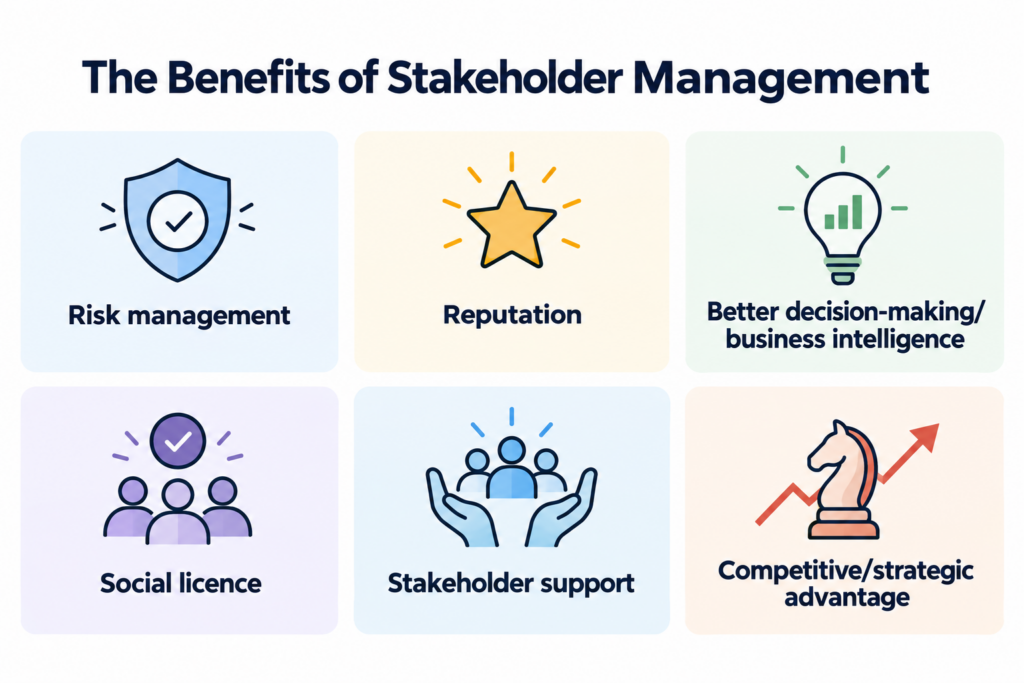
Stakeholder management is an important process for many organizations and projects, and has a range of benefits and use cases. For instance:
- Running a successful project — Managing stakeholders (and doing it well) can help you develop and maintain good relationships with the communities who will be affected, along with other stakeholders.
- Supporting stakeholder engagement – By first identifying stakeholders and assessing their interests, you can create a firm foundation on which to build your stakeholder engagement strategy.
- Meet legal obligations – With increasing legislation around privacy protections and the right to information, it’s even more important than ever that organizations or projects have a clearly defined stakeholder management plan and protocols.
- Manage expectations – With community expectations higher than ever (and still rising), organizations can benefit from greater understanding and careful management.
- Manage risks – Managing stakeholders in a systematic, controlled way can help to identify, mitigate, and avoid a range of risks associated with your organization or project.
- Gain a social license – The stakeholder management process can help to identify opportunities that allow you to gain a social license to operate.
- Build social capital – Because social capital requires relationships to generate value, managing stakeholders effectively can accelerate the growth of your social capital.
- Improve reputation – Through the stakeholder management process, your organization can build relationships with key stakeholders and improve your reputation on specific issues, like transparency and sustainability.
- Greater business intelligence – Understanding stakeholder concerns and interests can lead to ideas for products or services that will address stakeholder needs or allow the company to reduce costs and maximise value.
- Align business goals – Seeking to understand your stakeholders while communicating your business goals can help you better align with stakeholders.
- Increased stakeholder support – Stakeholder management can sometimes lead to greater support by improving communication, increasing transparency, and building trust.
- Reduce delays – Strategically managing stakeholders can allow you to quickly provide information and request feedback, and stakeholder insights and cooperation can help to reduce potential project delays.
- Improved sustainability – Managing and engaging with stakeholders delivers insights that are key to sustainable decision making.
- Support corporate governance – Through the stakeholder management process, you can identify and manage a range of demands and expectations from various governing groups and stakeholders.
- Gain a competitive advantage – Any organization can gain a competitive advantage by more effectively understanding their stakeholders, identifying opportunities, and uncovering potential risks.
The Stakeholder Management Process
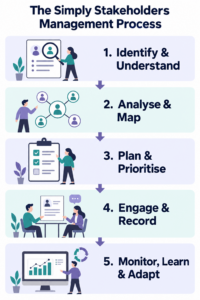
So, what does a deliberate, strategic approach to stakeholder management actually look like? Generally, you could break it down into four main steps:
Understand Your Stakeholders
The key to a successful stakeholder management program is to start with a good understanding of your stakeholders. And make sure you are testing and refining that understanding throughout the process.
After identifying stakeholders, begin your stakeholder analysis by considering and making note of:
- Other information – What other information can you collect on stakeholders that will help you understand their needs, priorities, preferences and concerns?
- Demographics – Based on demographic data, are you engaging with a broad cross-section of the community and stakeholder groups?
- Social networks – Are you focusing on the important, yet often undocumented, social connections between stakeholders?
- Salience – Have you considered using the Salience Model to examine the power, urgency (need for immediate action) and legitimacy (appropriate stakeholders) — and the interaction or groups of stakeholders this creates?
- Expectations – What are the stakeholder expectations and how do they compare with the scope and expectations of the project or organization? Is there a gap or mismatch? If so, how will this be managed?
- Preferences – What information do stakeholders want from you, how often, and in what format/channel?
- Interests – What financial/social/emotional interest do they have in the outcome of your work? Is it positive or negative?
- Motivations – What are the key motivations that will drive their perceptions of your project or organization and their interactions with you?
- Opinions – What is their current opinion of your organization and project? Is it based on good information?
- Influences – Who influences their opinions? Who do they influence, in turn?
Five questions you should be able to answer:
- WHO are they? – Role, organisation, community, demographics, location, group.
- WHAT matters to them? – Needs, interests, expectations, concerns, issues.
- HOW are they affected? – Impact, interest, benefits, risks.
- WHO influences them? – Relationships, networks, connections, influence.
- WHERE do they currently stand? – Position, sentiment, trust, relationship quality.
Stakeholder Mapping
To continue your stakeholder analysis, it’s helpful to ‘map’ or visualize your stakeholders in relation to other key stakeholders and key criteria. This will enable you to strategize how you will prioritize and approach either individual, organization, or group of stakeholders.
What is stakeholder mapping?
Stakeholder mapping is a term often used to describe the process of assigning values that shape priorities and strategies for each stakeholder, based on their ranking against some set criteria. Sometimes stakeholders are simply assigned a rank (of low-medium-high or 1-5) against each criteria. Often they are plotted on a matrix to provide a visual depiction of the range of stakeholders in your program. After you have ranked your stakeholders or plotted them on these matrices, you next need to consider how this information will influence your stakeholder management plan and strategy.
Common stakeholder mapping methods
There are a number of standard frameworks used for stakeholder mapping:
- Salience Model
- Stakeholder Knowledge Base Chart
- Power/Interest Grid
- Power/Predictability Matrix
- Stakeholder Relationship Mapping
- Stakeholder Mapping Spreadsheets
- Multi-Dimensional Stakeholder Mapping
We cover these frameworks and methods in detail in our blog on stakeholder mapping. But you can also preview many of these below:
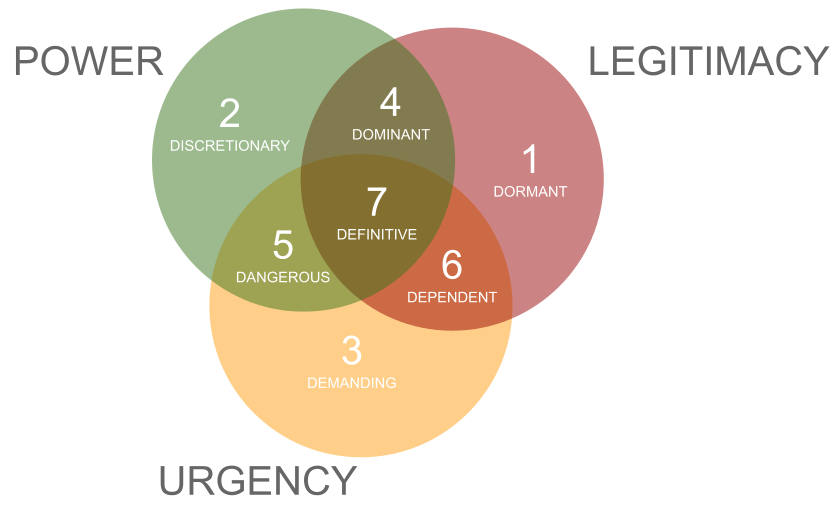
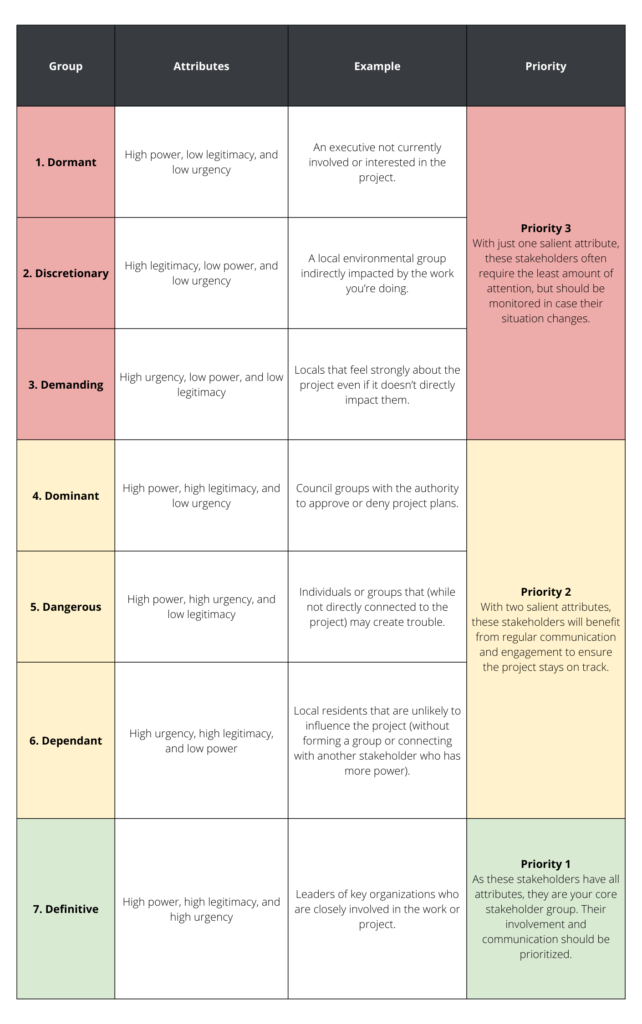
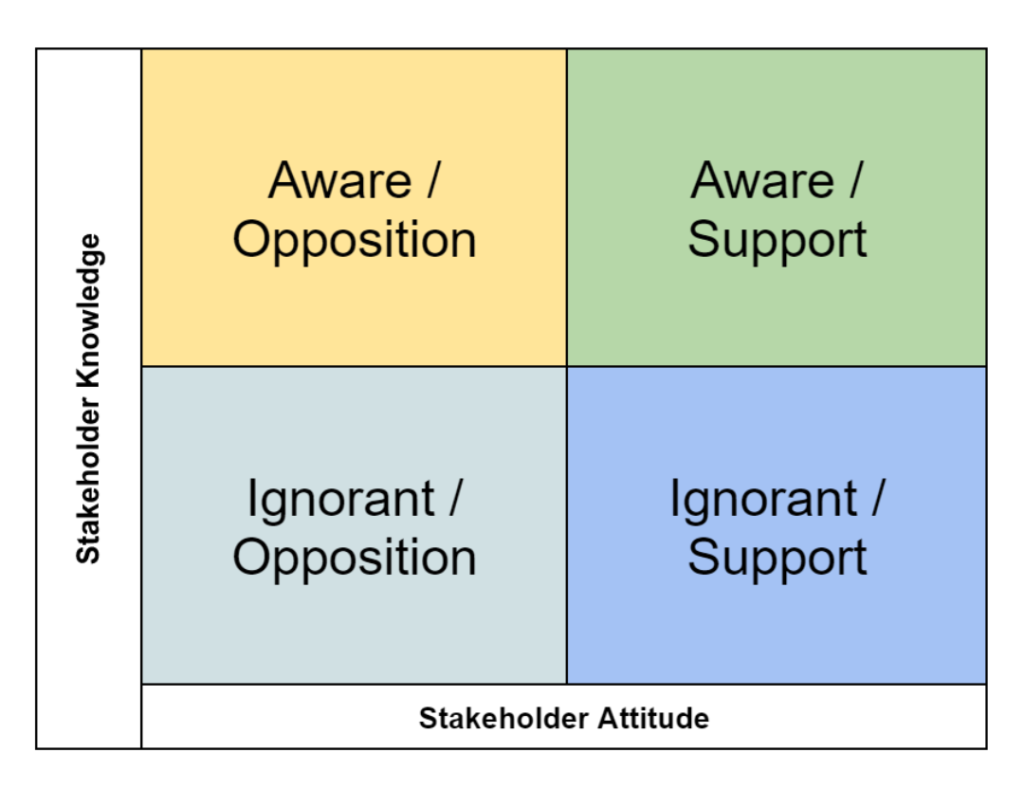
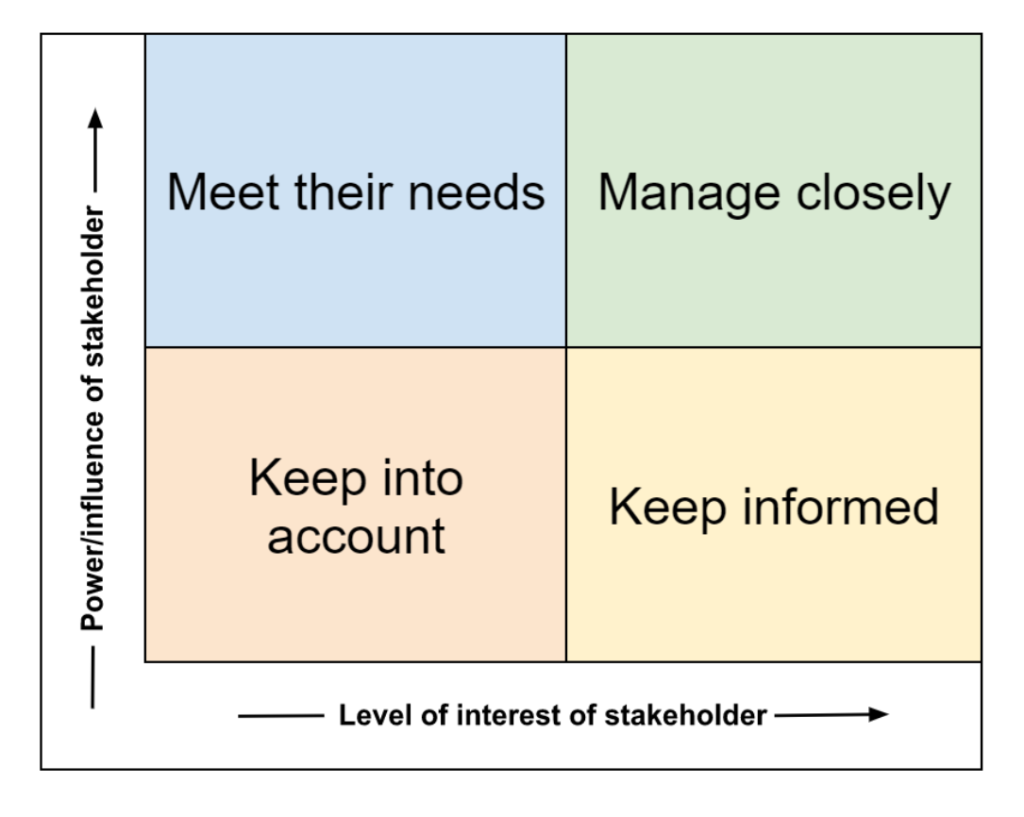
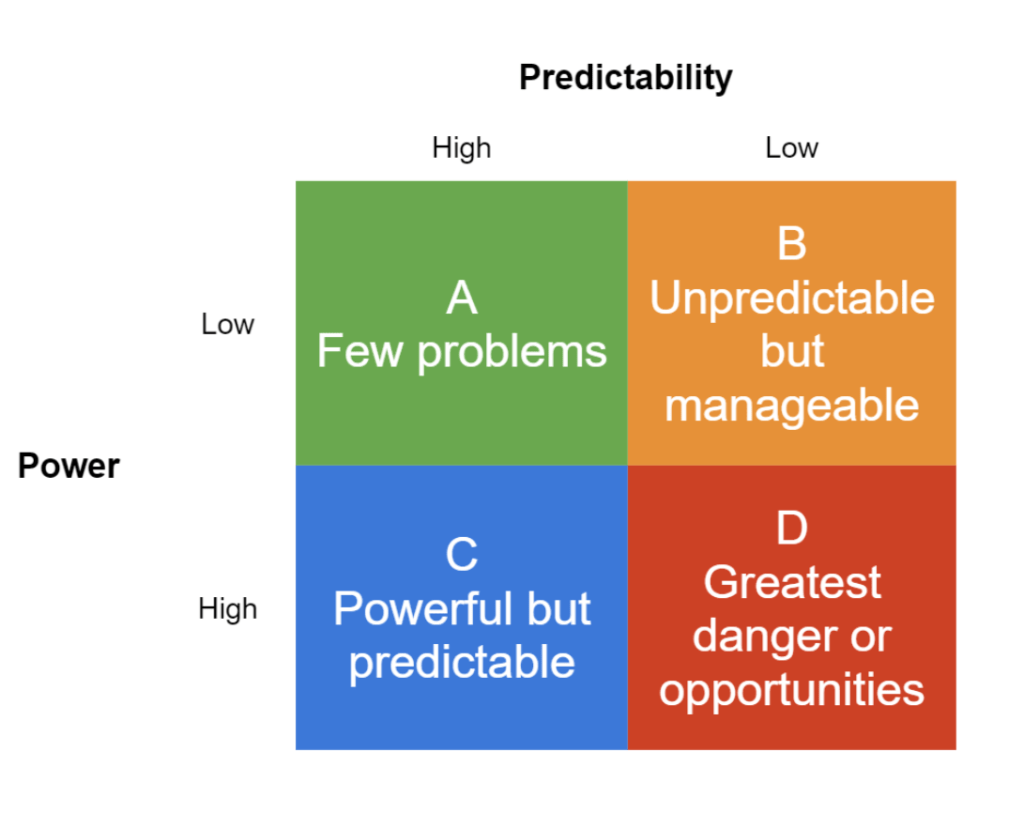
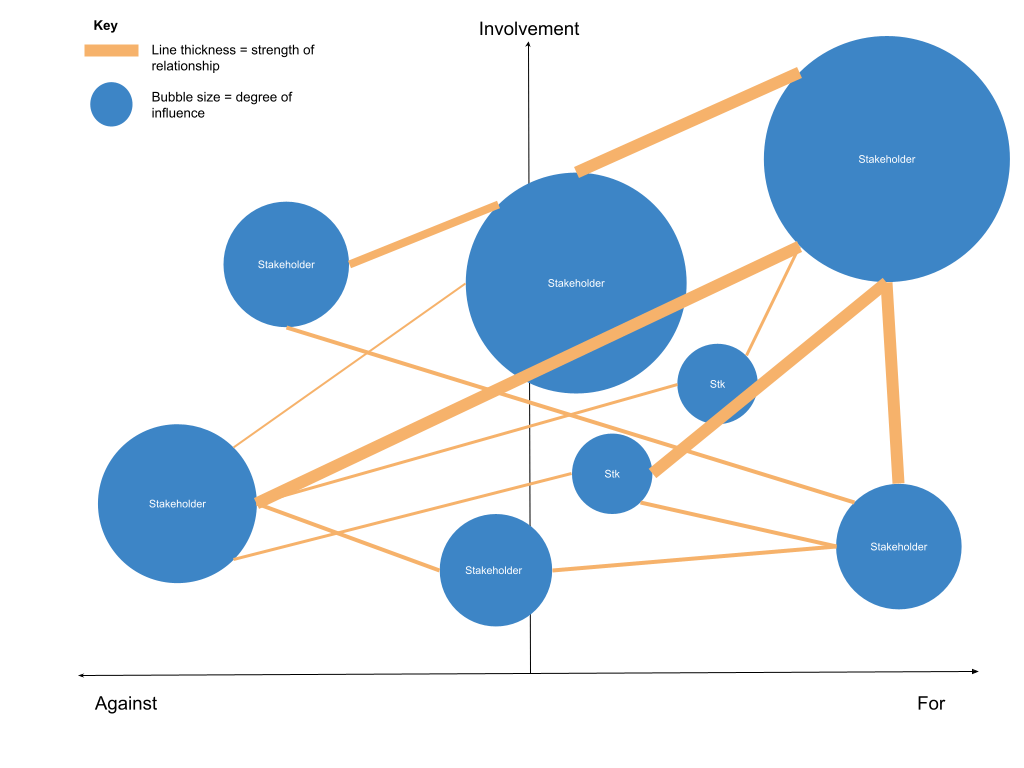
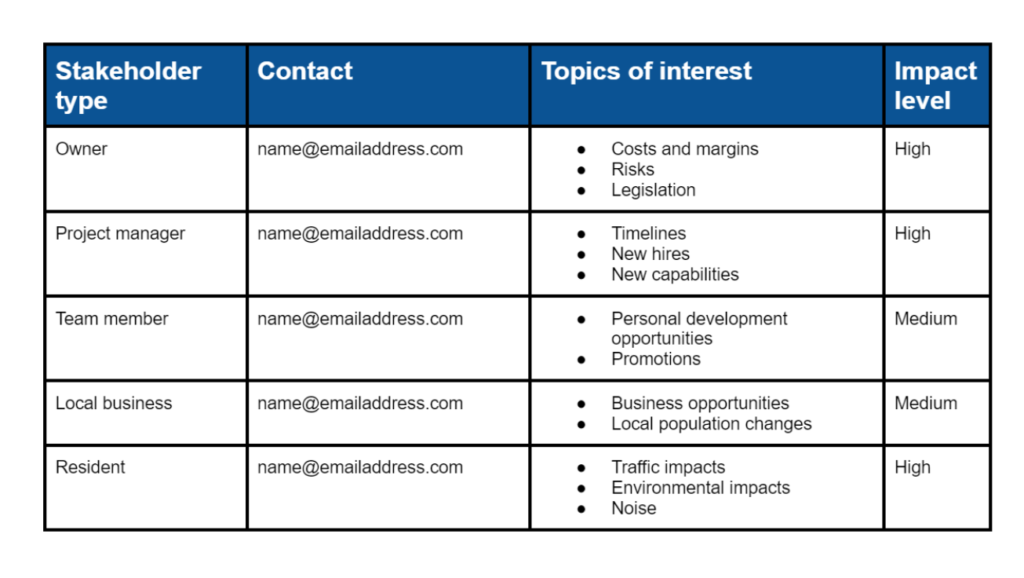
At Simply Stakeholders, we take a multi-dimensional approach to stakeholder mapping inside our stakeholder software.
The limitation of static stakeholder maps
Some of the ‘industry standard’ grids are a bit dated and don’t take into account shifting power relationships and stakeholder expectations (especially with easy access to social media and the risk-averse nature of governments when it comes to political damage). It’s important to take this into account when selecting a framework or model to ensure that you can fully understand your stakeholders and ensure your strategy caters to all their needs.
Stakeholders change. Their influence changes. Their position changes. Their relationships change. Their sentiment changes. So a stakeholder map shouldn’t be a workshop artifact created at the beginning of the project and then forgotten.
The Simply Stakeholders approach to stakeholder mapping
Our approach to stakeholder mapping includes:
- Segmentation based on influence, interest, impact, position, effort and criticality
- Mapping connections between stakeholders in a visual network relationship map
- Custom fields to track additional information such as demographics
- The multi-dimensional method (our preferred method) so that you can map on a scale from very low to very high for the criteria of:
| Influence
The level of influence a stakeholder has over the project |
Interest
The right of the stakeholder to be consulted and involved in the decisions. |
Impact The level of impact the stakeholder has on the project. |
| Criticality
How critical is this stakeholder to the success of the project?
|
Effort
How much effort would it take to genuinely engage this stakeholder?
|
Position The current position of this stakeholder towards this project
|
Importantly, our software also tracks how these stakeholder mapping values change over time.
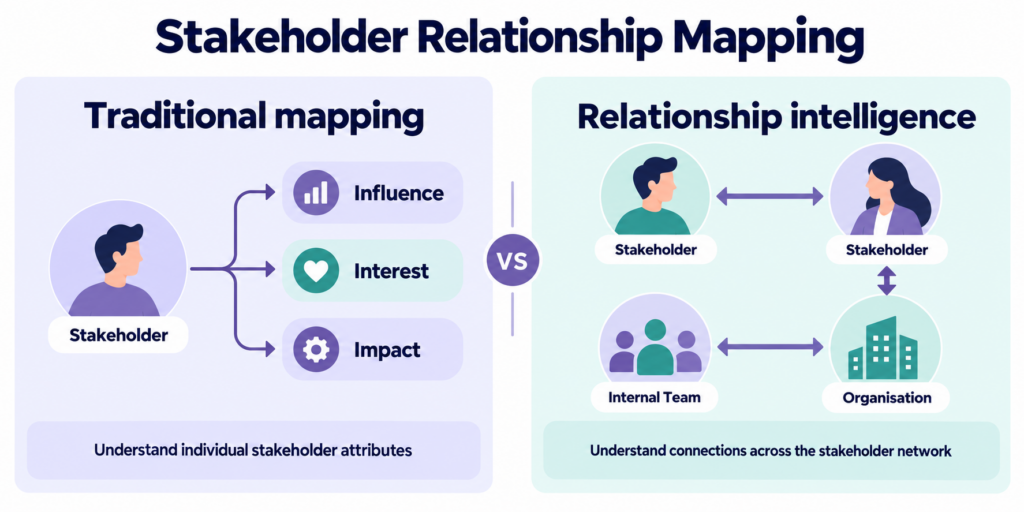
Stakeholder Relationship Mapping
Conventional stakeholder analysis focuses on the attributes of individual stakeholders. Relationship mapping adds another layer, answering the question:
How are stakeholders connected?
This introduces considerations such as:
- who influences whom?
- who are the connectors between stakeholder groups?
- which relationships are strong or weak and how are they changing?
- which influential stakeholder have weak relationships with us?
- where are there relationship dependencies?
- where are the gaps in our organisational network?
Create a Stakeholder Management Plan
A stakeholder management plan is a document that outlines appropriate management strategies to effectively engage stakeholders throughout the lifecycle of the project, based on the analysis of their needs, interests, and potential impact on the project’s success.
Your stakeholder management plan will include some of the information you’ve gathered from earlier steps in the process, as you identified, analyzed, and organized your stakeholders. But before you jump into creating your plan, start by asking the following questions:
- What are the strategic reasons for consulting with stakeholders at this stage?
- Who needs to be consulted?
- What are the priority issues (for them and for you)?
- What will be the most effective methods of communicating with stakeholders?
- Who within the company is responsible for what activities?
- Are there any other engagement activities that will occur in the proposed time frame (perhaps with other sections of your organization)?
- Are there opportunities to collaborate to ensure key project messages are consistent and avoid consultation fatigue?
- How will the results be captured, tracked, reported, and disseminated?
It’s important to be strategic and clear about who you are engaging with (and why) before you get too far into the process. This will not only help to save time and money, but also help you manage expectations and gain trust.
Here are 5 components that should make up your stakeholder management plan:
1. Identify Stakeholders
 |
|
Remember — not all stakeholders in the same group will necessarily have unified opinions or priorities.
2. Analyze Stakeholders
 |
|
Include any other information to help better understand stakeholder needs, priorities, and issues.
3. Strategize and Prioritize
 |
|
Consider the most appropriate ways to engage with each group.
4. Assign Responsibilities
 |
|
Consider the roles and requirements for stakeholder management.
5. Monitor and Report
 |
|
Consider who you should report to, when you should report, and what you should report on.
We have quite a few resources that can help you put together your stakeholder management plan, including:
- How to Create a Stakeholder Management Plan [Webinar]
- Stakeholder Plan Foundations: How to Get Started [Blog]
- Stakeholder Management Plan in Six Steps [Blog]
Or jump straight into our online tool to create your stakeholder management plan in just 15 minutes:
Online Tool: Create a Stakeholder Management Plan
Implementing Your Stakeholder Strategy
A stakeholder plan creates value when interactions, issues, commitments and outcomes are consistently captured.
Four things teams should record as part of their stakeholder engagement processes:
- Interactions – include enough detail in here to include what was discussed (not just that a meeting was held). Without sufficient data in each record, it is difficult to do any meaningful analysis of issues, sentiment, risks, opportunities and trends.
- Issues – some systems like Simply Stakeholders will automatically analyse the issues and tag them in interactions. In other systems, make sure you consistently tag and track issues and have a robust issues register maintained.
- Commitments – what promises were made and to whom?
- Outcomes – what changed as a result of your engagement?

Once your stakeholder management plan is in place and you’ve gained acceptance from your colleagues, executive team, and other relevant stakeholders in your organization, it’s time to implement it.
This means putting in place the tools, communications, activities, and other strategies and resources you’ve identified to manage your stakeholders. Plus, ensuring that the other responsible people implement their assigned activities and tasks.
Monitoring Stakeholder Relationships Over TimeImplementing your current plan is just the beginning. Throughout the implementation, you should monitor your stakeholders to see how they respond to the strategies and check whether you’re meeting the objectives of your plan, project, and organization. Regular reports are important so that you can keep the relevant people in the loop — and track how your plan is progressing.
Monitoring and reporting will often reveal opportunities to improve your processes — new insights into stakeholders, feedback, changing expectations, emerging issues, and changing sentiments. As you learn new things about your stakeholders, use this as an opportunity to adjust your stakeholder management strategies.
|
Activity How many meetings did we have? |
Engagement Who did we hear from? |
Understanding What are stakeholders telling us? |
Relationship How are relationships changing? |
Strategic insight What should we do next? |
Advanced Stakeholder Management Tips
We’ve already covered some basic processes and plans you can follow to get started with stakeholder management. But let’s dive a little deeper into some best practices and more advanced tips you can apply to help you achieve the best possible outcomes.
Get Compliant
With increasing legislation and concerns around privacy and the use of personal data, it’s more important than ever to have clear, well documented processes for your stakeholder management.
For instance, if you are working in or providing services to the European Union and the United Kingdom, you must take particular note of the GDPR requirements that came into play in May 2018. Most other countries have also increasingly tightened requirements for:
- Legitimacy – What data you can legitimately collect and store
- Permissions – How you seek permission for collecting that data
- Usage – How you use that data, and whether it is for a legitimate purpose and consistent with the reasons you gave for collecting the data
- Storage location – Where you store that data and the location of any people who need to access that data
- Security – What security measures you have in place to protect that data
- Requests – Making it easy for the public to request a copy of the data you store on them, and providing it in a machine-readable format
Be Comprehensive
After identifying your stakeholders, review your stakeholder lists to ensure they genuinely represent the whole range of stakeholders. Your needs assessments and engagement programs are all dependent on you having up-to-date and representative stakeholder lists, so make a note to check for comprehensiveness on a regular basis.
Be Honest and Transparent
Honesty is the best policy with stakeholder management! Be honest about why and how you gather information from stakeholders, including social media tracking (going above and beyond the legislated requirements). Be transparent about what you are collecting, why, and what you plan to use the data for.
Segment Stakeholders
After analyzing and mapping your stakeholders, segment them into lists to help you provide a more relevant, tailored stakeholder experience. You could slice your list by a variety of attributes, including location, demographics, industry, interest, needs, influence, and impact.
Another benefit of this is that you can gain insights into how specific stakeholder groups are responding to your communication and activities. And you can make sure you’re reaching the right people with the right message at the right time.
Evaluate Your Plan
Evaluation is an important part of stakeholder management but too many organizations don’t do this well. In particular, you should evaluate whether your plan was successful based on pre-defined measures of success. We talk about this inside our eBook on evaluating stakeholder engagement and public consultation and our webinar on how to evaluate your stakeholder engagement.
Audit Your Data Processes
Regularly audit your data management processes to ensure they’re appropriate, compliant, and efficient. Check that the metrics you’re gathering are fair — to ensure that your conclusions and recommendations accurately represent stakeholder views and requirements.
Another issue to consider is whether you’re keeping your stakeholder system up-to-date. Encourage your team to regularly add new stakeholders to your lists and ensure all interactions are automatically or manually added to the system. The sooner data is added, the less likely it’ll be missed or forgotten.
It’s also a good idea to run maintenance on your data to clean it up. Look for duplicate stakeholder records and merge them. Or (ideally) use a stakeholder management system that allows for sophisticated cross-project stakeholder sharing to minimize stakeholder list duplication and keep your data squeaky clean.
Set Up Shared Stakeholder Lists
Stakeholder management is a huge task — and one best shared with your team. So, make sure that your contact list is in a format that’s easy to share, and allows multiple to work on it simultaneously. The problem that so often occurs with spreadsheets is that you end up having issues with version control and information spread across multiple places. Once you are working inside an SRM like Simply Stakeholders, you can be confident that all users with permission have access to the latest and most up-to-date list.
Of course, be aware of privacy and other legislation around the use of personal information —make sure you are still compliant with the legislation in your country.
Collect the Right Information Right From the Start
From the start of your stakeholder management process, consider what information you might need from stakeholders in future in order to contact them and gather meaningful insights. For example, if you have a signup form on your website, ensure you include all the fields that are important to track. For example, a postcode or area code can allow you to tailor your insights and communication to very specific locations.
This will save you time gathering information manually, and give you richer information on each stakeholder — above and beyond just their name and email address.
Of course you do need to balance this against form best practices, ensuring that you don’t end up with a form that’s so long that most stakeholders won’t complete it.
Manage Grievances
Grievance and complaints handling is an important part of stakeholder management in most organizations. A well-functioning grievance mechanism provides a transparent, credible, and fair process to all parties. It enhances outcomes and gives people the satisfaction that their complaints have been heard, even if the outcome is less than optimal.
A good complaint handling process helps build trust as part of the broader community relations activities and contributes to the overall success of the company’s social performance.
Get Inspired and Think Outside the Box
When creating your stakeholder management plan and deciding on what activities you should include, think outside the box — and consider new, tech-enabled methods that may not have been previously available. Explore case studies, academic papers, new platforms, and data capabilities to see what’s possible!
International standards and stakeholder engagement frameworks
Stakeholder management and engagement practices are supported by a number of international standards and frameworks. These include ISO 26000 Guidance on Social Responsibility, the AA1000 Stakeholder Engagement Standard, the OECD Guidelines for Multinational Enterprises on Responsible Business Conduct, the Global Reporting Initiative (GRI) Standards, and, for organisations delivering major projects, the IFC Performance Standards and Stakeholder Engagement Good Practice Handbook.
While these frameworks have different purposes, they share several principles: identify affected stakeholders, understand their interests and impacts, engage meaningfully, maintain two-way communication, respond to stakeholder input and integrate stakeholder insights into organisational decision-making.
Best Practice Stakeholder Management
Good stakeholder management is more than maintaining a stakeholder list or recording meetings. It is an ongoing process of building understanding, managing relationships, identifying emerging issues and using stakeholder intelligence to make better decisions.
Effective stakeholder management should also be informed by recognised stakeholder engagement frameworks. The AA1000 Stakeholder Engagement Standard, for example, provides a widely used framework for planning, preparing, implementing and improving stakeholder engagement.
While every organisation and project is different, there are some principles that consistently underpin effective stakeholder management.
10 principles of effective stakeholder management
1. Be clear about your purpose
Start by understanding why you are engaging stakeholders and what you need to achieve. Your approach will be different if your goal is to understand community concerns, build support for a project, meet regulatory requirements, resolve an issue or maintain important long-term relationships.
Clear objectives make it easier to identify the right stakeholders, choose appropriate engagement methods and determine what information you need to capture.
2. Identify stakeholders comprehensively
Look beyond the most visible or powerful stakeholders. Consider anyone who can affect your organisation or project, anyone who may be affected by it, and people or organisations with an interest in the outcome (think of this as people who have a statutory, cultural, social or economic “right to be consulted”).
Stakeholder identification should also be ongoing. New stakeholders may emerge as projects, issues and communities change.
International guidance such as ISO 26000 also recognises stakeholder identification and engagement as fundamental practices of organisational social responsibility.
3. Understand what matters to your stakeholders
Knowing who your stakeholders are is only the beginning.
Effective stakeholder management requires an understanding of their interests, needs, expectations, concerns, motivations and priorities. You should also consider how they are affected by your activities, how much influence they have, their current position and who may influence them.
This deeper understanding allows you to engage stakeholders based on what actually matters to them rather than relying on assumptions.
4. Understand relationships, not just individual stakeholders
Stakeholders don’t exist in isolation. They belong to communities, organisations and networks and may influence each other’s opinions and behaviour.
Understanding these relationships can reveal influential connectors, important networks, potential allies, relationship gaps and areas where issues could spread.
You should also understand the relationships between stakeholders and people within your own organisation. An important stakeholder may have several relationships across your organisation, or none at all.
Meaningful engagement is more than communicating information. The OECD Guidelines for Multinational Enterprises on Responsible Business Conduct describe meaningful stakeholder engagement as an ongoing, two-way process conducted in good faith and responsive to stakeholder views.
5. Prioritise intelligently
Not every stakeholder requires the same level or type of engagement.
Stakeholder mapping can help you prioritise based on factors such as influence, interest, impact, position, relationship quality, salience or strategic importance.
But avoid treating a stakeholder’s position on a map as permanent. Influence, interest, sentiment and relationships can change, sometimes rapidly. Prioritisation should therefore be reviewed as new information becomes available.
6. Maintain a shared source of truth
Stakeholder knowledge shouldn’t live in individual inboxes, spreadsheets, meeting notes or people’s memories.
Maintain a central stakeholder record that brings together important information about stakeholders, relationships, interactions, issues, commitments and outcomes.
This creates organisational memory, improves coordination and reduces the risk of important stakeholder intelligence disappearing when team members change roles or leave.
7. Record engagement consistently
Recording that a meeting occurred isn’t enough. Where appropriate, capture what was discussed, issues or concerns raised, commitments made, stakeholder sentiment, important changes and agreed next steps.
Consistent records make it possible to understand the history of a relationship and identify patterns across many interactions and stakeholders.
8. Protect stakeholder information
Stakeholder information can be sensitive. Collect information for a clear and legitimate purpose, be transparent about how it will be used, and avoid collecting information simply because you can.
Appropriate privacy, security, permissions and data-governance practices should be built into your stakeholder management process, especially in relation to where and how the data is stored and secured, and how it is used.
9. Measure outcomes, not just activity
Counting meetings, emails, events and consultation responses can tell you how much engagement has occurred. It doesn’t necessarily tell you whether that engagement was effective. Look beyond activity measures to understand changes in stakeholder sentiment, relationships, issues, trust, support, risk and outcomes.
The more important question is not simply “How much engagement did we do?” but “What changed as a result?”
10. Learn and adapt
Stakeholder management should never be static. Monitor changes in stakeholder priorities, relationships, influence, sentiment and emerging issues. Use what you learn from engagement to adjust your strategy and, where appropriate, influence organisational or project decisions.
For major projects, stakeholder engagement should continue throughout the project lifecycle rather than being treated as a one-off consultation exercise. The International Finance Corporation’s Stakeholder Engagement Good Practice Handbook provides practical guidance on integrating stakeholder engagement from project concept and planning through construction, operations and eventual decommissioning.
The strongest stakeholder management programs create a continuous cycle:
Listen → Understand → Act → Monitor → Learn → Adapt
This turns stakeholder management from an administrative process into a source of strategic intelligence.
How AI is Changing Stakeholder Management
Stakeholder teams have traditionally faced a difficult problem: they collect large amounts of valuable information through meetings, emails, phone calls, consultation activities, surveys and other interactions, but analysing all of that information consistently can be difficult and time-consuming.
As a result, important stakeholder intelligence can remain buried in individual interaction records, spreadsheets, documents and people’s memories.
AI is beginning to change this.
Used appropriately, AI can help organisations analyse large volumes of qualitative stakeholder information, identify patterns and turn engagement records into insights that are easier for teams and decision-makers to use.
From stakeholder records to stakeholder intelligence
The evolution of stakeholder reporting can be thought of as a maturity curve:
Descriptive → Diagnostic → Strategic → Predictive → Prescriptive
Descriptive — “What happened?”
Traditional stakeholder reporting often focuses on activity: meetings held, stakeholders contacted, issues recorded or consultation responses received.
AI can help summarise this information quickly and consistently.
Diagnostic — “What changed and why?”
The next level is understanding changes across the data.
Are particular issues being mentioned more frequently? Has stakeholder sentiment shifted? Are concerns concentrated among particular stakeholder groups, communities or locations?
AI can help teams identify these patterns across many interactions.
Strategic — “What matters?”
Not every issue or stakeholder interaction deserves the same level of management attention.
By analysing issues, relationships, stakeholder characteristics, sentiment and engagement history together, AI can help surface the themes, stakeholders and changes that may be most significant.
Predictive — “What appears to be emerging?”
When stakeholder information is captured consistently over time, patterns may provide early signals of emerging risks, opportunities or changes in stakeholder attitudes.
AI can help identify these signals earlier than manual review alone, although they should be treated as indicators for further investigation rather than certain predictions.
Prescriptive — “What should we do next?”
The most advanced use of stakeholder intelligence is to support decisions.
Which relationships need attention? Which issues warrant escalation? Where might further engagement be valuable? Which stakeholders or communities are we not hearing from?
AI can help decision-makers identify where attention may be required and evaluate possible next steps.
Practical uses of AI in stakeholder management
Depending on the quality and structure of the underlying stakeholder data, AI can assist with tasks such as:
- summarising stakeholder interactions and engagement histories
- analysing sentiment across qualitative feedback
- identifying recurring and emerging issues
- detecting themes across large volumes of engagement data
- summarising the history of a stakeholder relationship
- identifying changes in stakeholder concerns or position over time
- comparing issues across stakeholder groups, projects or locations
- preparing stakeholder reports and management briefings
- highlighting information that may require management attention.
The important shift is from using technology simply to store stakeholder information to using it to help understand what that information means.
AI is only as useful as the stakeholder data behind it
AI cannot compensate for poor stakeholder management practices. If interactions aren’t recorded, stakeholder records are incomplete, issues are inconsistently categorised or important relationship information exists only in people’s heads, the analysis will also be incomplete.
Organisations that want to use AI effectively therefore need strong foundations: consistent stakeholder records, good engagement data, appropriate data structures and clear governance.
AI doesn’t replace stakeholder relationships
Stakeholder management is fundamentally about people and relationships. AI cannot replace trust, empathy, judgement, local knowledge or the conversations required to build strong stakeholder relationships. Nor should an AI-generated assessment of a stakeholder be accepted uncritically as fact.
Instead, AI is most useful as a tool for augmenting human judgement.
It can help teams process more information, recognise patterns earlier and ask better questions. People can then apply context, experience and judgement to determine what those signals mean and what action, if any, should be taken.
The opportunity isn’t to automate stakeholder relationships. It is to give the people responsible for those relationships better stakeholder intelligence.
How to Choose Stakeholder Management Software
One final, important element to stakeholder management that we’ve touched on already is your software or tools. There’s a lot that goes into the stakeholder management process — to do it properly (especially at scale or over a long period of time), you really need the appropriate tools for the task.
Typically, organizations use one of the following tools:
- Spreadsheets (like Excel) – fine for very small/simple programs
- CRMs or Customer Relationship Managers (like Hubspot or Salesforce) – useful where stakeholder relationships largely overlap with customer/business-development relationships
- SRMs or Stakeholder Relationship Management Systems – designed for ongoing stakeholder relationships, interactions, issues and engagement.
- AI-enabled Stakeholder Intelligence Platforms (Simply Stakeholders) – adds qualitative analysis, sentiment, issue identification, summaries, relationship insights, strategic guidance and reporting.
Firstly, if you haven’t already, it really is time to leave the spreadsheets behind. They don’t offer enough collaborative features (including version control), automations/integrations, analysis/tracking, and reporting functionality. Plus, they’re difficult to offer the level of security and privacy that today’s organizations need when handling people’s data.
Secondly, it’s important to acknowledge that CRMs were just not designed for the job of managing complex stakeholder relationships. They are optimised for managing sales processes and commercial customer relationships. Many a large organisation has spent large amounts of money and time in trying to customise a CRM for a stakeholder relationship management purpose, only to have the entire project fail.
SRM systems while no longer new, are niche products designed specifically for stakeholder relationship management. Some products that are designed by stakeholder engagement experts have continued to evolve into Stakeholder Intelligence Platforms, making the best use of modern technology and adapting to the changing requirements for stakeholder engagement and relationship management.
CRM vs Stakeholder Relationship Management Software
Now, if you’re trying to decide between a CRM and SRM, it can be tricky if you’re new to these types of software. At first glance, they might even look pretty similar.
So, what are the similarities and differences between the two? When looking at most CRM products on the market from a stakeholder management perspective, compared with Simply Stakeholders, here’s what you’ll find:
| CRM (Customer Relationship Management)
Designed to manage and track the sales process |
SRM (Stakeholder Relationship Management)
Designed to manage and track stakeholder relationships and issues |
| ✅ Cloud-Based
✅ Collaboration tools ✅ Reporting and analytics ✅ API Integrations ❌ Multiple Projects ❌ Stakeholder mapping ❌ AI-driven sentiment insights ❌ Project history ❌ Simplified data re-use |
✅ Cloud-Based
✅ Collaboration tools ✅ Multiple Projects ✅ Reporting and analytics ✅ API Integrations ✅ Stakeholder mapping ✅ AI-driven sentiment insights ✅ Project history ✅ Simplified data re-use |
While they have some core functionalities in common, you’ll soon find that a CRM falls short on managing complex projects and stakeholders, and lacks important features for analysis and tracking. So, if you’re serious about managing your stakeholders, make sure you trial purpose-built stakeholder software.
Read more about the difference between a CRM vs SRM. We’ve also covered the reasons CRMs might not be working for your project or organization.
Exploring software to support your stakeholder management process? When it comes to stakeholder software, Simply Stakeholders is a great choice for organizations of all sizes. It offers a user-friendly interface, one place for all your stakeholder interactions, stakeholder mapping, and cool features like AI-driven analysis.
What Does Good Stakeholder Management Look Like?
Stakeholder management maturity isn’t determined by how many stakeholder records an organisation has or how much engagement it conducts.
The more useful question is:
How effectively does the organisation turn stakeholder relationships and engagement into understanding, coordinated action and better decisions?
Organisations often progress through three broad stages.
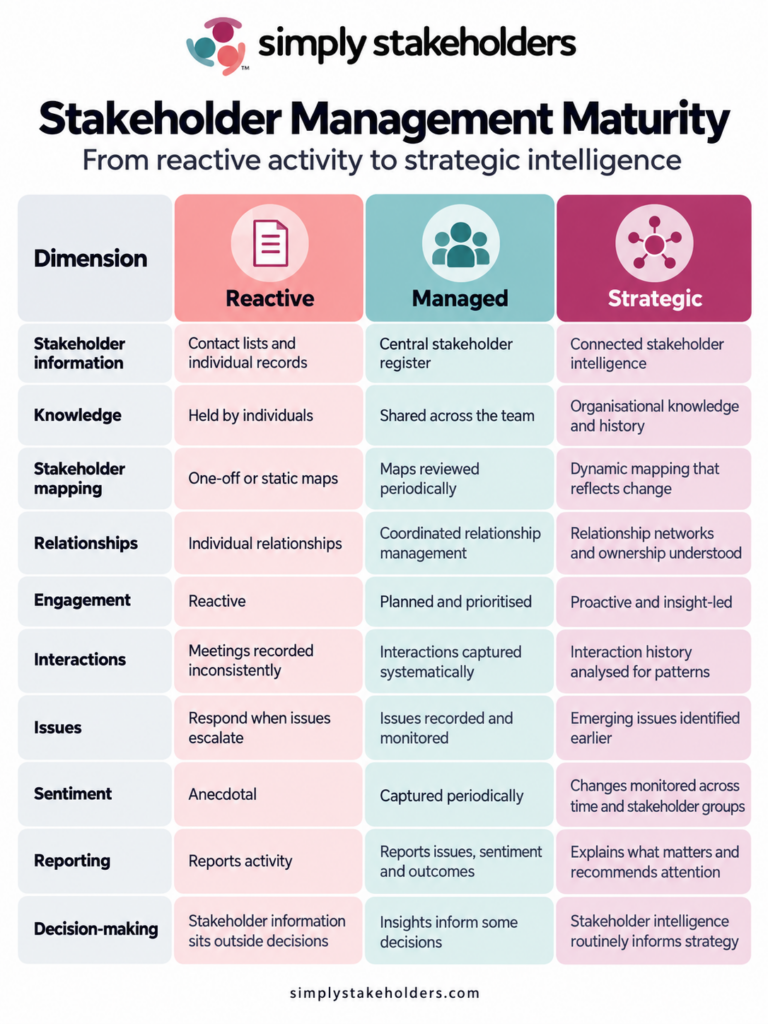
Moving from reactive to strategic stakeholder management doesn’t necessarily mean doing more engagement. It means getting more value from the engagement you already do.
At the reactive end of the spectrum, stakeholder knowledge is often fragmented across spreadsheets, inboxes and individual team members. Engagement happens in response to immediate needs, and reporting tends to describe activities.
A managed approach creates more consistency. Stakeholders, interactions and issues are recorded centrally; responsibilities are clearer; engagement is planned; and management has better visibility of stakeholder activity and concerns.
Strategic stakeholder management goes further. It connects information across stakeholders, relationships, interactions, issues and time to understand what is changing, why it matters and where attention is required.
The ultimate goal is to move from:
Recording stakeholder activity → Understanding stakeholder relationships → Generating stakeholder intelligence → Informing better decisions.
That is when stakeholder management becomes more than a process. It becomes an organisational capability.
Frequently Asked Questions
What is stakeholder management?
Stakeholder management is the systematic process of identifying, understanding, prioritising and building relationships with people and organisations that can affect — or are affected by — a project, policy or organisation.
It includes stakeholder analysis and mapping, engagement planning, recording interactions and issues, monitoring relationships and using stakeholder insights to inform decisions.
Why is stakeholder management important?
Stakeholder management helps organisations understand the people who can influence or be affected by their decisions. Done well, it can identify risks and opportunities earlier, improve decision-making, strengthen relationships, build trust and support, protect reputation and reduce the likelihood of conflict, delays or loss of social licence.
It also helps organisations ensure stakeholder knowledge is retained and shared rather than residing with individual team members.
What are the five steps of stakeholder management?
A practical stakeholder management process involves five steps:
- Identify and understand your stakeholders, including their needs, interests, concerns and expectations.
- Analyse and map their influence, impact, relationships, position and other relevant characteristics.
- Plan and prioritise the relationships and engagement activities that require attention.
- Engage and record interactions, issues, commitments and outcomes.
- Monitor, learn and adapt as stakeholders, relationships and circumstances change.
Stakeholder management should be treated as a continuous cycle rather than a one-off exercise.
What is the difference between stakeholder management and stakeholder engagement?
Stakeholder management is the broader process, covering stakeholder identification, analysis, mapping, planning, relationship management, information capture, monitoring and reporting.
Stakeholder engagement is the interaction itself — the conversations, consultation, communication, collaboration and other activities through which an organisation engages with its stakeholders.
Good stakeholder engagement is therefore an important part of effective stakeholder management.
What is stakeholder mapping?
Stakeholder mapping is the process of visually analysing and organising stakeholders according to characteristics that are important to a project or organisation.
Traditional stakeholder maps often consider factors such as power, influence, interest or impact. More advanced approaches can also consider stakeholder position, sentiment, relationship quality, salience and connections between stakeholders.
Because stakeholders and relationships change, maps should be reviewed and updated rather than treated as static documents.
What should a stakeholder management plan include?
A stakeholder management plan should identify the stakeholders relevant to a project or organisation, analyse their needs and characteristics, establish engagement priorities and objectives, define appropriate engagement approaches, assign responsibilities and explain how engagement and stakeholder relationships will be monitored.
The plan should be flexible enough to change as new stakeholders, issues and information emerge.
What is stakeholder relationship management software?
Stakeholder relationship management software, sometimes called an SRM or SRMS, is software designed specifically to help organisations manage stakeholder information, relationships and engagement.
Unlike a CRM, which is generally structured around customers, sales opportunities and revenue, stakeholder management software can track stakeholders, interactions, issues, commitments, sentiment, relationships, engagement activities and other information relevant to long-term stakeholder relationships.
How can AI be used in stakeholder management?
AI can help stakeholder teams analyse large amounts of qualitative engagement information more efficiently. Applications include summarising interactions, analysing sentiment, identifying recurring or emerging issues, detecting themes, reviewing relationship histories and preparing stakeholder reports.
AI is most effective when it supports rather than replaces human judgement. Its value depends heavily on the quality, completeness and consistency of the stakeholder data available for analysis.
Learn More
We’ve covered a lot of information here, but if you’d like to dive deeper into a specific aspect of stakeholder management (or you prefer your info in another format), you might like to explore these related resources:
- Top 7 Trends for Stakeholder Management in 2023 [Blog]
- What is Stakeholder Management and How Do You Get Started? [Blog]
- Stakeholder Management Plans [eBook]
- Remote Stakeholder Management [eBook]
- Stakeholder Management For Policy and Program Delivery [Webinar]
- 10 Steps for Success with Stakeholder Relationship Management [Webinar]
- What is Stakeholder Relationship Management? [Webinar]
- How to Create a Stakeholder Management Plan [Webinar]
Get In Touch
We’re always happy to share our knowledge and expertise. Get in touch and let us know what you think of the resources on this page. And be sure to subscribe to our email list to make sure you don’t miss future articles.