What is Public Consultation? A Practical Guide for Local Government
What Is Public Consultation?
Public consultation is the structured process of seeking input from people who may be affected by a government decision, policy, project or service before that decision is made. Effective public consultation helps councils make better decisions, reduce project risks, build community trust and demonstrate transparency.
Three things separate real public consultation from the appearance of it:
- There is a genuine decision still open. You are asking because the answer could change what you do. If the road is already funded, designed, and scheduled, asking the community whether they want it is not consultation.
- There is a defined audience who will be affected. Consultation isn’t a broadcast to everyone; it’s a deliberate effort to reach the residents, businesses, community groups, and other stakeholders who carry the consequences of the decision.
- There is a feedback loop that closes. People who contribute hear back about what you did with their input and why. Without the loop, participation collapses the next time you ask, because last time, nothing came of it.
The International Association for Public Participation (IAP2) places consultation on a spectrum of engagement that runs from inform through consult, involve, collaborate, and empower. Consultation sits early on that spectrum: you’re obtaining feedback on analysis, alternatives, and decisions, and promising to keep people informed and to acknowledge how their input shaped the outcome. It’s worth knowing where consultation sits, because a lot of friction in local government comes from a council promising consult while the community expected collaborate — or vice versa.
Every day, local governments make decisions that shape the places where people live, work and play. Whether it’s building a new sporting facility, changing parking restrictions, updating a planning scheme, introducing a waste collection service or developing a long-term strategic plan, those decisions affect communities in different ways.
Public consultation provides an opportunity for residents, businesses, community organisations and other stakeholders to contribute their knowledge, perspectives and concerns before decisions are finalised.
Done well, public consultation improves decision-making and strengthens trust.
Done poorly, it can leave communities feeling ignored, frustrated and less willing to participate in future engagement.
Yet despite significant investment in online consultation platforms and digital engagement tools, many organisations still struggle to answer fundamental questions such as:
- Are we engaging the right people?
- Are we building trust with our community?
- Are we learning from previous consultations?
- Are we remembering the commitments we’ve made?
- How are our stakeholder relationships changing over time?
These questions highlight an important distinction.
Public consultation is an activity. Community engagement is an organisational capability.
The most successful councils recognise that public consultation isn’t simply about collecting submissions; it is about building long-term relationships that enable better decisions for years to come.
This guide explains what public consultation is, how it differs from community engagement, how the IAP2 Spectrum supports effective participation, and why many leading organisations are evolving from project-based consultation towards stakeholder intelligence.
Public consultation vs engagement vs participation
These terms get used interchangeably, and the blur causes real problems when you’re setting expectations.
Community engagement is the umbrella. It covers the whole relationship between a council and its community over time — every touchpoint, campaign, conversation, and decision. Consultation is one activity that lives inside engagement.
Public consultation is a specific, time-bound activity with a start, an end, and a decision attached. You open it, you promote it, you gather input, you close it, and you report back.
Community participation describes how deeply people are involved. A survey is low participation; a resident sitting on an advisory panel that co-designs a plan is high participation. Consultation can be shallow or deep depending on the methods you choose.
Getting these distinctions right is important. When a council says “we consulted” but the community expected to help make the decision, the gap between those two words is where tempers fray and trust erodes.
Why Public Consultation Matters More Than Ever
Community expectations have changed dramatically over the past decade. People no longer expect government to inform them about decisions. They expect to be involved.
Residents want earlier engagement, greater transparency and genuine opportunities to influence outcomes. They also expect governments to remember previous conversations rather than treating every consultation as an isolated event.
At the same time, councils face increasing pressure to deliver more consultation with limited resources. Infrastructure investment is growing. Planning decisions are becoming more complex. Communities are more connected, and more vocal than ever before. Social media enables concerns to spread rapidly, while expectations around openness and accountability continue to rise.
Around the world, governments are strengthening requirements for openness and public participation. In Australia, councils must comply with state-based legislation governing community engagement, planning and public consultation.
Internationally, similar trends are emerging. California’s SB 707 (Brown Act Modernization Act) requires many local governments to improve public access to council meetings by providing two-way remote participation, translating agendas into commonly spoken community languages, adopting policies for technology disruptions, and taking additional steps to encourage residents to participate. The legislation recognises that meaningful participation increasingly depends on reducing barriers to access rather than simply holding meetings in public.
These changes reflect a broader shift in public expectations. Communities increasingly expect engagement to be:
- accessible
- inclusive
- transparent
- multilingual where appropriate
- available through both in-person and digital channels
For councils, this means consultation is no longer just about complying with statutory notice periods. It is about designing engagement processes that are genuinely accessible to the people they are intended to serve.
Against this backdrop, effective public consultation has become a strategic capability rather than simply a legislative requirement.
Good consultation helps councils:
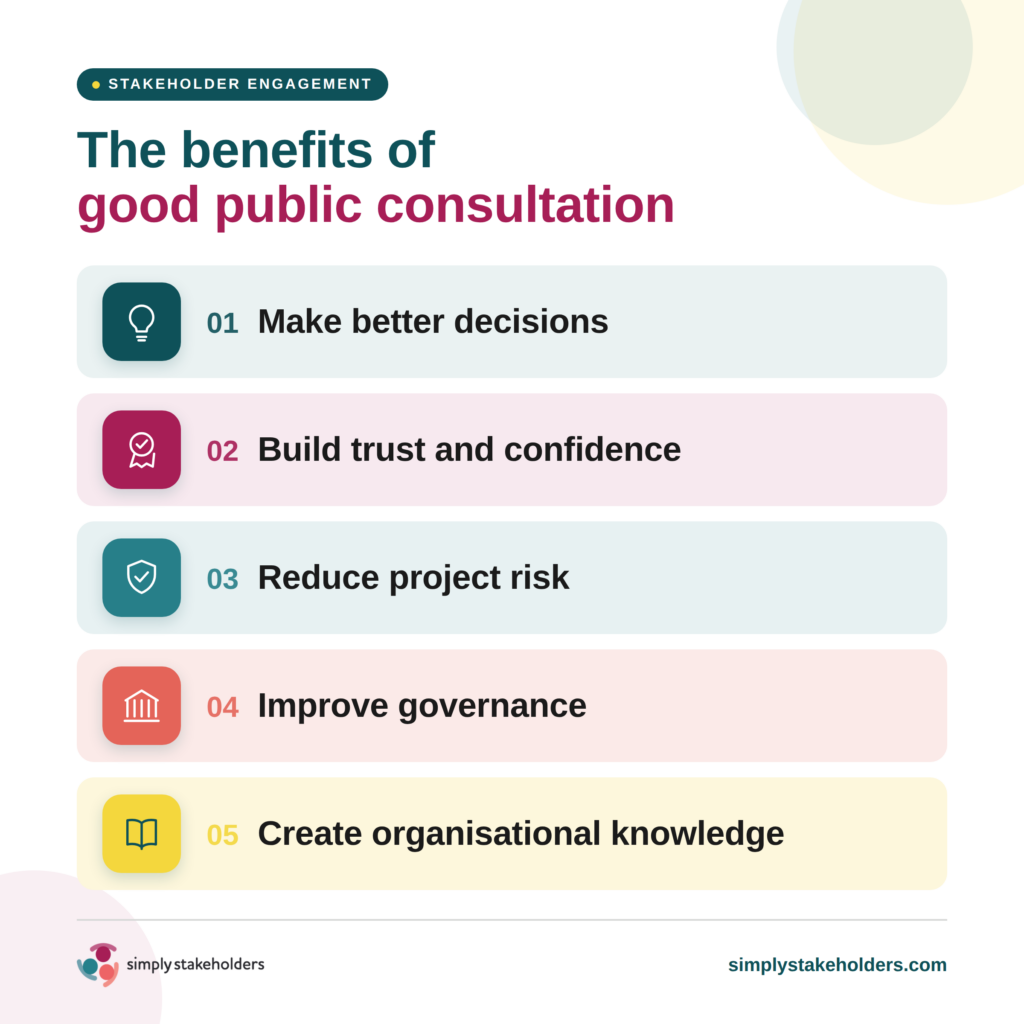
Make better decisions
Local communities possess knowledge that technical specialists often don’t. Residents understand neighbourhood history. Businesses understand economic impacts. Community organisations understand local needs. Early engagement helps uncover valuable information before projects are finalised.
Build trust and confidence.
Research consistently shows that people are more likely to accept decisions—even ones they disagree with—when they believe the process was fair, transparent and genuinely considered their input. Trust is built less by the final decision than by the quality of the engagement process.
Reduce project risk
Many disputes arise because concerns were identified too late.
Early consultation can reveal:
- emerging community opposition
- misinformation
- political sensitivities
- accessibility concerns
- environmental impacts
- cultural heritage issues
Addressing these early is often significantly less expensive than responding later in the process, after designs are complete or construction has begun.
Improve governance
Public consultation provides evidence that decisions have been informed by community input rather than made in isolation. Good governance includes:
- documented consultation processes
- transparent decision-making
- clear reporting
- auditable records
- accountability for commitments
Create organisational knowledge
Perhaps the greatest long-term benefit of consultation is the knowledge it generates. Every conversation improves understanding of:
- stakeholder priorities
- community concerns
- influential groups
- local history
- emerging issues
- relationship dynamics
When captured effectively, this knowledge becomes a valuable organisational asset that improves every future consultation.
The most valuable outcome of a consultation isn’t the consultation report—it’s the organisational knowledge created through every stakeholder interaction.
Public Consultation vs Community Engagement
The terms public consultation and community engagement are often used interchangeably. However, there is an important distinction. Public consultation is one important component of community engagement, but it is not the whole picture.
Community engagement is broader, longer-term and relationship-focused. Consultation is usually project-focused.
| Public Consultation | Community Engagement |
|---|---|
| Focuses on a specific proposal or decision | Focuses on ongoing relationships |
| Usually has a defined start and finish | Continuous |
| Often required by legislation | Strategic organisational practice |
| Seeks feedback | Builds trust |
| Project-specific | Organisation-wide |
| Measures participation | Measures relationships and community confidence |
Consider a council developing a new playground. The consultation may run for six weeks. Residents complete surveys. Parents attend workshops. Feedback is analysed. A report is produced. The consultation closes.
Community engagement, however, continues long after the playground opens. Council officers continue speaking with local residents. Maintenance issues are recorded. Future upgrades are discussed. Relationships continue developing. Every interaction contributes to a deeper understanding of the community.
This distinction becomes increasingly important because communities judge engagement over years—not individual projects.
Every consultation ends. Community relationships don’t.
Public Consultation vs Stakeholder Engagement
Another common source of confusion is the relationship between public consultation and stakeholder engagement. Although closely related, they have different objectives.
Public consultation focuses primarily on obtaining community input into decisions.
Stakeholder engagement encompasses all interactions between an organisation and the people, businesses and organisations who affect, or are affected by its activities.
For councils, stakeholders extend well beyond residents. They include:
- businesses
- community organisations
- sporting clubs
- schools
- Traditional Owners
- environmental groups
- developers
- utility providers
- emergency services
- neighbouring councils
- government agencies
Some of these stakeholders may never participate in a formal consultation, yet maintaining strong relationships with them remains essential.
Stakeholder engagement includes activities such as:
- meetings
- briefings
- relationship management
- issue resolution
- ongoing communication
- partnership development
- commitment tracking
Public consultation is one important engagement activity. Stakeholder engagement is the broader discipline that supports long-term organisational relationships.
Increasingly, leading councils are moving beyond simply managing consultations towards managing stakeholder relationships across the entire organisation.
Consultation collects opinions. Stakeholder engagement builds relationships. Stakeholder intelligence turns those relationships into better decisions.
The memory problem behind poor consultation
Here’s the pattern almost every council knows. A community member has been to five consultations over three years. They’ve raised the same concern about traffic near the primary school every single time. But each consultation was run by a different officer, logged in a different spreadsheet, or captured in notes that left with the person who ran the session. So every time, that resident starts from zero — re-explaining a concern the organisation should already hold.
From the resident’s side, it feels like being unheard. From the council’s side, it’s not indifference, it’s that the organisation’s memory of the relationship is scattered across inboxes, documents, have-your-say project sites, and people who have since moved on. When staff turn over, the relationship intelligence walks out the door with them, and the next project starts from a blank page.
This is what we call relationship debt: the stakeholder-management failures that accumulate quietly, like financial debt, but can’t be refinanced. You pay the interest in slower approvals, harder consultations, and communities that arrive already sceptical because last time didn’t go anywhere. Every forgotten commitment and every uncoordinated contact adds to the balance, and it compounds long before anyone names it.
Understanding the IAP2 Spectrum
One of the most widely recognised frameworks for public participation is the IAP2 Spectrum of Public Participation, developed by the International Association for Public Participation (IAP2). The Spectrun is currently under review and it is expected that a new version of it will be released later in 2026.
The original Spectrum recognises that not every decision requires the same level of community participation. Some decisions simply require informing the community. Others require consultation. Some benefit from collaboration or even shared decision-making. The Spectrum defines five levels of participation.
|
Inform |
Consult |
Involve |
Collaborate |
Empower |
|
| Public Promise | We will keep you informed. | We will listen to you, acknowledge your concerns and provide feedback on how public input influenced the decision. | We will work with you throughout the process. | We will partner with you in each aspect of the decision. | You will make the final decision. |
| Description | At this level, communication is one-way. The objective is to ensure the community understands what is happening. | This is the level most commonly associated with public consultation. The organisation actively seeks community views before making a decision. | Rather than seeking feedback at specific points, organisations involve stakeholders continuously during project development. | Collaboration involves shared problem-solving and joint development of solutions | At the highest level of participation, decision-making authority rests with the community. |
| Typical methods |
|
|
|
|
|
| Suitable for |
|
|
|
|
Empowerment is appropriate only where legislation and governance arrangements permit community decision-making. |
Beyond the IAP2 Spectrum: Defining the Purpose of Engagement
While the IAP2 Spectrum helps determine the appropriate level of public participation, it doesn’t answer another equally important question:
Why are we engaging in the first place?
Before selecting engagement methods or launching a consultation, councils should be clear about the primary purpose of engagement.
One useful way of thinking about this is the Capire Engagement Triangle, a planning framework that encourages practitioners to define the intended outcome of engagement before deciding how to engage. The framework identifies three broad objectives:
- Informing decisions – gathering community insights to help decision-makers better understand issues, preferences and local knowledge.
- Strengthening decisions – improving the quality, legitimacy and community acceptance of decisions by incorporating diverse perspectives.
- Sharing knowledge – creating opportunities for councils and communities to learn from one another, recognising that both bring valuable knowledge, lived experience and expertise to the conversation. This reflects Capire’s updated model, which replaced the earlier concept of “capacity building” with “sharing knowledge” to emphasise mutual learning rather than a one-way transfer of expertise.
The Engagement Triangle reminds us that engagement methods should follow engagement objectives, not the other way around.
For example, if the objective is simply to gather feedback on a draft parking strategy, an online survey may be appropriate. If the objective is to build shared understanding around a contentious urban renewal project, workshops, deliberative forums and ongoing stakeholder engagement are likely to be more effective.
The same engagement tool can produce very different outcomes depending on the intent behind its use.
The Community Engagement Maturity Model
The IAP2 Spectrum helps organisations choose the appropriate level of public participation for a specific decision. It does not measure how mature an organisation is at community engagement.
Two councils can both follow the IAP2 Spectrum and run technically successful consultations. Yet one consistently builds trust, learns from every project and strengthens stakeholder relationships, while the other begins each consultation with new spreadsheets, new mailing lists and little organisational memory.
The difference is organisational maturity.
Increasingly, leading practice recognises that effective public participation depends not only on individual projects but also on the organisation’s systems, governance, culture and ability to learn over time.
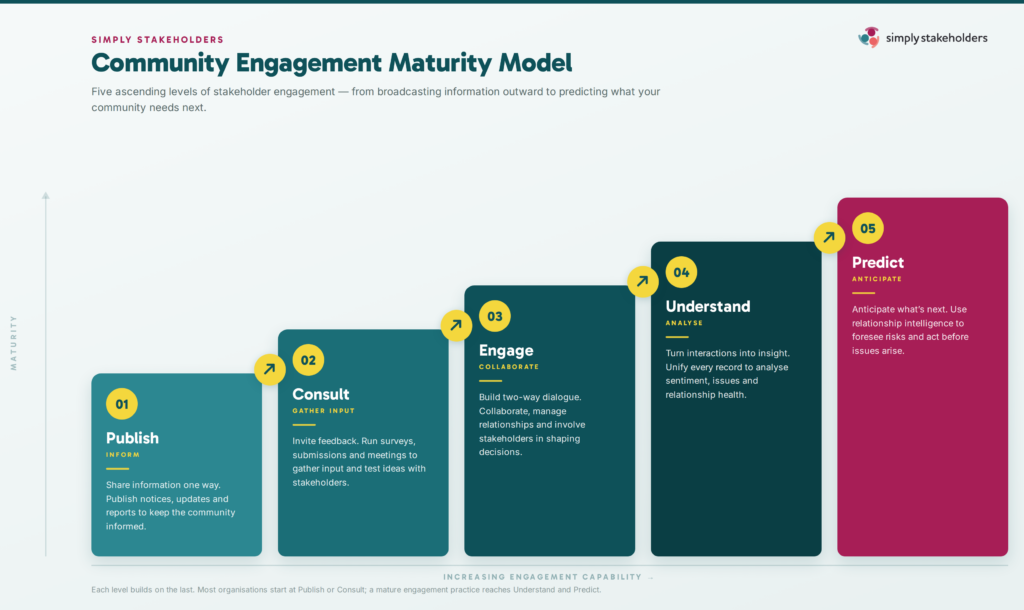
The Community Engagement Maturity Model describes how organisations evolve from simply publishing information to generating stakeholder intelligence that supports better strategic decisions.
Level 1 — Publish
“We tell the community.”
Communication is primarily one-way.
Success is measured by information distribution.
Typical technology:
- website
- newsletters
- media releases
Typical question:
Have we informed the community?
Level 2 — Consult
“We ask the community.”
The organisation begins seeking feedback through surveys, consultation portals and public meetings.
Engagement is largely project-based.
Success is measured through:
- submissions
- participation
- attendance
- website visits
Typical question:
How many people participated?
Level 3 — Engage
“We build relationships.”
Consultations become connected rather than isolated. Stakeholder history is retained. Departments coordinate engagement. Commitments are tracked.
Success is measured through:
- relationship quality
- stakeholder satisfaction
- consistency
- trust
Typical question:
How are our relationships evolving?
Level 4 — Understand
“We generate stakeholder intelligence.”
The organisation begins identifying patterns across thousands of interactions.
Leaders understand:
- emerging issues
- stakeholder influence
- recurring concerns
- community sentiment
- engagement gaps
Typical question:
What is our community telling us?
Level 5 — Predict
“We anticipate community outcomes.”
Artificial intelligence and stakeholder intelligence help organisations identify emerging risks before they become major issues.
Leaders can proactively identify:
- deteriorating relationships
- likely opposition
- missed commitments
- misinformation
- communities requiring additional engagement
Typical question:
What is likely to happen next?
Community Engagement Maturity at a Glance
| Level | Organisation Thinks… | Focus | Primary Measure |
|---|---|---|---|
| 1. Publish | “People need information.” | Communication | Reach |
| 2. Consult | “People should have their say.” | Collecting feedback | Participation |
| 3. Engage | “Relationships matter.” | Relationship management | Trust and consistency |
| 4. Understand | “Data should improve decisions.” | Stakeholder intelligence | Organisational insight |
| 5. Predict | “We should anticipate issues.” | Strategic decision support | Better decisions and reduced risk |
Bringing the Frameworks Together
Each of the frameworks discussed in this guide answers a different planning question.
| Framework | Key Question | Purpose |
|---|---|---|
| IAP2 Spectrum | How much participation is appropriate? | Select the appropriate level of public participation. |
| Capire Engagement Triangle | Why are we engaging? | Clarify the purpose and desired outcome of engagement before selecting methods. |
| Community Engagement Maturity Model | How capable is our organisation? | Assess how effectively engagement is embedded across governance, systems, culture and stakeholder relationships. |
Together, these frameworks provide a practical foundation for designing high-quality engagement:
- Clarify the purpose (Capire Engagement Triangle).
- Choose the appropriate level of participation (IAP2 Spectrum).
- Select the right engagement methods (Consultation Plan).
- Capture and apply organisational learning (Community Engagement Maturity Model).
Too often, organisations start by asking “Should we run a survey or a workshop?” Mature organisations start by asking “What are we trying to achieve?” When the purpose of engagement is clear, the appropriate methods—and the measures of success—become much easier to define.
Characteristics of Mature Community Engagement Organisations
As organisations mature, community engagement becomes less dependent on individual staff members and more embedded in governance, systems and organisational culture.
Highly mature organisations typically demonstrate the following characteristics:
✔ Clear engagement principles adopted across the organisation
✔ Consistent consultation planning and reporting
✔ Shared stakeholder information rather than isolated spreadsheets
✔ Clear ownership of stakeholder relationships
✔ Executive visibility of emerging community issues
✔ Continuous evaluation and improvement
✔ Organisational learning from previous consultations
✔ Technology that supports—not replaces—good engagement practice
These organisations don’t simply run better consultations. They become better at listening, learning and responding over time.
A consultation platform helps you run a consultation. A mature engagement organisation remembers every conversation, learns from every interaction and continuously strengthens its relationship with the community.
Why councils run government consultations
Government consultations aren’t optional good manners. For local government they’re driven by a mix of legal obligation, better decisions, and social licence.
Statutory requirements. Across Australian states, local government acts and planning frameworks require councils to consult on specific decisions — community strategic plans, significant policy changes, certain development applications, road closures, changes to community facilities, and more. The exact triggers vary by state, but the principle is consistent: some decisions can’t be made behind closed doors.
Better decisions. The people who use a park, drive a corridor, or run a business on a main street hold knowledge your team doesn’t have. Consultation surfaces the operational reality that plans miss: the intersection that’s dangerous at school pick-up, the drainage that already floods, the loading zone a business depends on. Skipping that input doesn’t make the problem disappear; it just moves it to the complaints inbox after construction.
Social licence and risk. This is where the cost of poor consultation shows up. When communities feel unheard, opposition organises, projects stall, and relationships sour in ways that outlast the individual decision. For a council, delay isn’t only a budget line, it’s the credibility you spend every time you go back to the same community for the next project.
The public consultation process, step by step
1. Define the decision and the scope
Before you write a single question, be honest about what’s actually negotiable. Is the location fixed but the design open? Is the budget capped? What feedback could genuinely change the outcome, and what can’t? Communities respond well to clear scope and badly to the discovery that they were consulted on things that were never up for grabs.
2. Identify and map your stakeholders
Work out who is affected and how. For a town centre upgrade that means adjacent traders, residents on the block, accessibility advocates, the local chamber of commerce, delivery operators, and the people who simply pass through. Stakeholder mapping is a clear framework for ensuring that you identify all the appropriate and relevant stakeholders and can plan your consultation appropriately for each group..
3. Choose your methods
Match the method to the audience and the depth of participation you need. Surveys and online submission forms reach breadth. Drop-in sessions, workshops, and pop-ups at the local market reach people who won’t fill in a form. Advisory panels and deliberative forums reach depth. Most council consultations blend several methods so that a working parent and a retiree both have a realistic way to contribute.
4. Promote it and lower the barriers
A consultation nobody knows about produces feedback from nobody who matters. Use the channels your community actually uses — local Facebook groups, the library noticeboard, rates notices, schools, culturally appropriate channels for communities that don’t engage in English. The goal is to make participating easy for the people who are hardest to reach, not just convenient for the people who always show up.
5. Gather, record, and analyse the feedback
This is where many councils lose control. Feedback arrives across email, submission portals, workshop notes, phone calls, and social media, and it lands with different officers in different departments. If that input isn’t captured against the stakeholder who gave it, you lose the thread, and when the same resident raises the same concern six months later, nobody knows it’s the second time.
6. Close the loop and report back
Publish what you heard, what you decided, and why; including where you went a different way than the feedback suggested, and your reasons. Closing the loop is the single most powerful thing you can do to make the next consultation work, because it proves participation is worth people’s time.
What separates good consultation from box-ticking
You can run every step above and still produce consultation the community doesn’t trust. The difference usually comes down to a few things.
You consulted early enough to matter. Feedback gathered while options are still open changes decisions. Feedback gathered a fortnight before a locked-in vote changes nothing, and everyone knows it.
You reached the people who don’t usually turn up. Consultation that only hears from the organised and the retired isn’t representative, and a decision built on it is fragile.
You remembered what people already told you. Communities have long memories. When a resident makes the same point they made in three previous consultations and your team treats it as new, the message received is that nobody was listening the first three times.
That last point is where most councils are quietly exposed , and it’s less about effort than about memory.
Why a spreadsheet isn’t a consultation plan
Most councils manage consultation with some combination of a spreadsheet, a shared drive, an email folder, and an engagement platform for the public-facing part. Each does part of the job. None of them holds the whole relationship.
A survey tool captures responses but not the history of the person who responded. A spreadsheet captures a stakeholder list but not the last three interactions or the commitment someone made on the council’s behalf. An engagement platform runs the campaign but doesn’t tell your roads team what your planning team already promised the same resident.
This is the distinction between engagement tools and stakeholder relationship management (SRM). Engagement platforms are built for mass consultation — running the campaign, collecting comments and feedback. SRM is built for organisational intelligence — remembering who your stakeholders are, what they care about, what was said, what was promised, and by whom, across every department and every project, so the knowledge survives staff turnover.
A council that treats consultation as a series of one-off campaigns will keep paying relationship debt. A council that treats it as a continuous relationship, where every consultation builds on a shared, organisation-wide memory of the community, compounds trust instead.
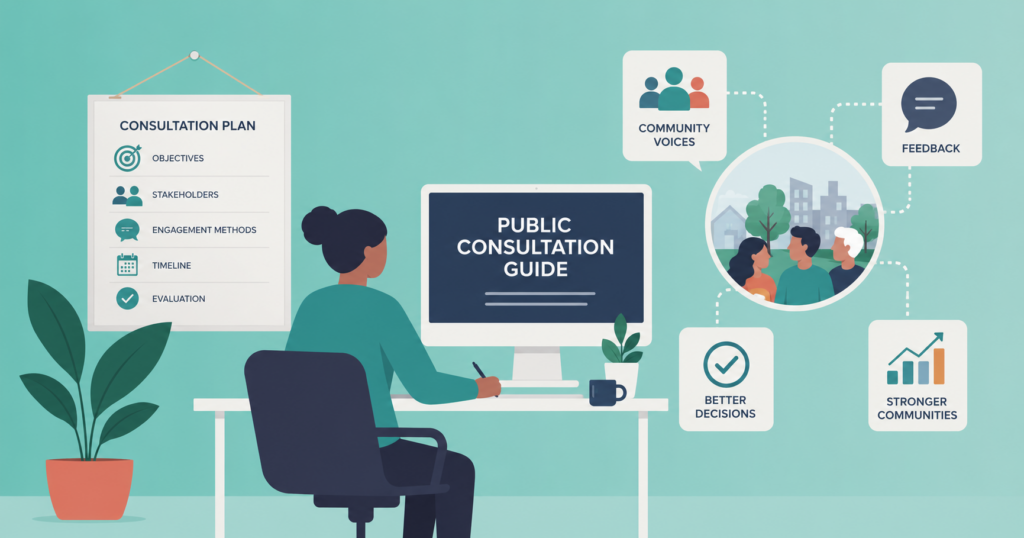
How to Build a Consultation Plan?
A consultation plan is a documented strategy that outlines how an organisation will engage stakeholders throughout a project or decision-making process.
Depending on the size and complexity of the project, a consultation plan might be a two-page document or a comprehensive engagement strategy.
At a minimum, every consultation plan should answer six key questions:
- Why are we consulting?
- Who needs to be involved?
- What decisions are open to influence?
- How will engagement occur?
- How will feedback be used?
- How will we know whether the consultation was successful?
Without clear answers to these questions, consultation can quickly become unfocused, inconsistent or perceived as tokenistic. More importantly, a good consultation plan shifts the focus from “How will we run this consultation?” to “How will this consultation help us make a better decision?”
Step 1: Define the Purpose
Every consultation should begin with a clearly articulated purpose.
This sounds obvious, but many consultations begin with a predetermined engagement method, such as launching an online survey, before anyone has agreed on the desired outcome.
Instead, start by asking:
- What decision are we trying to make?
- What problem are we trying to solve?
- Why are we seeking community input?
- What aspects of the proposal can genuinely change?
- What has already been decided?
Being transparent about these questions helps build trust and sets realistic expectations from the outset.
For example, if funding has already been secured for a new sports facility, consultation may focus on its design, location of amenities or operating hours, not whether the facility should be built at all.
Communities generally accept constraints when they are explained honestly. They become frustrated when they discover them after participating.
Step 2: Identify Your Stakeholders
One of the biggest mistakes organisations make is assuming that consultation is simply about communicating with nearby residents. In reality, most council decisions affect a much broader network of stakeholders.
For example, a proposal to redevelop a local streetscape may involve:
- adjacent residents
- local businesses
- accessibility advocates
- public transport operators
- cycling groups
- emergency services
- schools
- Traditional Owners
- utility providers
- heritage organisations
- elected representatives
- neighbouring councils
Each group may have different concerns, expectations and preferred ways of engaging.
A stakeholder analysis helps determine:
- who is affected
- who has influence
- who has specialist knowledge
- who may experience disproportionate impacts
- who may require tailored engagement approaches
Rather than treating all stakeholders equally, councils should prioritise engagement based on the level of impact and the significance of each stakeholder’s relationship with the project. Doing a quick stakeholder analysis would be really helpful at this stage.
Guide to Stakeholder Analysis Check out our helpful guide for how to do stakeholder analysis
Step 3: Choose the Right Engagement Methods
Not every consultation method is appropriate for every project. A neighbourhood playground upgrade requires a different engagement approach to developing a twenty-year Community Strategic Plan.
Your consultation methods should be influenced by:
- the purpose of engagement
- the appropriate IAP2 participation level
- stakeholder preferences
- project complexity
- available resources
- accessibility requirements
- legislative obligations
Using multiple complementary methods often produces the best outcomes.
For example:
- Online surveys can gather broad community sentiment.
- Workshops help explore complex issues.
- Pop-up sessions reach people who may never attend formal meetings.
- Interviews provide valuable insights from key stakeholders.
- Community reference groups support long-term collaboration on major projects.
No single engagement method reaches every part of the community. The objective should be inclusion, not convenience.
Step 4: Develop a Communication Plan
Effective consultation is built on clear, consistent communication before, during and after engagement.
Your communication plan should identify:
- key messages
- communication channels
- timelines
- spokespersons
- branding
- accessibility requirements
- translation needs
- media management
Importantly, communication should continue after consultation closes.
Participants deserve to know:
- what feedback was received
- what themes emerged
- how input influenced decisions
- why some suggestions were not adopted
- what happens next
Closing the feedback loop is one of the simplest, and most effective ways to build community trust.
Step 5: Plan for Analysis and Reporting
Collecting feedback is only half the job. The real value of consultation comes from understanding what the feedback means. Major consultations can generate thousands of comments across surveys, submissions, emails, meetings and social media. Without a structured approach, valuable insights can easily be overlooked.
Your consultation plan should define:
- how feedback will be analysed
- who is responsible
- reporting formats
- issue categorisation
- sentiment analysis
- governance approvals
Increasingly, councils are using artificial intelligence to assist with summarising responses, identifying recurring themes and detecting emerging issues. However, human judgement remains essential to interpreting complex community perspectives.
Step 6: Measure Success
Many organisations finish consultation once the report is written. High-performing organisations evaluate whether the consultation achieved its objectives.
Success measures might include:
Participation
- Number of participants
- Diversity of participants
- Geographic representation
Process
- Delivery against timeline
- Completion of planned activities
- Accessibility outcomes
Quality
- Stakeholder satisfaction
- Community trust
- Transparency
- Representation of affected communities
Organisational Learning
- Lessons identified
- Improvements implemented
- Stakeholder knowledge retained
- Relationships strengthened
The final category is often overlooked. Every consultation should improve the organisation’s ability to engage more effectively next time.
A consultation plan shouldn’t only guide the current project. It should contribute to the organisation’s long-term understanding of its community. Every consultation should leave the council knowing more than it did before.
Choosing the Right Consultation Methods
One of the most common misconceptions about public consultation is that there is a “best” engagement method.
There isn’t.
Every consultation method has strengths, limitations and situations where it is most effective. The challenge for councils is selecting methods that align with the project’s objectives, stakeholders and desired outcomes, not simply repeating the techniques used on previous projects.
The best consultations often combine several complementary methods, allowing different members of the community to participate in ways that suit their needs.
Online Surveys
Online surveys remain one of the most widely used consultation tools because they are easy to distribute, relatively inexpensive and capable of reaching large audiences. They work well when organisations need to understand broad community preferences or gather structured quantitative feedback.
Best suited for:
- Strategic plans
- Draft policies
- Service reviews
- Budget priorities
Strengths
- Broad reach
- Easy to analyse
- Cost-effective
- Accessible at any time
Limitations
- Limited opportunity for discussion
- May not reach digitally excluded groups
- Often attracts participants with strong existing views
Public Meetings
Public meetings allow communities to hear directly from decision-makers and ask questions. While they can build transparency, they are less effective for gathering representative community views. Attendance is often dominated by highly interested stakeholders.
Best suited for:
- Major infrastructure projects
- High-profile community issues
- Information sharing
Community Workshops
Workshops provide opportunities for collaborative problem solving rather than simply collecting opinions. Participants can explore trade-offs, test ideas and contribute to developing solutions. They are particularly valuable for complex or contested projects.
Pop-up Engagement
Pop-up consultation takes engagement into the community rather than expecting people to attend formal meetings.
Examples include:
- shopping centres
- libraries
- sporting events
- community festivals
- transport hubs
Pop-ups often engage people who would otherwise never participate.
Stakeholder Interviews
One-on-one interviews provide deeper insights than surveys and are particularly useful for understanding the perspectives of key stakeholders.
They work well with:
- business leaders
- community organisations
- government agencies
- Traditional Owners
- elected representatives
Interviews also help build stronger long-term relationships.
Community Reference Groups
Major infrastructure projects frequently establish community reference groups to provide ongoing input throughout planning and delivery. Unlike one-off consultations, these groups build continuity and trust over extended periods.
Deliberative Engagement
Some decisions benefit from more intensive participation processes such as citizens’ juries, deliberative panels or participatory budgeting. These approaches involve smaller groups of participants who are provided with balanced information, hear from experts and work together to develop recommendations. While more resource-intensive, they can produce high-quality outcomes for complex policy questions.
Digital Engagement Platforms
Digital consultation platforms are a common way councils engage with their communities. Features such as project pages, interactive maps, discussion forums and online submissions make participation more accessible and efficient than traditional paper-based processes.
These platforms are particularly effective for:
- publishing project information
- collecting submissions
- running surveys
- mapping local issues
They have become an important part of the modern engagement toolkit. However, it is important to recognise what these platforms are designed to do. They primarily support individual consultation projects. They are not designed to manage long-term stakeholder relationships across multiple projects, departments and years of engagement. This distinction becomes increasingly important as councils mature their engagement practices.
It is also interesting to note that the rising trend of councils using these platforms for citizen engagement parallels a rise in community sentiment that they are not being heard and rising distrust in engagement and the organisations who run them.
Choosing Methods Based on Purpose
Rather than asking, “Should we run a survey or a workshop?”, a better question is:
“What are we trying to achieve?”
Different objectives require different methods.
| If your objective is… | Suitable methods |
|---|---|
| Inform the community | Website, digital engagement platform, newsletters, fact sheets, social media |
| Gather broad community feedback | Online surveys, submissions, interactive maps |
| Understand complex issues | Workshops, focus groups, interviews |
| Build relationships | Stakeholder meetings, reference groups, ongoing engagement |
| Co-design solutions | Collaborative workshops, design charrettes, deliberative panels |
| Reach underrepresented communities | Pop-up engagement, targeted outreach, community partnerships |
This reinforces an important principle explored earlier in this guide through the Capire Engagement Triangle: engagement methods should follow engagement objectives, not the other way around.
The most successful councils don’t rely on a single consultation technique. They combine methods that are appropriate for the decision, accessible to the community and capable of generating meaningful insights.
A survey is a tool. A workshop is a tool. An engagement portal is a tool. Communities don’t judge engagement by the tools you use—they judge it by whether they feel heard, respected and able to influence decisions.
What High-Quality Public Participation Looks Like
Collecting public feedback is relatively easy. Designing and delivering high-quality public participation is much harder.
For many years, organisations measured the success of consultation using operational metrics:
- How many survey responses were received?
- How many people attended the public meeting?
- How many visitors viewed the project website?
- How many submissions were lodged?
These metrics remain useful. They tell us whether people participated. They tell us very little about whether the participation was meaningful.
- Did the consultation reach the people most affected?
- Did participants have enough information to contribute constructively?
- Did decision-makers genuinely consider the feedback?
- Did the process build trust?
- Did the organisation learn something that will improve future engagement?
These questions focus on quality, not quantity.
As governments around the world seek to rebuild public trust and improve decision-making, there is growing recognition that how organisations engage matters just as much as how often they engage.
Recent work by Simon Fraser University’s Morris J. Wosk Centre for Dialogue, developed with public participation practitioners and government organisations, argues that quality public participation should be evaluated against principles that extend far beyond simply collecting feedback. Instead, organisations should consider whether participation is inclusive, transparent, accountable, informed and responsive to community needs.
This represents an important shift in thinking.
Rather than asking:
“Did we run a consultation?”
Leading organisations increasingly ask:
“Did we create the conditions for meaningful participation?”
The Five Characteristics of High-Quality Public Participation
While every consultation is different, high-quality public participation consistently demonstrates five characteristics.
1. Accountability
Effective consultation gives people confidence that their participation has purpose.
Participants should understand:
- why consultation is taking place
- what decisions are open to influence
- who will make the final decision
- how community input will be considered
- when decisions will be made
One of the quickest ways to undermine trust is to ask for feedback on issues that have already been decided. Communities quickly recognise when consultation is simply validating a predetermined outcome.
This is sometimes referred to as consultation theatre—engagement that creates the appearance of participation without offering a genuine opportunity to influence decisions.
The Victorian Parliament’s Inquiry into Community Consultation highlighted concerns that consultation can become a compliance exercise when engagement occurs too late or without clearly demonstrating how community input influences decisions. The inquiry recommended earlier engagement, greater transparency and stronger accountability throughout the consultation process.
High-quality participation begins with being honest about what is—and is not—open for discussion.
2. Transparency
People are more willing to participate when they understand how decisions are being made. Transparency means more than publishing information online.
It means openly explaining:
- why consultation is occurring
- what evidence has informed the proposal
- what constraints exist
- what trade-offs must be considered
- how feedback will be analysed
- how final decisions will be communicated
Importantly, transparency doesn’t end when consultation closes.
Participants deserve to know:
- what the community said
- what themes emerged
- what changed as a result
- why some suggestions could not be adopted
- what happens next
Closing the feedback loop demonstrates respect for participants and significantly improves confidence in future consultations.
3. Inclusive Participation
One of the biggest challenges facing local government is ensuring consultation reflects the diversity of the communities it serves. The loudest voices are not always the most representative.
High-quality participation actively seeks to include people who might otherwise face barriers to participation, including:
- culturally and linguistically diverse communities
- Aboriginal and Torres Strait Islander peoples
- young people
- older residents
- people living with disability
- renters
- shift workers
- small business owners
- geographically isolated communities
This often requires using multiple engagement methods rather than relying solely on online surveys or public meetings. Accessibility is becoming an increasingly important expectation of modern public participation.
Around the world, governments are introducing measures to make participation easier through digital access, multilingual communication and more inclusive engagement practices. The objective is not simply to maximise participation. It is to ensure that the people most affected by a decision have a meaningful opportunity to contribute.
4. Informed Participation
Communities can only provide meaningful input if they understand the issue being discussed. Too often, consultation asks participants to express an opinion without providing sufficient context.
High-quality participation equips people with balanced, accessible information about:
- the problem being addressed
- available options
- evidence supporting the proposal
- likely impacts
- competing priorities
- financial constraints
- legislative requirements
This does not mean persuading people to support a proposal. It means ensuring they have enough information to participate constructively. Well-informed participants tend to provide more practical, solution-focused feedback, leading to better decisions for everyone.
5. Responsive Design
There is no single engagement method that works for every consultation. A community visioning exercise requires a different approach to consulting on temporary road closures.
Responsive consultation recognises that engagement should be designed around:
- the complexity of the issue
- stakeholder needs
- cultural considerations
- community preferences
- available time
- project risks
Measuring What Matters
Many councils already report participation statistics.
For example:
- 3,200 survey responses
- 14,000 website visits
- 680 submissions
- 12 community meetings
These are useful operational metrics. However, they do not necessarily tell us whether engagement was successful. High-quality organisations increasingly measure outcomes that reflect relationship quality and organisational learning.
Traditional Consultation Metrics
- Number of participants
- Survey completion rates
- Website traffic
- Event attendance
- Social media engagement
- Number of submissions
These help answer:
“How much engagement occurred?”
High-Quality Participation Metrics
Leading organisations also measure:
- Did we reach the people most affected?
- Were underrepresented communities included?
- Did participants understand the issues?
- Did stakeholders feel heard?
- Did consultation influence decisions?
- Were commitments fulfilled?
- Has community trust improved?
- What organisational learning was generated?
- How have stakeholder relationships changed?
These questions help answer something much more valuable:
“Did engagement improve our decision-making and strengthen our relationship with the community?”
Participation is an output. Trust is an outcome.
Measuring how many people responded tells you how busy your consultation was. Measuring how relationships changed tells you whether your engagement made a lasting difference.
From Projects to Organisational Learning
One of the most overlooked outcomes of public participation is the organisational knowledge it creates.
Every consultation generates valuable information about:
- stakeholder priorities
- community concerns
- emerging issues
- influential community leaders
- preferred communication channels
- commitments made by council
- relationships between stakeholders
- changing sentiment over time
Unfortunately, this knowledge is often lost. When consultations are managed as standalone projects, stakeholder information is scattered across spreadsheets, email inboxes, survey platforms and project files. The next project begins with another stakeholder list. Another survey. Another set of introductions.
The organisation has participated in consultation—but it has not learned from it.
High-quality public participation captures knowledge once and builds on it continuously. Every interaction contributes to a richer understanding of the community. Every consultation strengthens—not resets—the relationship between council and its stakeholders.
This is one of the defining characteristics of mature community engagement organisations.
Technology Supports Quality—It Doesn’t Create It
Digital consultation platforms have improved the accessibility and efficiency of public participation. They make it easier to publish projects, collect submissions, facilitate discussions and report on consultation activities.
These are important capabilities. However, technology alone cannot create high-quality engagement.
High-quality participation depends on organisational capability, including:
- clear governance
- skilled practitioners
- thoughtful consultation planning
- strong stakeholder relationships
- organisational memory
- continuous improvement
- leadership commitment to engagement
Technology should support these capabilities, not replace them.
The highest-performing councils recognise that successful engagement is not defined by the sophistication of their consultation portal. It is defined by the quality of the relationships they build with their communities and the confidence those communities have that their voices genuinely matter.
Good consultation collects feedback. Great engagement creates organisational learning.
The real value of public participation isn’t the consultation report—it’s the knowledge, trust and relationships that make every future decision better.
Trend: Participation Is Becoming More Accessible by Design |
|
Historically, public participation often depended on residents being able to attend evening council meetings in person. Increasingly, governments are recognising that this excludes many people, including shift workers, carers, people with disabilities and those living in remote areas. Legislation such as California’s SB 707 reflects a broader movement towards participation by design, requiring many local governments to provide remote attendance options, improve multilingual access and proactively encourage public participation. Technology has an important role to play in making participation easier. However, accessibility is only the beginning. The next challenge for councils is ensuring that participation leads to stronger relationships, better organisational learning and more informed decision-making. |
Common Public Consultation Mistakes (and How to Avoid Them)
Most councils don’t set out to run poor consultations. Engagement practitioners are passionate about involving communities, making better decisions and building trust.
Yet despite significant investment in engagement, many organisations still experience community opposition, declining participation, consultation fatigue and accusations that “Council never listens.”
The problem is rarely a lack of commitment. More often, it is a combination of organisational processes, fragmented information and unrealistic expectations.
The following challenges appear repeatedly across local government—not because councils don’t care about engagement, but because delivering consistent, high-quality participation across hundreds of projects is inherently difficult. Recognising these challenges is the first step towards improving them.
Mistake 1: Starting Consultation Too Late
One of the most common reasons consultations fail is that they begin after the most important decisions have already been made.
Communities generally understand that some constraints, such as budgets, legislation or engineering requirements, cannot be changed. What frustrates people is discovering that consultation is only seeking feedback on minor details after the major decisions have already been finalised.
The Victorian Parliamentary Inquiry into Community Consultation emphasised the importance of engaging communities early enough for participation to genuinely influence decisions, rather than treating consultation as the final step before implementation.
Best practice
Begin engagement when there are still meaningful choices available.
Clearly explain:
- what can change
- what cannot change
- why
Communities are far more accepting of constraints when they are communicated honestly from the beginning.
Mistake 2: Confusing Consultation with Community Engagement
Running a consultation is not the same as building relationships. Many organisations invest heavily in individual consultation projects but treat each one as an isolated exercise.
When the project finishes:
- stakeholder lists are archived
- submissions are stored
- reports are published
Then the next project starts from scratch. The result is repeated introductions, duplicated questions and communities feeling that previous conversations have been forgotten.
Community engagement should be cumulative. Every consultation should strengthen the organisation’s understanding of its stakeholders and improve future engagement.
Consultation is an event. Community engagement is an ongoing relationship.
Every project should build on the relationships established by the last—not begin again with a blank stakeholder register.
Mistake 3: Measuring Participation Instead of Trust
Many consultation reports celebrate statistics such as:
- 5,200 website visits
- 1,800 survey responses
- 450 submissions
- 12 community meetings
These are valuable operational measures.
But they don’t necessarily tell us whether engagement was successful.
For example:
- Did participants feel heard?
- Were underrepresented communities involved?
- Did relationships improve?
- Did community confidence increase?
- Were commitments honoured?
Participation is easy to count. Trust is harder to measure. et trust is ultimately what determines whether communities continue participating in future consultations.
High-performing organisations increasingly measure:
- stakeholder satisfaction
- relationship health
- issue resolution
- commitment completion
- organisational learning
Because these indicators reveal whether engagement is creating long-term value rather than simply generating activity.
Mistake 4: Consultation Theatre
One of the greatest risks facing public participation is what many practitioners describe as consultation theatre—engagement that appears genuine but offers little real opportunity to influence decisions.
Consultation theatre can occur when:
- engagement happens after key decisions have been made
- only preferred options are presented
- feedback is collected but never acknowledged
- consultation fulfils statutory requirements without informing decision-making
- communities never hear what happened to their input
The result is often worse than no consultation at all. Communities begin to lose confidence that participation makes any difference. Participation rates decline. Opposition becomes more organised. Future consultations become more difficult.
The Victorian Parliamentary Inquiry highlighted the importance of demonstrating how community input influences decisions and ensuring consultation is integrated into decision-making rather than treated as a compliance exercise.
Good consultation is not measured by whether everyone agrees with the outcome. It is measured by whether people believe the process was fair.
Mistake 5: Relying on One Engagement Method
Every community is different. Every project is different. Yet many organisations rely heavily on a single engagement approach.
For example:
- publishing an online survey
- creating a project in a digital consultation site
- sending a newsletter
Each of these methods reaches different people. None reaches everyone. Younger residents may respond online. Older residents may prefer face-to-face conversations. Businesses may request one-on-one briefings. Community organisations may benefit from workshops.
Effective consultation combines multiple engagement methods to ensure diverse voices can participate. The objective should not be maximum efficiency. It should be meaningful inclusion.
Mistake 6: Losing Organisational Memory
Valuable knowledge disappears every time staff roles change, projects finish, consultants leave or systems are replaced. This is not simply frustrating for the community. It is inefficient for the organisation. The organisation continually rebuilds knowledge it once possessed.
Mistake 7: Working in Departmental Silos
Most councils don’t have one engagement team. They have dozens of teams engaging stakeholders every day. Planning, engineering, parks, waste, libraries, economic development, community services, are all engaging with the same community. And each department creates and manages it own stakeholder lists, consultation records and reporting processes.
Residents, however, don’t experience “departments.” They experience one council.
When information isn’t shared internally, communities often receive:
- conflicting messages
- repeated requests for information
- duplicated consultation
- inconsistent follow-up
Breaking down these silos is one of the hallmarks of mature community engagement organisations.
Mistake 8: Treating Technology as the Solution
But technology cannot compensate for unclear objectives, weak governance or poor engagement practices.
An online engagement platform cannot decide:
- whether the right stakeholders have been identified
- whether engagement started early enough
- whether commitments have been honoured
- whether trust is improving
- whether relationships are becoming stronger
Technology supports engagement. It does not replace good engagement.
The highest-performing organisations invest as much in people, governance and organisational learning as they do in software.
The Common Thread
Although these mistakes appear different, they usually stem from the same underlying issue.
The organisation treats consultation as a series of individual projects rather than as an ongoing organisational capability. Each consultation becomes a separate event. Knowledge is lost. Relationships weaken. Trust must be rebuilt.
Mature organisations think differently. Every consultation contributes to a growing understanding of their community. Every interaction strengthens organisational knowledge. Every project builds on the last.
That shift—from managing consultations to managing stakeholder relationships—is one of the defining characteristics of leading community engagement organisations.
What’s Next?
Understanding these common mistakes naturally leads to an important question:
What role should technology play?
Many councils have invested in online consultation platforms to support community participation. These platforms are valuable, but they represent only one part of the engagement ecosystem.
In the next chapter, we’ll explore the difference between consultation platforms and Stakeholder Relationship Management software, and why an increasing number of councils are using both to move beyond project-based consultation towards long-term stakeholder intelligence.
Consultation Platforms and Stakeholder Relationship Management Software
Over the last decade or two, digital consultation platforms have changed the way councils engage with their communities. Project websites, online polls, map based feedback, discussion forums, budgeting tools, have all made public participation more accessible (to people who have access to the technology and the digital literacy to participate). Despite their limitations of relatively low participation rates, and inaccessibility to sections of the community, they have brought many benefits to the practice of public participation and consultation, especially in terms of efficiency.
However, as councils have become more sophisticated in their engagement practices, many have discovered that running project level consultations efficiently and managing stakeholder relationships effectively are two different challenges. One focuses on individual public consultation projects, The other focuses on long-term organisational relationships. Understanding the distinction between these becomes important as councils seek to build community trust over years, not just deliver successful consultation projects.
Consultation Platforms Are Designed for Individual Engagement Processes
Consultation platforms are purpose-built to support public participation during a specific consultation.
Typical capabilities include:
- publishing project information
- online polls
- interactive maps
- discussion forums
- document libraries
- map based feedback collection
- consultation reporting
These capabilities make public consultation significantly easier to manage.
For many councils, they have replaced paper surveys, manual submissions and static project webpages.
They answer questions such as:
- How many people participated?
- What feedback did we receive?
- Which ideas were most popular?
- What themes emerged during this consultation?
These are valuable insights.
But they primarily relate to this consultation. And in some ways, these tools compound the “memory problem” described earlier, where each project starts from scratch and communities are asked the same questions over and over again.
Stakeholder Relationship Management Software Is Designed for Organisational Memory
Stakeholder Relationship Management (SRM) software like Simply Stakeholders solves a different problem.
Rather than managing a public consultation project, it manages the organisation’s relationships with stakeholders across every project and every department.
Instead of asking:
“What happened during this consultation?”
SRM asks:
“What do we know about this stakeholder after five years of working together?”
Typical capabilities include:
- organisation-wide stakeholder register
- complete interaction history
- stakeholder mapping
- relationship mapping
- issue management
- commitment tracking
- meeting records
- correspondence
- relationship ownership
- AI-generated stakeholder insights
- executive reporting
This information continues accumulating long after individual consultations have closed. The organisation develops an increasingly rich understanding of its community.
Comparing the Two Approaches
| Digital Public Consultation Platforms | Stakeholder Relationship Management Software |
|---|---|
| Supports individual consultation projects | Supports long-term stakeholder relationships |
| Publishes project information | Maintains organisation-wide stakeholder knowledge |
| Collects online feedback | Records every interaction – online and in-person |
| Information is kept at an individual project level | Stakeholder relationship history |
| Basic issues tracking | Issue management across all channels of engagement |
| Basic sentiment assessment of some types of feedback | Sentiment tracking over multiple channels, multiple projects, over the long term |
| Consultation reporting | Cross-project reporting |
| Project-focused | Relationship-focused |
| Consultation ends when the project finishes | Relationships continue across multiple years and projects |
Neither approach replaces the other. They solve different problems.
Why Leading Councils Increasingly Use Both
The most mature organisations increasingly view digital public consultation platforms and Stakeholder Relationship Management software as complementary.
A consultation platform helps deliver an effective consultation.
A Stakeholder Relationship Management platform ensures that knowledge generated during that consultation becomes part of the organisation’s long-term understanding of its community.
For example:
A resident submits feedback on a cycling strategy. The public consultation platform records the submission and provides information on the project.
The Stakeholder Relationship Management platform records:
- who the stakeholder is
- previous consultations they’ve participated in
- meetings they’ve attended
- issues they’ve raised
- commitments made to them
- relationships with local community groups
- communication preferences
- ongoing engagement history
The public consultation becomes part of a much larger relationship.
Consultation platforms collect community input. Stakeholder Relationship Management preserves community knowledge.
One improves individual projects. The other improves every future project.
Beyond Public Consultation: Building Stakeholder Intelligence
The greatest value of stakeholder information isn’t simply storing it. It’s learning from it. As organisations capture years of stakeholder interactions, they begin identifying patterns that would never be visible within a single consultation.
For example:
- Which communities consistently participate?
- Which important stakeholder groups rarely engage?
- Which issues repeatedly emerge across different projects?
- Which commitments remain outstanding?
- Which relationships are becoming stronger?
- Where is community trust improving—or declining?
This is where stakeholder management evolves into Stakeholder Intelligence.
Rather than simply recording engagement activities, councils begin generating insights that support better strategic decision-making. Artificial intelligence is accelerating this transition.
Modern platforms can increasingly help organisations:
- identify emerging issues
- summarise engagement activity
- detect recurring concerns
- analyse stakeholder sentiment
- highlight relationship risks
- recommend follow-up actions
The value no longer lies only in collecting data. It lies in converting engagement data into organisational intelligence.
Every Consultation Should Strengthen the Next One
One of the defining characteristics of mature engagement organisations is that every public consultation leaves them better prepared for the next.
Instead of creating another isolated project file, each consultation contributes to a growing body of organisational knowledge. Stakeholders don’t have to repeat their history. Commitments aren’t forgotten. Relationships continue developing regardless of staff changes or project boundaries. The organisation becomes progressively better at listening, learning and responding.
This is the transition described earlier in the Community Engagement Maturity Model:
- From Publish
- To Consult
- To Engage
- To Understand
- To Predict
Online public consultation platforms play an important role in that journey. But they represent only one part of a broader organisational capability. The organisations building the strongest community relationships are those that connect consultation with long-term stakeholder management, organisational learning and stakeholder intelligence.
The future of community engagement isn’t running more consultations.
It’s ensuring every public consultation makes the next one smarter.
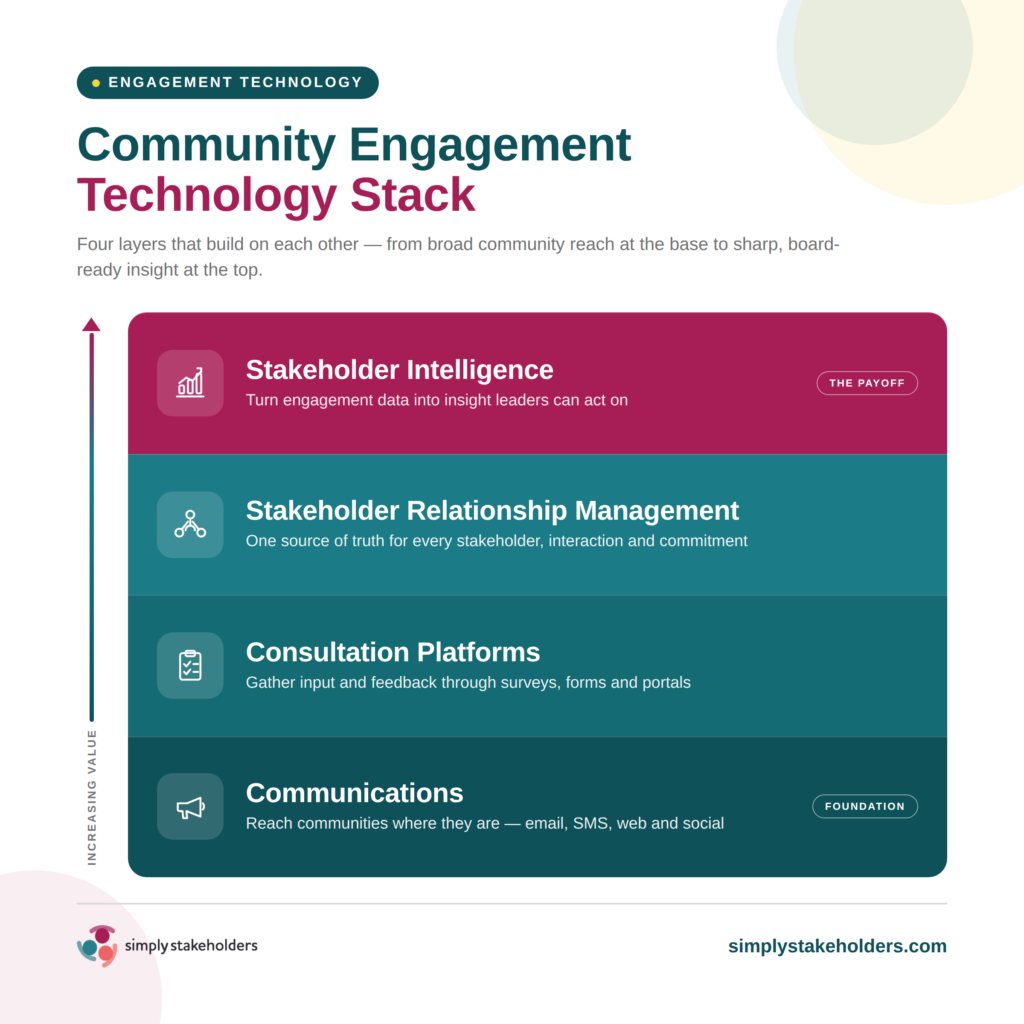
Looking Ahead
Public consultation continues to evolve. Communities expect engagement to be earlier, more inclusive, more transparent and more responsive than ever before. At the same time, advances in AI, analytics and stakeholder intelligence are changing what organisations can learn from every interaction.
| Ready to strengthen your public consultation? Simply Stakeholders helps Councils and other government agencies build their stakeholder intelligence through stakeholder relationship management, creating one source of truth of all public consultation, community engagement and stakeholder engagement activities.Request a personalised demo at simplystakeholders.com or contact our team to discuss how we can support your public consultation efforts. |