CSRD Reporting and Stakeholders: What It Is, ESRS Expectations, and Industry Insights

The EU’s Corporate Sustainability Reporting Directive (CSRD) is in full swing. Over 50,000 organizations operating in the EU are lawfully obliged to disclose their environmental, social, and governance (ESG) impacts, and how these topics affect their business and all relevant stakeholders.
The arrival of CSRD is viewed as a positive move. PwC’s Global CSRD Survey 2024 revealed that participating organizations and businesses can see multiple benefits flowing from sustainability reporting under CSRD, including:
- Better environmental performance
- Improved risk mitigation
- More effective corporate governance
- Improved engagement with all stakeholders.
And it’s the last point that we’re most interested in.
This article explores briefly what the CSRD is and goes into greater detail regarding the directive’s emphasis on mandatory stakeholder engagement and the ways stakeholder relationship management (SRM) software can remove some of the friction and fear when it comes to assessment time.
The CSRD and Why It Has Our Full Attention
Introduced in 2022 and updated in 2025, the CSRD is underpinned by 12 European Sustainability Reporting Standards (ESRS). Since its arrival, any company operating within Europe with over 1,000 employees and a €450 million net turnover must produce an annual report that:
- Details the risks and opportunities arising from social and environmental issues
- Declares social and environmental impacts as a result of their business activities.
For organizations seeking ESG compliance via voluntary frameworks (such as the Global Reporting Initiative or Carbon Disclosure Project), collating and reporting this information may not be a shock to the system. They may already be including some stakeholder engagement to gain an ESG score.
The difference for organizations now tasked with CSRD reporting and stakeholders is that engagement is baked into processes, making it mandatory. As the CSRD is a regulatory standard, stakeholder engagement is no longer an ‘if you can’. It’s a ‘you must’ in order to comply and avoid the risk of penalties or fines.
Visit the EU’s CSRD directive site, and you’ll find strongly worded messages such as this:
“…the necessity of engaging stakeholders cannot be overstated.”
Failing to disclose demonstrated stakeholder engagement means the assessment is incomplete. And where this is the case, the company or organization may be marked as non-compliant.
CSRD Reporting and Stakeholders: What’s Required?
The CSRD includes a thorough double materiality assessment covering each ESG topic.
This is to ensure the reports provide the transparency and accountability the directive was designed to mandate.
The Double Materiality Assessment
The double materiality assessment comes under ESRS 1 General Requirements. It ensures no stone is left unturned in reporting. Organizations are required to stress-test their materiality impact. They must assess not only what they can see from inside the organization, but also the experience and perspectives of voices outside regarding the organization and ESG topics.
Here’s how the two strands of the double materiality assessment work.
The impact materiality: How an organization’s operations and processes affect people (work conditions, human rights, equal opportunities, local communities) and the environment (emissions, responsible waste management, supply chain management, etc.)
Sometimes referred to as the ‘inside-out’ view, the impact materiality assessment concerns an organization’s internal processes and standards, and how they affect external stakeholders and the world in which the organization operates.
The financial materiality: How an organization’s economic and financial performance is affected by sustainability factors, such as climate change. This assessment also covers financially-linked governance, such as risk and opportunity assessments affecting cash flow, capital, and the financial health of the organization.
Because financial materiality considers factors that are outside the organization’s power, this can sometimes be called the outside-in view.

CSRD Reporting and Stakeholder Engagement: It’s Unavoidable
The EU expects stakeholders to be involved throughout the CSRD’s double materiality assessment, to inform the report, and for the company to understand completely how it affects its surroundings and people.
Early stakeholder engagement is crucial. But who is involved and how feedback is gathered depends on the sustainability topic in question.
Impact materiality and financial materiality are of interest to different stakeholder groups. And the ESRS presents two broad stakeholder groups.
The first are affected stakeholders, and can include:
- Employees and temporary or contract workers
- Local communities living near an organization’s operations
- Consumers, customers, and end users of the organization’s products or services
- First Nations or Indigenous peoples where an organization’s operations affect their land, territories, or rights
- Vulnerable groups, such as children, migrants, and people with disabilities.
The second group is users of sustainability statements and reports, and includes:
- Investors and shareholders
- Business partners
- Financial institutions
- NGOs
- Trade and labour unions
- Regulators and policymakers.
Knowing which individuals or groups to engage with to fulfil the requirements of the materiality assessment is the first challenge. Do this by creating a stakeholder register and identifying key stakeholders, before moving on to stakeholder mapping and devising a stakeholder engagement plan.
Failing to demonstrate and disclose stakeholder engagement means the materiality assessment is incomplete, which could put the organization on shaky ground. So your organization must be clear on the CSRD reporting and stakeholders’ roles within the work.
What the ESRS Expects
To ensure reporting uniformity, the ESRS includes specific sections in the directive outlining what organizations are expected to manage stakeholder engagement.
You’ll find these in ESRS 1 (paragraphs 22-26) and ESRS 2 (SBM-2).
Within these sections, your organization must disclose:
- Key stakeholder methodology: How the organization identified relevant stakeholders and the methods used to categorize and map them
- Engagement strategies: The methods used to engage stakeholders and the frequency of engagement
- Engagement goals and objectives: What the organization is trying to learn and understand as a result of stakeholder engagement
- Results analysis and reporting: How stakeholder feedback and views link to topics in the material assessment
- Stakeholder concerns: Issues stakeholders raised relating to the organization’s material assessment topics.
While CSRD reporting and stakeholder engagement are mandatory, the ESRS has left the door open when it comes to the methods an organization uses. This offers some flexibility in using strategies, tools, and practices that are best aligned with your organization, commonly used within your industry, and (most importantly) will elicit engagement from stakeholders.
That said, the ESRS does require organizations to do the following as part of their engagement process.
- Maintain engagement: Stakeholder consultations and engagement are ongoing and part of a well-maintained relationship.
- Document interactions: they must have recorded proof of who was consulted (as a way of ensuring inclusivity of all stakeholders) and what they said.
- Strategic decision-making: Demonstrating how stakeholder engagement and feedback is informing and guiding ESG plans and the materiality assessment.
5 Ways Simply Stakeholders Supports CSRD Reporting
CSRD reporting and stakeholder involvement might feel like a massive data and people management task. Particularly for organizations with long supply chains and multiple or complex stakeholder groups.
Hurried, superficial stakeholder engagement assessments are a recipe for non-compliance. But get it right, and you can breathe a sigh of relief and simultaneously satisfy stakeholders.
Making sure you have the right stakeholder management software to support CSRD reporting and stakeholders is a simple first step. The Simply Stakeholders platform can help in the 5 following ways.
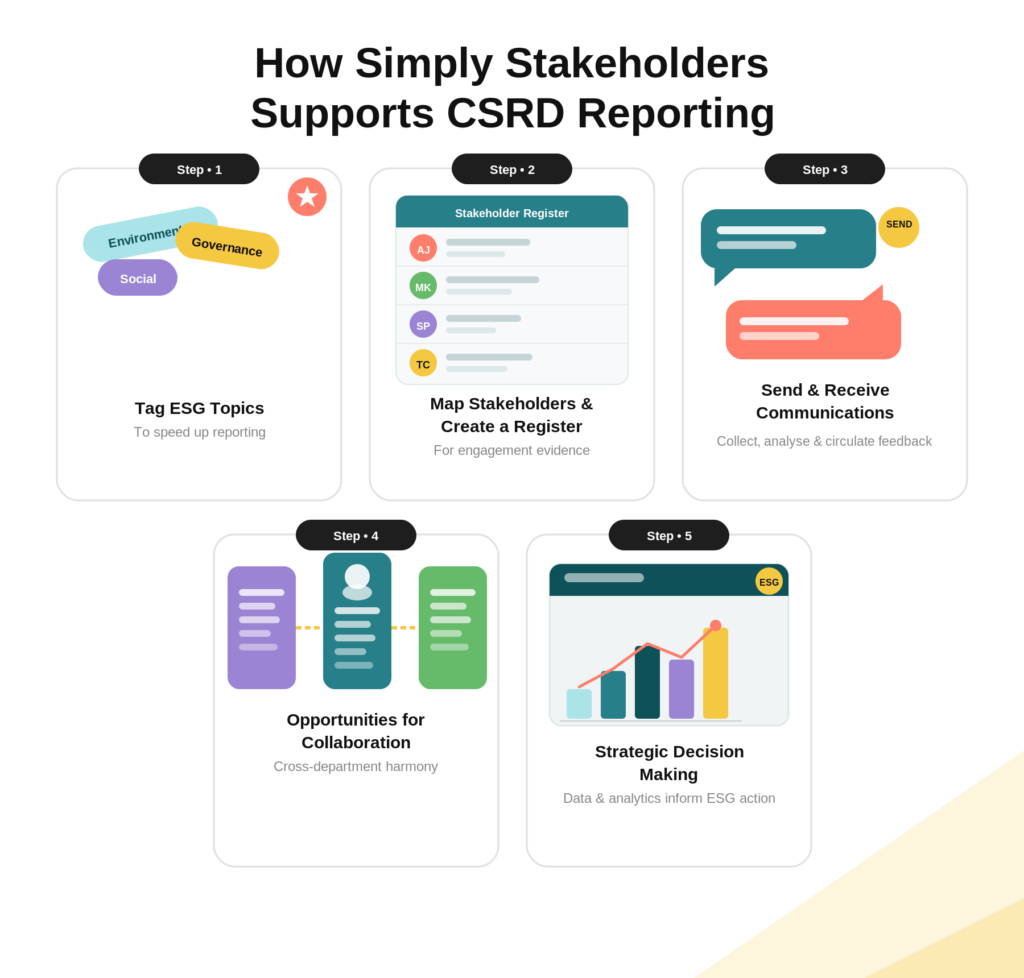
1. Tagging ESG topics
Speeds up the collation of report information by automatically organising key stakeholder interactions and data related to ESG reporting relevant to CSRD compliance.
2. Organizing and Mapping Stakeholders
Create effective stakeholder mapping visuals for CSRD evidence using an intuitive stakeholder register that records contact lists, relationships, and interactions.
3. Communicating With Stakeholders
Keep in touch with stakeholders and request feedback using email outreach and SMS messaging and built-in tools make it easy to create and circulate surveys.
4. Sharing Processes and Collaborating
Ensure cohesion and collaboration among cross-department teams responsible for stakeholder engagement by enabling them to capture and share lists, forms, templates, and automated workflows.
5. Real Data Decision Making
Simplify project tracking and speed up report creation. Custom dashboards and reports show the key metrics for CSRD reporting, which can be used as evidence for those stakeholders who use sustainability statements and reports.
Engaging Stakeholders for CSRD Reporting
CSRD reporting has mandated stakeholder engagement, making the management of stakeholder relationships and data more important than ever for organizations operating in or through the EU.
Now you understand why it’s important and exactly what’s expected to fulfil the double material assessment, the next step is formulating a specific stakeholder engagement plan that supports the CSRD.
Your next stop: ESG Stakeholder Engagement: A Vital Part of ESG Strategy.