Effective Stakeholder Meetings: Tips and Strategies for Success

Organizing and conducting effective stakeholder meetings contribute to building strong stakeholder relationships. And when there’s a solid trust-based relationship that underpins positive collaboration, projects are more likely to succeed.
If you’re in the phase of your project where you’re starting to plan your stakeholder engagement strategy, and wondering which style of stakeholder meeting is best, read on.
This article covers:
- The different types of stakeholder meetings
- Tips for preparing for each type of stakeholder meeting
- On-the-day suggestions to ensure the meeting is a success
- How stakeholder software helps organizations facilitate stakeholder meetings.
You’ll also hear from Simply Stakeholders’ CEO Allison Hendricks, with first-hand insights on how to keep meetings calm and productive, even when controversial topics are up for discussion.
Let’s begin by understanding what stakeholder meetings are and how they originated.
Stakeholder Meetings — Why They Matter
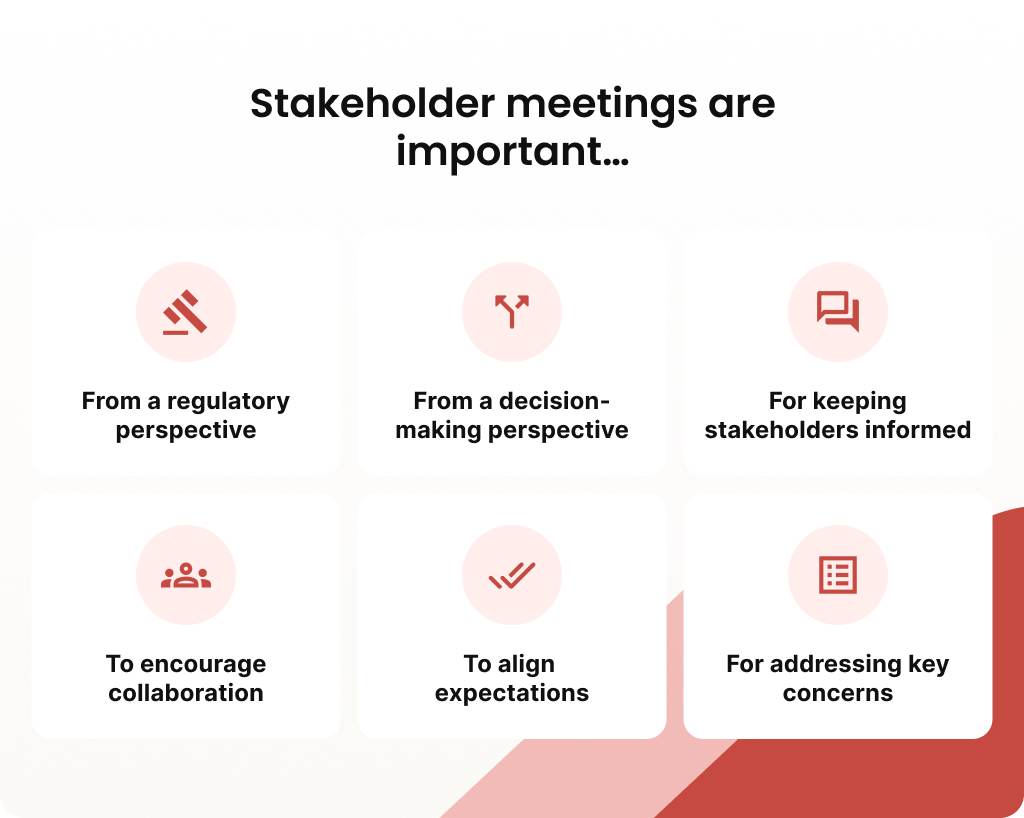
Stakeholder meetings are important to your project on two levels.
- From a regulatory and compliance perspective: Depending on the nature and scope of the project, consulting with communities, employees, shareholders, and citizens may be mandated to fulfil legal and compliance obligations.
- From a decision-making perspective: Stakeholder contributions bring fresh insights and experiences to the project that can inform better decisions and positively influence outcomes.
So, who should attend a stakeholder meeting?
Gather together any relevant stakeholder individuals or groups, internal or external. Because the meeting is a forum where everyone with a vested interest in the project and its outcomes can:
- Be kept informed: Regarding the project’s progress
- Align expectations: So discussions are approached respectively and productively
- Air or address key concerns: To establish common ground and meaningful outcomes.
They’re a chance to hear each voice and create two-way dialogue essential to building meaningful stakeholder engagement.
Active listening and meaningful dialogue can only happen when the meeting is well planned, well run, and productive. And historically, staging productive stakeholder meetings wasn’t (and sometimes still isn’t) all that easy.
The Town Hall Meeting Format (And Why It Desperately Had to Change)
For a long time, town hall meetings were the only form of community consultation. Predominantly used by government departments and larger organizations, in-person town halls were popular until the mid-2000s. Then fears around safety and questions around productivity saw the format evolve. Meetings moved to an online format or to open-day sessions that facilitated smaller group discussions.
But on or offline, ‘town halls’ still refer to meetings that attract a large audience and are chaired or hosted by officials linked to the project. The latter usually sit up front or on a stage and deliver information to the audience.
Given the structure described above, town halls regularly failed as a consultation method. With officials driving the meeting, stakeholders often reported feeling lectured to, or that they’d been presented with a fait accompli. Town Halls just weren’t seen as an opportunity to contribute in a two-way dialogue.
The high level of control or token Q&A sessions at the end of a meeting would lead to frustration, mistrust, and antipathy. Stakeholders felt unheard, resulting in anger and resentment towards the project and organization. Consequently, town halls were recognised as largely counterproductive and fell out of favor as an effective stakeholder meeting style. So, what’s replaced them?
Stakeholder Meeting Styles
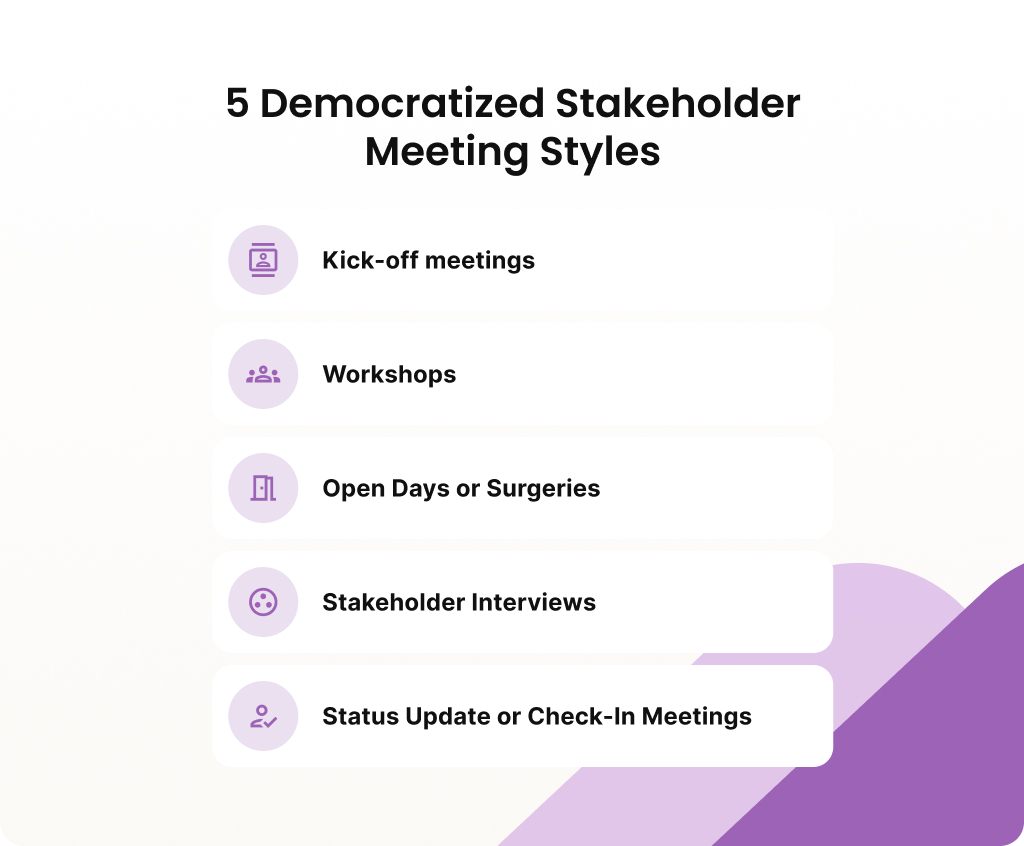
With town halls viewed as unproductive and unworkable, modern stakeholder engagement favors the following meeting styles to meet project goals, fulfil required stakeholder commitments, manage risks, and ensure positive progress within a project.
Kick-off Meetings for Internal Stakeholders
At the very start of a project, kick-off or launch meetings involving internal stakeholders bring the core project team together.
The purpose of this meeting is to:
- Confirm the project’s purpose and goals
- Highlight milestones and ideal timelines
- Ensure everyone involved is clear on their responsibilities
- Announce and clarify key people within the project and their roles.
Workshops — Flexible Format, Issue Specific
Useful for gathering ideas and problem-solving, workshops invite relevant stakeholders to table ideas that address a specific project challenge. Workshops are a proactive way to make sure people are heard. They also encourage creativity and provide a chance for organizations to hear outside perspectives.
Flexible in style, a workshop can run for a couple of hours, involve a small group of stakeholders, and be held in a municipal building. Or it can be a large, multi-day event with hundreds, sometimes thousands, of people joining in. Really, the scope and size of a workshop reflects the complexity of the topic that needs workshopping.
You may have heard of the ‘world cafe’ format
This style of workshop is more deliberative. Participants join small table group discussions on various sub-topics around the main topic under consideration.
World cafes work by intentionally connecting multiple perspectives on a topic and engaging participants in several rounds of small-group conversations.
Open Days or Surgeries — Town Hall Reimagined
Useful for larger-scale stakeholder meetings and consultations, open days or (for governments) surgeries echo the town hall structure, without the potentially divisive panel-audience format. Instead, presentation boards or handouts are placed around the room, and senior stakeholders — C-suite, planning, finance, engagement officers, etc — circulate and talk with members of the public and local community.
The drop-in, go-at-your-own pace approach is generally seen as a less polarizing method for information sharing, building or maintaining relationships, or repairing any damage done. They’re also an effective way to facilitate more one-on-one conversations between participants and subject matter experts.
Stakeholder Interviews — Small Scale, Loose Agenda
Interviews involve no more than 1- 4 stakeholders. They’re ideal for encouraging more reserved stakeholder groups to contribute their views, concerns, and ideas, or getting into greater detail on a particular topic. But their strength is also their downfall. With only a handful of voices being heard, opinion, perspective, and decisions may be limited.
It’s a good idea to have tentative questions or topics you’d like to address with the stakeholder. But interviews work best when the agenda is loose, and the stakeholder can drive the direction of the discussion.

Status Update or Check-In Meetings — Success, Challenges, and Projections
These meetings are to keep stakeholders informed about the project progress. Status update meetings may cover:
- Project successes so far
- Any changes to the project scope
- Any challenges or barriers the project faces
- Solutions being explored to overcome challenges
- Financial forecasts and data relating to the project to date.
The frequency of these meetings is driven by hitting (or missing) milestones and a timetable for reporting the overall progress of the project.
Stakeholder Meetings Are Better, But Not Perfect
Workshops, interviews, and open days are popular current formats, but they’re not without their drawbacks.
People still want town hall-style meetings to discuss proposed projects and plans. There is a demand for having a cross-section of stakeholders in the same room so people can hear and evaluate perspectives they may not have considered. But without careful control, these meetings can spiral into shouting matches or echo chambers.
On the other hand, smaller meeting styles allow a greater freedom to speak, but people may feel the conversation is being too forcefully led or too tightly controlled.
Ultimately, whatever the format, careful planning is the key to making your stakeholder meeting effective.
Preparing For a Stakeholder Meeting
It’s a corporate-world sin to call a meeting that could have been an email. Best not to be guilty on that score. But when a meeting accommodating a cross-section of stakeholders is called for, you’ll want to make sure your house is in order before sending out those meeting invites.
Here’s what to consider when preparing for a stakeholder meeting.
Identify Key Stakeholders
A stakeholder is any person, group, or organization impacted or influenced by, or having a legal or other right to be consulted and involved in the work you’re proposing to do. Within these groups, you’ll need to work out who your key stakeholders are. There is a subtle difference.
A key stakeholder is one who presents a higher potential risk or reward. In short, they’re critical to the success of your project. These are the people who need an invite to your meeting.
Recognizing who these people, groups, and organizations are starts with creating a whole stakeholder list. Narrow the list down using these key stakeholder identification techniques.

Set Clear Objectives and Goals
Being very clear about the purpose and scope of the meeting is the most critical preparatory step. It helps in two ways.
The first is practical. Clear meeting goals and objectives keep the event on track. Should discussions veer off course (which they inevitably will), a clearly stated objective and goal gives the meeting chair a focal point to bring everyone back to.
The second is psychological — managing stakeholder expectations. They may be ready to rock up to your meeting with an idea or opinion, completely irrelevant to the topic on the agenda or the goal you want the meeting to achieve.
Setting meeting objectives and goals helps attendees understand what to expect and what to bring to the meeting. This helps minimize the risk of the meeting veering off course or people leaving frustrated because they expected a particular (and different) outcome that was never a possibility.
| Real World Example: The Case for Up Front Transparency
Here’s Simply Stakeholders CEO and founder Allison Hendricks, on the strategy she used to ensure town hall meetings were as productive as possible. “Before developing stakeholder software, I worked as a stakeholder management and community engagement consultant. I was responsible for running community meetings. Sometimes the projects were highly controversial, the environment politically charged, and emotions were usually running high. Aware of this, I knew I needed to set clear objectives and goals. So the meeting would start with a slide divided into two columns. The first column listed points that the stakeholders could influence. The second outlines items that were beyond the scope of influence or even the project itself. Naturally, as the meeting progressed, tensions would rise, and when people shouted comments relating to points that couldn’t be influenced (e.g. We don’t want this project to happen!) I wouldn’t dismiss their concerns. I’d invite them to decide if they wanted to spend the meeting discussing that point and their desire to stop the project. But emphasise that the outcome wouldn’t change as those particular decisions had already been made. From here, I would then invite conversation to discuss the things that could be changed and influenced, which generally led to more productive, proactive town halls. While the initial reaction to my slide about what could and could not be influenced was often frustration and outrage, in the end, participants appreciated the transparency and honesty it offered.” |
Circulate an Agenda or Questions
Depending on the type of stakeholder meeting you’re running, you may want to send an agenda or questions you hope to address to meeting attendees beforehand. Giving stakeholders a chance to consider the points set to be raised paves the way for thoughtful, valuable, relevant discussion during the meeting.
Choose an Appropriate Location
The meeting place influences how at ease and energised attendees feel. As meetings are an opportunity for open and honest dialogue, you want to make sure the venue facilitates that.
Some points to consider when choosing a location are:
- Is the room big enough to accommodate everyone comfortably?
- Is it accessible for people with disabilities or those who have mobility challenges?
- Is recording equipment (assuming you’re using it) in the most unobtrusive place? So people focus on you and the discussions rather than worrying about the camera.
- Are the chairs comfortable enough for people to remain seated for the duration of (what could be) a long meeting?
- Is the venue easily accessible by public transport?

Assemble Necessary Materials — And Test Digital Ones
What are the physical and digital things you need for conducting the meeting? Think about items for people to refer to so they have the information they need during the meeting. Or materials you need so that you can collect, analyze, and evaluate the meeting while it’s in progress and afterwards.
Hardware and handouts may include:
- Information boards or models
- Paper and pens for participants to take notes
- Cameras and microphones, if the meeting is being recorded
- Printed flyers, booklets, or single-page handouts for each attendee
- A strong and stable internet connection for any part of the meeting that’s virtual.
Stakeholder Meeting Best Practices
You know who’s coming to your meeting, the style of the meeting, and how you need to prepare. But what about when the day rolls around? How can you ensure you and your stakeholders have a positive, productive experience that delivers solid outcomes all round?
Here are four meeting best practices that will help ensure a meeting that runs smoothly and makes the most of everyone’s time.
1. Make a Positive Start
Your opening sets the tone. So welcome people to the meeting and thank them for their time. It’s the polite thing to do. If you’re in Australia, then your introduction should include a Welcome to Country acknowledgement.
If you have a panel or presenters, introduce them before outlining the agenda. You should also use the start of the meeting to preframe the conversation.
Preframing isn’t about manipulating the discussion or making people feel boxed in. It’s about managing stakeholder expectations and ensuring everyone is on the same page when it comes to the meeting objectives and goals.
2. Facilitating Effective Communication — Listen, Share, Respond
Stakeholder meetings are only useful when individuals and groups actively participate in dialogue. Use these methods to nudge positive stakeholder communication along.
- Active listening: Focus on what’s being said rather than thinking about the next question, allow pauses, non-verbal cues, and keep eye contact.
- Share insights: Whether it’s data, analysis, or forecasting, be transparent to encourage open and honest communication.
- Engage in discussion: Be prepared to answer questions that arise and address concerns.
- Prepare open-ended questions: To lead the conversation or encourage hesitant stakeholders to contribute.
- Remain on topic: Leading a meeting means helping participants stay focused on the point of discussion and minimizing distractions.
3. Managing Feedback and Issues
Not every stakeholder, individual, group, or organization may have the same expectations and opinions about the project or plans you want to discuss. You can lay the groundwork for minimizing potential conflict by using strategic stakeholder relationship-building techniques. But meeting facilitators shouldn’t shy away from acknowledging and defusing challenging stakeholder feedback or issues in the moment.
When debates kick off, it’s important to handle them tactfully but clearly, so differences of opinion or disputes don’t derail proceedings and (hopefully) get resolved.
During your meeting, try to:
- Allow time for questions and answers
- Acknowledge differences of opinion rather than dismissing them
- Identify common ground during moments of escalating tension
- Give stakeholders the means to confidently and comfortably offer feedback
- Record feedback and issues
- Bring people back to the meeting agenda.
4. Verbal Summary and Wrap-Up
Signal the meeting is drawing to an end by spending a few minutes summarizing the main discussion points, agreed actions, and next steps.
If possible, tell attendees when they can expect a copy of the meeting minutes or where they can find information regarding the outcomes of the meeting. (On a website, via email, a typed letter, follow-up phone call, etc.)
Finally, thank everyone in attendance for their time and participation.
Post-Meeting Follow-Up
When you’re in the middle of a meeting it’s not always possible to process everything that’s said or decided. Following your meeting, take these post-meeting steps to help people see that all the talk is resulting in action.
Summarizing Meeting Outcomes
Circulate a meeting summary promptly once the meeting ends. Ideally, you already know how your stakeholders prefer to be contacted. If in doubt, send an engaging email.
Include the meeting minutes in this correspondence, along with a summary of the key discussion points, main outcomes, and action items. For action items, you may also need to let people know how they can track any progress.
Action Item Progress Tracking
Stakeholder relationship management software that includes task management makes it easy for organizations, governments, and non-profits to assign and track tasks raised during a stakeholder meeting. This ensures transparency and allows stakeholders to keep organizations accountable.
Perhaps progress is tracked using online tools. Accountability may come from communicating that progress via:
- Email or printed newsletter updates
- Phone calls or follow-up meetings
- Detailed progress reports.
Again, how this information is best communicated should be guided by stakeholder preference.
Using Software for Stakeholder Meetings
Stakeholder meetings have evolved way beyond the original, clunky town hall format. The power of stakeholder collaboration in ensuring the success of a project is better understood. And this has led to engagement practices, forums, and meeting methods that better facilitate two-way conversations, leading to more broadly endorsed and meaningful outcomes.
Technology has played an important role in the evolution of stakeholder meeting methods. Video calls, improved and less intrusive recording methods, and the ability to manage volumes of data more effectively help to capture reliable accounts of meetings and interactions. As a result, meetings are more accessible, transparent, and productive.
Level-Up Your Stakeholder Meetings
When you’re ready to see how stakeholder relationship management software can assist during your meetings, let us know. The Simply Stakeholders team is ready to help and walk you through a demo of our communication and collaboration tools.