The 3 Key Trust Building Components of A Community Engagement Plan

Project management research indicates that poor community engagement and flawed stakeholder management are major contributors to roughly 70% of failed, planned projects.
When the success of your project relies on community stakeholder support, a solid community engagement plan is vital. And by ‘solid’ we mean one that:
- Elicits levels of community participation that give you the responses and requisite social licence (SLO) to operate
- Builds and maintains trust between the organization and the community stakeholders affected by the planned project.
This guide champions the three core stakeholder relationship principles that should underpin every community engagement plan. And it offers practical suggestions on how to include those principles in your framework.
Looking for information on how to write a community engagement plan? Then stick around. We’ve got that, too. But let’s start with the basics.
What Is Community Engagement?
Community engagement is the strategic approach an organization takes to build relationships with community-based stakeholders. It focuses heavily on developing communications and managing interactions, but shouldn’t be confused with a stakeholder communications plan.
Done well, community engagement drives positive collaboration that achieves specific outcomes for the organization and for the community.
The UN’s Community Engagement Guidelines sum up community engagement as follows:
“Community engagement” is a strategic process to directly involve local populations in all aspects of decision-making, policy development and implementation to strengthen local ownership, capacities and community structures as well as to improve transparency, accountability and optimal resource allocations across diverse settings.”
Who Are Community Stakeholders?
There are two community stakeholder categories: a community of place and a community of interest.
Community of place stakeholders: These are groups based on common geography, such as country, state, region, suburb, or neighborhood. Project managers and stakeholder engagement officers may refer to them as ‘neighbour stakeholders.’
Community of interest stakeholders: These groups share a common interest, such as customs, values, religion, lifestyle, etc. Common interest stakeholders may include citizens, businesses, residents, investors, employees, and so on.
The type of community stakeholder group you’re liaising with influences how you shape your engagement plan and the strategies you’ll use to engage them.

How Community Engagement Drives Project Success
Depending on the scope of the project, community engagement may form part of meeting legal obligations. For example, involving First Nations groups when Native Title land is involved is a legislated form of community engagement; without it, the project sets itself up for failure. However, in this article, we’re focusing more on why community engagement plans are a wise ethical business decision.
Research by KPMG and the Project Management Institute proves there’s a strong link between stakeholder satisfaction and project success. And this makes complete common sense. Stakeholders who are actively involved in a project are more likely to support it, resulting in the organization or project gaining SLO. But community acceptance is only one aspect of why community engagement matters.
Robust community engagement paves the way for:
- Increased trust: Engaging with community members demonstrates trust-building openness and transparency
- Positive social responsibility: Understanding and appreciating local social, environmental, and economic factors increases naturally as a result of community engagement.
- Better decision making: An engaged community offers information and perspectives that the organization may not have considered.
- Successful conflict management: It’s easier to pinpoint and navigate potential conflicts, find common ground, and overcome obstacles to keep the project moving forward.
The Long-Term Benefits of Gaining Stakeholder Trust
Trust isn’t gained overnight. As with any human relationship, it takes time to earn and build it. We’ll look in detail at how to achieve that, but let’s take a moment to understand why gaining stakeholder trust is often project-critical and the long-term benefits of putting that work in early.
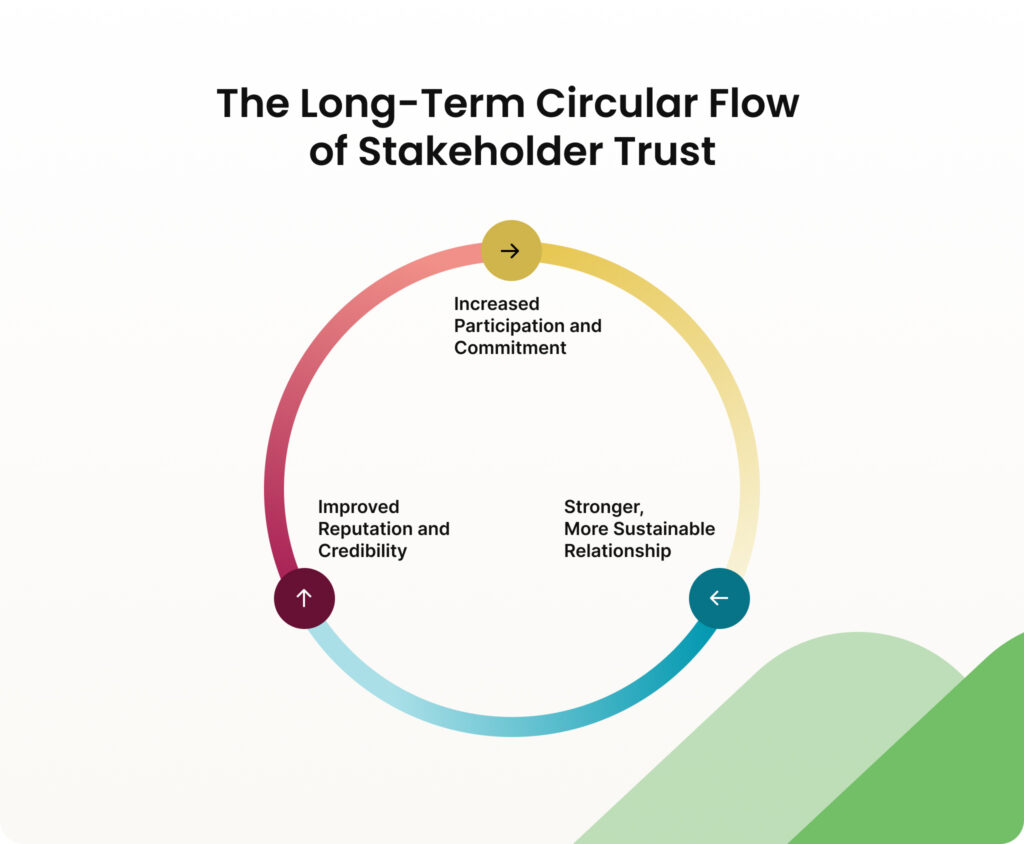
Embedding the three key principles of community stakeholder management in your plan unlocks a project-long, life-cycle of benefits.
Increased Participation and Commitment
A community that trusts an organization or government is more willing to participate actively and consistently. Requesting that participation is often the starting point. But over time if trust remains solid and a relationship is built, free-flowing, two-way dialogue ensues. This invaluable interaction ensures consistent collaboration, which potentially leads to greater outcomes for both parties.
Stronger, More Sustainable Relationships
When a community participates and commits, quality decision-making is easier. Those calling the shots are kept fully informed. In the long term, this means fewer changes or reviews — the best solutions and options are already in place.
And when change is needed? Finding and implementing solutions is simpler due to the strength and depth of the relationship. Ongoing partnerships and collaborations often result in positive change for the lifetime of the asset or project.
Improved Reputation and Credibility
Strong, sustainable relationships naturally lead to improved reputation and credibility. The community trusts you, and projects are successfully completed.
There’s a knock-on effect from successful community stakeholder engagement. Outsiders see an organization with SLO, transparency, and strong governance — important aspects for attracting new collaborators, resources, and future project support.
The 3 Key Trust-Building Components Every Engagement Plan Needs
Creating a solid community engagement plan that delivers the long-term benefits just mentioned means embedding these three fundamental stakeholder management principles into your plan.
1. Transparency
Transparency should never be only a compliance check-box exercise. It’s an ethical business decision that leads to stronger outcomes.
Organizations and local governments that are forthcoming with the goal, processes, and expected outcomes of their project reduce the likelihood of stakeholder confusion, anxiety, and distrust. And research shows repeatedly that transparency builds stakeholder trust and confidence.
Embed transparency into your plan by:
- Providing clear and consistent information: Without overwhelming stakeholders.
- Choosing appropriate means of communication: Make these accessible and appealing to the community.
- Publishing contact details: Ensure organization representatives and project leaders are contactable and available for consultation.
- Staying in touch: Share evidence, metrics, and evaluation methods as well as updates on how progress is being monitored.
- Addressing challenges head-on: Taking early action when challenges arise, ideally before they become public, and being honest about setbacks.
2. Feedback Loops
It’s one thing to engage a community and claim to have listened. It’s another to create a feedback loop that collects, analyses, and acts on the input provided by the community concerned.
Whether it’s through interviews, surveys, written correspondence, or another stakeholder meeting format, the first step is gathering the perspectives of the community. Then create the loop.
Choose the most efficient tools and relatable professionals to analyse the feedback. Wherever possible, act on it to remedy or improve the situation. Then feed those changes back to the community.
Embed feedback loops into your plan by:
- Identifying the key community stakeholder groups: Who you need feedback from and at what stage, as well as deciding the best communication channels.
- Defining the project goals and metrics: So feedback questions and methods align with stated goals and can be clearly communicated to stakeholders.
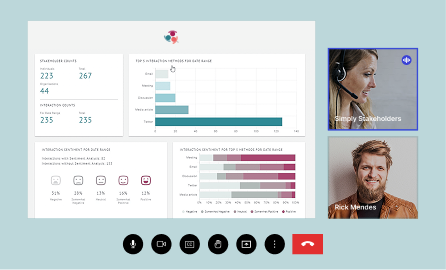
- Centralizing feedback: Use stakeholder feedback and sentiment analysis tools, such as Simply Stakeholders, to capture and review feedback.
- Summarize and distribute feedback: Acknowledge feedback gathered and be proactive about next steps.
- Set feedback schedules and milestones: Dates and timelines for additional feedback and when any action prompted by feedback will be completed.
3. Authentic Storytelling
Any marketer will tell you that people buy from people. Sure, reported information and data give people the nuts and bolts details. But human-centred testimonials, case studies, and real-life stories make the project relatable. Your community engagement plan shouldn’t be without this trust-building component.
Immersive content, such as photos, videos, site talks and walks, and community events, enhances awareness and helps people connect to the project on a personal level. Storytelling also allows you to frame the narrative, helping those who are sceptical see a different perspective.
Embed storytelling into your plan by:
- Developing a narrative: Think about how you want stakeholders to think or feel about your project or organization.
- Understanding your stakeholders: Knowing what motivates them and what they value will make it easier to find relevant stories.
- Highlight positive change: As the project progresses, show people at a local and community level what changes they can see or feel already.

Real Results: When a Community Engagement Plan Works
Simply Stakeholders provides stakeholder relationship management (SRM) software for several large and potentially divisive energy industry projects. Wind farm developments are often the most complex.
For these projects, community engagement plans are more than a regulatory necessity. They’re a critical part of progressing the project. Without community engagement and support, the project is likely to stall or worse, fail.
For one large Australian wind farm developer, using Simply Stakeholders allowed them to easily:
- Manage stakeholder data
- Gain stakeholder insights and predict potential issues
- Track complex stakeholder relationships
- Record stakeholder sentiment.
The developer needed specific tools to support community consultation and track engagement. As befitted a project of this complexity, this engagement included conducting community meetings, sending project updates to stakeholders, and visiting landholders and neighbours to keep them up to date with the project progress and maintain trust and relationships.
They included stakeholder management software in their community engagement plan as a central source of truth holding all vital data, including everything relevant to the community and their feedback. The result? The developer maintained transparency and trust throughout the project
Read: Stakeholder Software for Wind Farms (a case study).
Building a Community Engagement Plan
Trust is at the centre of a successful community engagement plan. And trust is fostered by using these three key stakeholder relationship components:
- Establish and maintain transparency
- Establish feedback loops
- Include authentic storytelling.
Stakeholder relationship management software can support the design, framework, and implementation of your community engagement plan.
When you’re ready to take the next step and create the plan itself, we’re here to help.
Our comprehensive guide Mastering Your Stakeholder Engagement Plan dives deep into the benefits, strategies and processes needed to create your own plan – even for complex, high-stakes engagement.