ESG Stakeholder Engagement: A Vital Part of ESG Strategy

Some sections of the global community want you to believe ESG is dead. It isn’t.
In fact, environmental, social, and governance (ESG) plans and frameworks are more relevant than ever. Mandatory directives and voluntary frameworks support the practical and ethical sustainability processes that matter to stakeholder groups, including customers, employees, and investors.
This article addresses the specific and crucial role of ESG stakeholder engagement. It champions engagement as crucial to fostering collaboration and acknowledges the role of stakeholders in forcing accountability and enabling long-term growth.
But first, let’s define what ESG stakeholder engagement is.
What Is ESG Stakeholder Engagement?
ESG stakeholder engagement involves speaking to and working with stakeholders who have a direct interest in an organization’s environmental, social, and governance work, policies, processes, and commitments.
Organizations will use stakeholder engagement methods (surveys, interviews, workshops, etc) to elicit and encourage stakeholder feedback. Then they evaluate that feedback and apply it to help shape and progress their ESG strategy, as well as satisfy mandatory ESG regulations.
Who Are ESG Stakeholders?
ESG Stakeholders are a mix of internal and external stakeholders.
They include:
- Employees
- Board members
- Shareholders
- Suppliers
- Customers
- NGOs, communities, and the general public
- The media
- Educational institutions
- Local and national governments, or international governing bodies and organizations.
The groups you’ll engage with will depend on whether you’re working on the environment, social, or governance part of your strategy.
Here are some brief examples of how different ESG stakeholders may engage with each part of your strategy.
Environmental (E)
The environmental part of ‘ESG’ assesses a company’s sustainability standards and practices. It concerns carbon and greenhouse gas emissions, how the organization protects or supports biodiversity, and the steps taken to minimize operational impact on the environment.
Stakeholders relevant to this work could include:
- Employees
- Conservation groups
- Suppliers.
Engaging stakeholders on environmental plans might involve:
- Asking staff for improved waste management ideas
- Meeting with suppliers to discuss their processes
- Consulting environmental engineers to come up with solutions to meet legal environmental obligations.

Social (S)
Stakeholder engagement and management are often most strongly associated with the ‘S’ in ‘ESG’. It concerns the human, social aspect of the strategy, such as fair treatment of employees, relationship building with communities, and trust created between the organization and its customers.
Stakeholders relevant to this work may include:
- Employees
- Labor unions
- Human rights organizations.
Achieving social compliance may involve ensuring fair wages and offering equal opportunities. In essence, the ‘S’ in ESG covers all the ongoing work that protects human and employee rights so operations are fair, ethical, and compliant with international standards.
Governance (G)
Governance covers the structure and running of the company, its ethics, and how it’s managed. Being governance compliant matters to a huge range of stakeholders.
Stakeholders who may be engaged to assist with governance compliance could include:
- Investors and shareholders
- The board and C-Suite
- Employees
- Government organizations
- Customers and clients.
Engagement on this level may involve circulating company information, providing opportunities for feedback on organizational management, and publishing financial reports to ensure transparency.
Stakeholder Engagement Strengthens ESG Efforts
Gathering and heeding perspectives and voices of a wide range of stakeholders empowers your organization’s ESG efforts. It provides fresh insights you may not have otherwise found and data that can support your work. And that’s just for starters.
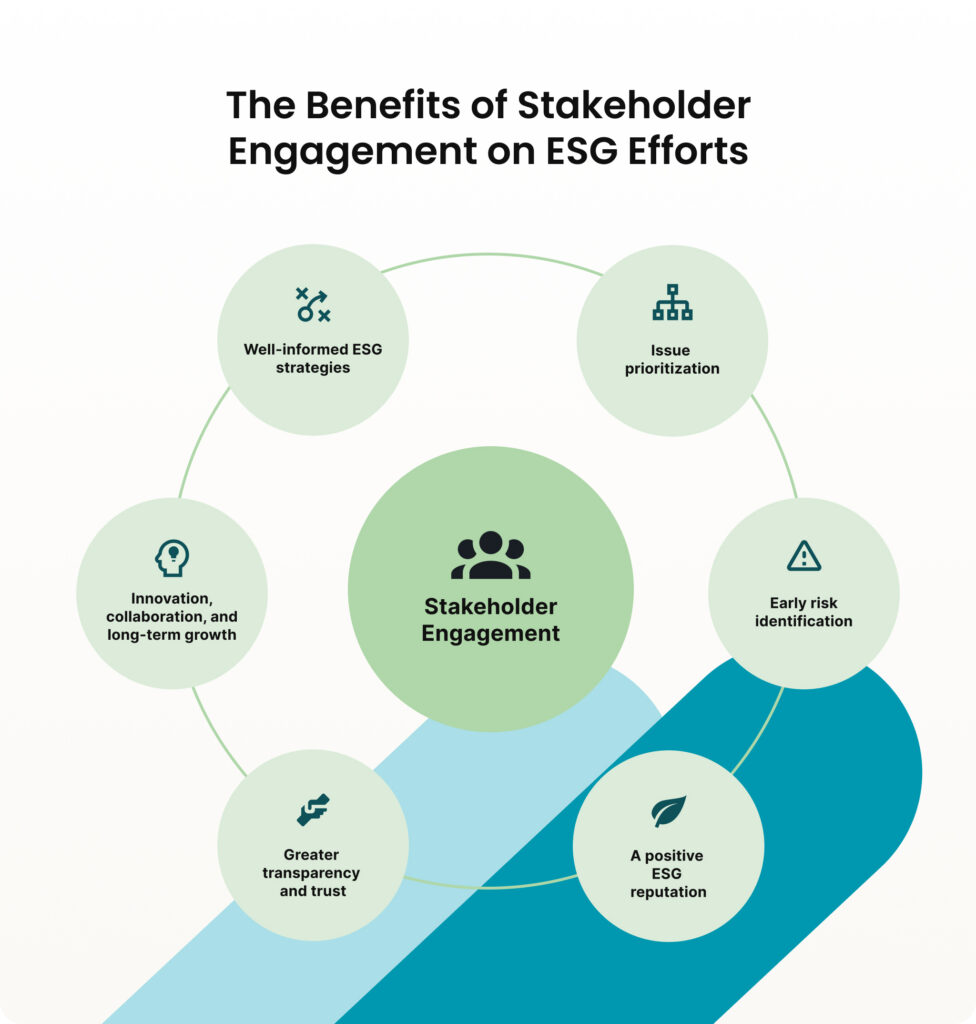
Well-Informed Strategies
A strategy based on perceptions, feelings, and what your competitors may or may not be doing is a recipe for struggle and potential failure.
Organizations that actively incorporate the voices, thoughts, and opinions of the people who work in it, for it, or with it in their ESG strategy are more likely to take practical action and achieve relevant outcomes.
ESG Issue Prioritization
Stakeholders will value some ESG issues more highly than others. By asking them what matters most to them, organizations can prioritize work on these issues, enhancing trust, credibility, and impact.
Early Risk Identification
The sooner a risk or challenge is identified, the easier it is to manage or resolve. Regular and ongoing stakeholder dialogue helps you catch that work earlier. Genuine, transparent two-way communication around fledgling problems and issues can help avoid larger crises, financial repercussions, or failure to meet regulatory compliance.
Positive ESG Reputation
Instances of greenwashing, pinkwashing, and blue washing have fuelled ESG strategy scepticism. Demonstrably fulfilling the stakeholder-supported commitments outlined in your plan is the best way to keep your ESG reputation intact.
Anchoring your brand image in honesty and transparency protects existing relationships. And may even attract future stakeholders and investors looking to engage with genuinely ESG-conscious organizations.

Transparency and Trust
Some ESG regulations have stakeholder engagement built into the framework — compliance relies on it. (More on that point in a moment.) But ESG stakeholder engagement is more than a mandatory check-box exercise.
Stakeholder consultation is an ethical business decision. It promotes transparency and shows a genuine commitment to ESG practices.
Innovation, Collaboration, and Long-Term Growth
ESG work is open-ended. It evolves as conditions change inside the organization and may also reflect changing global attitudes.
Keeping the strategy relevant to stakeholders means nurturing the relationships that inform ESG ideas and actions. And when there’s a complex ESG challenge, it’s these relationships that foster innovation,deliver workable solutions, and lead to long-term growth and shared benefits.
Regulatory Compliance and Stakeholder Engagement
ESG stakeholder engagement may be optional or mandatory depending on the framework an organisation is following. Where stakeholder engagement is baked into the terms, an organization must comply to avoid penalties and fines. In some instances, stakeholder engagement is mandatory to be ESG compliant.
Corporate Sustainability Reporting Directive (CSRD)
The EU’s CSRD was introduced in 2022, and as many as 50,000 companies across the bloc must provide evidence of complying with the directive by 2028.
According to the EU’s CSRD directive site, ‘the necessity of engaging stakeholders cannot be overstated.’ Sections that explicitly mandate stakeholder engagement include:
- ESRS 1 (General Requirements) – Companies must complete a materiality assessment that includes the views of stakeholders regarding impact materiality, financial materiality, and the intersection of the two.
- ESRS 2 (SBM-2) – Mandatory reporting of stakeholder engagement, which details how relevant stakeholders are identified, how engagement is conducted, engagement purpose, and how stakeholder engagement results and concerns translate into ESG action.
SEC Climate-Related Disclosure Rules
The US-based SEC Climate-Related Disclosure Rules have been rolled out by the Securities and Exchange Commission. Its Final Rules standardize the way public companies disclose risks and impacts of climate-related matters. The aim is to better protect investors, maintain fair markets, and promote capital formation.
The mandated Final Rules state that:
- Regulation S-K, (Item 1501) – Companies must disclose details about board and management governance of climate-related risks and the material impacts of these risks.
- Regulation S-K, (Items 1502-1503) – Companies must disclose the climate-related risks that have had or are likely to have an impact on the business strategy, and describe the activities the company has taken to mitigate these risks or adapt to them.
Australian Sustainability Reporting Standards
Managed by the Australian Accounting Standards Board (AASB), recently mandated sustainability reporting standards require all qualifying companies to disclose information on climate, modern slavery, gender equality, and greenhouse gas emissions.
ESG stakeholder engagement is part of compliance, with the standards saying:
- AASB S2 – Stakeholder engagement forms part of the materiality process. Surveys, focus groups, interviews, and feedback loops provide evidence that stakeholder views have been gathered, considered, and prioritized logically.
6 Methods to Successfully Engage ESG Stakeholders
Having defined the ‘what’ and ‘who’ of ESG Stakeholder management and outlined the benefits, let’s move on to practical methods for engaging stakeholders. Specifically, how those methods support ESG work.
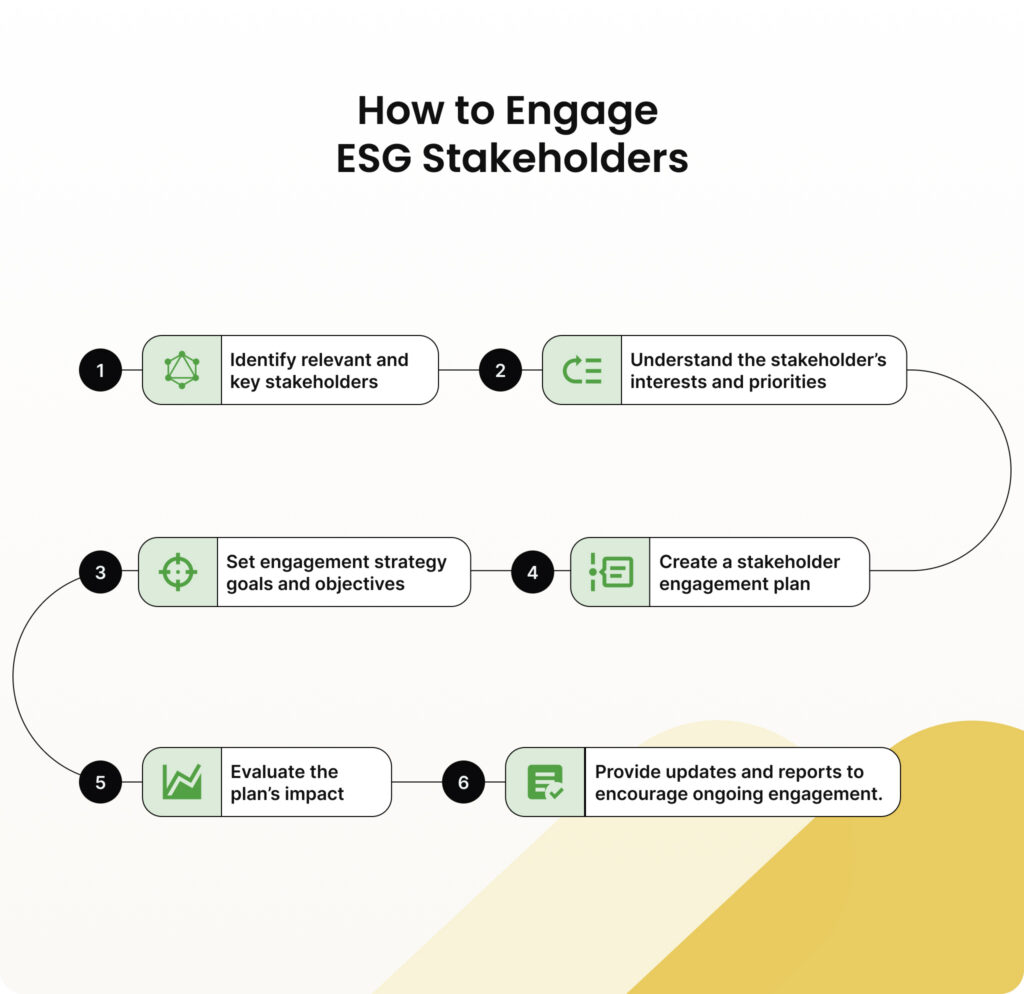
1. Identify Relevant and Key Stakeholders
People engage more readily when they feel they can make a valuable contribution to an issue or a situation that actively aligns with their values or impacts their lives. Identifying the stakeholders for whom the specific environmental, social, or governance issue you’re working on is most relevant instantly increases your chance of successful, meaningful engagement.
Find all the relevant people by referring to your stakeholder register. Then use stakeholder mapping or an influence matrix to establish who the key stakeholders are. These are the people with the greatest potential to influence your work. Work out how they may impact your ESG strategy or reporting.
2. Understand Stakeholder Interests
Surveys, interviews, and whole stakeholder meetings give stakeholders a forum for airing their perspectives and raising concerns around the issues that matter most. Organizations likely to gain stakeholder support are the ones who listen, understand, and acknowledge stakeholder needs in their ESG strategies and present ways to meet them.
Managing different (and sometimes complex) needs of each stakeholder group requires transparency and tact. It involves knowing which interests to act on, which to shelve, and how best to communicate those decisions.
3. Set Strategy Goals and Objectives
Engagement works best when you know two things. Firstly, what you want and need to achieve, and secondly, how to feed the results of that engagement back into your ESG strategy. Set engagement goals and objectives, defining how these align with the organization’s strategic ESG objectives.
Clear, value-aligned goals and objectives will also keep the organization accountable and deliver measurable analytics for tracking progress.
4. Create a Stakeholder Engagement Plan
A stakeholder engagement plan documents how an organization will engage with its stakeholders and why that work is important. In the case of ESG, it concerns the methods and strategies that facilitate useful, meaningful engagement, two-way communication, and open dialogue. The engagement plan should also note the resources and methods needed to capture and evaluate feedback that results in actionable reports.
5. Evaluate the Plan’s Impact
Tracking the outcomes of planned engagement shows you
- What’s worked, so you can do more of that
- What hasn’t worked, so you can refine or change that.
Analyzing and evaluating stakeholder data and sentiments gathered from initial engagement can inform and enhance future outreach.
How regularly you revise the plan depends on:
- The scope of the project: Its planned duration and the volume of stakeholders involved
- The size of the engagement team: Larger teams are likely to be able to review engagement plans more often than smaller teams or those with stretched resources.
6. Provide Updates and a Results Report
When stakeholders see that the engagement they’ve invested is making a difference in your ESG plan and work, they trust and support you. Providing project updates and publishing reports that share how stakeholder engagement has been incorporated, lessons learned, and outcomes achieved, will keep people on side and encourage future participation.
The Challenges of ESG Stakeholder Engagement
Engaging stakeholders can be challenging. Lack of everyone’s time (employees and stakeholders), scarce resources, flagging inspiration, and sometimes tight budgets affect how successfully an organization can engage its stakeholders.
Before we look at some examples of companies that navigate these challenges successfully, let’s acknowledge that the sometimes delicate and controversial nature of ESG topics presents a challenge you may not face in other stakeholder engagement initiatives.
Mishandling ESG stakeholder engagement risks relationship and reputational damage. Fear of getting it wrong leads some organizations to believe it’s easier not to involve stakeholders. Instead, they opt for marketing techniques that give the appearance they’re fulfilling ESG duties. (E.g., greenwashing.)
Engaging stakeholders to inform ESG strategies is vital to getting it right.
Case Studies: Examples of ESG Stakeholder Engagement
Many companies and organizations are using inspiring and creative ways to ensure ESG stakeholder engagement. Here are three examples.
Patagonia
Outdoor adventure apparel company Patagonia, has strong ESG values and frameworks. Stakeholder engagement initiatives that support those values include:
- Shop Informed: This helps customers become more responsible shoppers.
- The Worn Wear program: Stakeholders are encouraged to resell Patagonia items they no longer need, or buy listed pre-loved items. The program stops Patagonia clothing from going to landfill.
- Forced labor and climate risk reports: Patagonia regularly reviews and publishes these on its website, maintaining transparent communication on two of ESG’s most pressing global issues.
Intrepid Travel
Adventure travel company Intrepid embeds sustainability and social impact into its business model by:
- Publishing its Integrated Annual Report: Intrepid stays transparent by publishing data and information on the company’s carbon emissions and the steps it’s taking to further minimize its environmental impact.
- Supply chain reviews: Articles about how Intrepid reviews its entire supply chain to work with more local, independent, values-aligned businesses appear on the company website.
- The Good Times blog: A space where customers, employees, suppliers, and local guides can share their adventures and Intrepid-specific stories.
Cisco
Networking, cybersecurity, and AI technology company Cisco embraces stakeholder engagement to support its ESG efforts by:
- Launching the 40 Communities initiative: To bridge the data and digital divide, Cisco’s 40 Communities initiative involves getting feedback from and working with stakeholders such as customers, partners, and local leaders in communities around the world.
- Weekly Check-Ins: These give employee stakeholders a chance to feedback to the company, supporting their social and governance commitments.
- Collaborating with like-minded groups: A comprehensive list of the initiatives, organizations, and NGOs they collaborate with to advance environmental and human rights practices within the technology industry is on their website.
Stakeholder Engagement Brings ESG Success
Tackling environmental, social, and governance issues and challenges can be complex and controversial. Early stakeholder engagement can relieve some of the tension and show empathy and understanding.
Genuine, sustained collaboration with stakeholders lets organizations set and achieve ESG goals that matter to and impact everyone. But as we’ve seen, these aren’t the only positive outcomes.
Engaging ESG-relevant stakeholders can improve brand visibility and approval, build and maintain trust, and even minimize risk.
Simply Stakeholders: Smarter ESG Stakeholder Engagement
Stakeholder relationship management (SRM) software provides powerful tools that support effective stakeholder engagement — during ESG projects and beyond.
Stakeholder mapping, AI-driven issue detection, and advanced insights make sure your methods of engagement are well-timed, properly curated, and align with the needs of your stakeholders.
When you’re ready to find out more.