The Catalysts, Technologies, and Challenges Involved in Local Government Digital Transformation

The prospect of changing systems and processes that have been in place for decades can feel like an intimidating task. But local governments and municipalities must take steps to embrace a digital-first mindset so they can increase efficiency and better serve both employees and constituents.
Done well, digital transformation at a local government level can present exciting opportunities. It’s a chance for stakeholders, government officials, and the local community to collaborate — finding ways to transform the services they use every day. For instance, the technologies replacing legacy systems can improve data collection to enable better, faster decision-making. And improving built-in security systems will hopefully lead to greater trust and peace of mind for communities.
Perhaps you’ve been tasked with leading or supporting digital transformation in your own local government organization. It’s a critical task that will have far-reaching impacts. So, what’s involved in a digital transformation? And what sort of technologies can help?
This guide will answer both of these questions and by the end of it, you’ll be a step closer to becoming a local government powered by digital. We’ll explore:
- What it means to undergo a digital transformation
- The common catalysts that drive a change
- Which technologies local governments are using
- Potential barriers that can slow digital adoption and how to overcome them
- Practical steps local governments can take to implement a digital transformation.

What is Digital Transformation in Local Government?
Digital transformation means adopting a digital-first mindset. It involves reimagining processes, services, assets, and deliverables using digital technology. And anything that’s still analogue is reformatted for digital. (Because honestly, dealing with reams of paper is both a nightmare and a security risk.)
Digital transformation at a local government level can include:
- Automating manual processes
- Setting up online permitting
- Delivering document management
- Holding online town hall meetings
- Providing interactive website content
- Implementing a stakeholder CRM for improved coordination
- Crowdsourcing ideas and feedback on local projects and issues
- Establishing programs that ensure digital inclusion for all residents
- Setting up AI-powered chatbots to assist with commonly asked questions
- Delivering a mobile-first experience and apps for anywhere, anytime access.
For local governments, meeting constituents’ needs is the driving force for digital transformation. But this is rarely the only catalyst.
The Driving Forces Behind Change
Moving away from legacy processes and technologies happens when either the government workforce or the constituents realizes the current system is no longer fit for purpose. And with approximately 4.3 billion people owning a smartphone, the majority of the global population now expects to be able to complete almost any task with the help of technology.
Local governments offer and deliver thousands of services and processes. Those adopting a digital-first outlook recognize that some of these tasks can be done digitally. The result is an agile local government that’s more efficient, transparent, and responsive to the needs of constituents, as well as the workforce.
What’s Driving Digital Transformation At Staffordshire County Council?
Staffordshire County Council (SCC) is a UK-based local government. They began their four-year digital transformation journey in 2024. But what’s driving the need for such radical, long-term change?
The publication of their Digital Innovation Strategy provides constituents and stakeholders with their why. This extract is taken from their strategy.
“Our vision for the future is that Staffordshire County Council will drive digital excellence to enhance our services, fostering inclusivity to build a smarter more connected future for our communities and workforce.
We want to make the most of the opportunities that digital offers to empower our frontline workforce to support our most vulnerable residents and promote independence, ensuring new technology enhances and complements our human workforce.”
Elsewhere in the report, they acknowledge that cost, environmental considerations, and accessibility are also key motivators. And this final point is important to note.
Digital transformation involves modernising processes and embracing digital technologies for a (largely) tech-savvy community. But as SCC acknowledges, a successful digital transformation shouldn’t happen at the expense of those who may find the transition difficult. A balance needs to be struck. But more on that shortly.

5 Constituent Expectations of a Digital Savvy Local Government
Constituents or local communities expect the following from their local government:
- Efficient platforms: Efficient and functional platforms that allow easy completion of essential tasks, such as form filling, booking appointments, and finding government-related information.
- Security: A secure environment and reassurance that any data shared or collected is protected.
- Ease of access: To complete local government-related tasks at a time that suits them and using a device they’re comfortable with.
- Better value: Digital technologies that result in costs being saved, leading to a redistribution of the budget.
- Greater sustainability: Greater steps towards sustainability and better environmental considerations with the assistance of data collection and analysis technologies.
4 Workforce Expectations of a Digital Savvy Local Government
Following digital transformation, staff working for local government will expect:
- Efficient work: Streamlined workflows that maximise functionality and efficiency, freeing up staff time to focus on high-value tasks.
- Regulatory compliance: Platforms that comply with national data security regulations.
- Insights: Access to data, analytics, and local insights that are necessary for decision-making.
- Access: Remote work access, so employees can continue their responsibilities even when they’re not in government offices, and don’t need to rely on paper forms or legacy systems.
Now that we know what digital transformation is, let’s look at the technologies involved that make it a reality.
The Technologies Used For Digital Transformation
Digital transformation can involve a number of technologies. Any that are chosen will need to meet the needs of the government and the constituents — and many of them will need to integrate with other systems to support critical functionality.
What follows is a list of game-changing technologies — technologies that have the power to speed things up, protect budget, improve government-community relations, save the planet, and shield people from cyber criminals. You’ll find a short description of what each technology does, as well as an example of a local government putting it to good use.
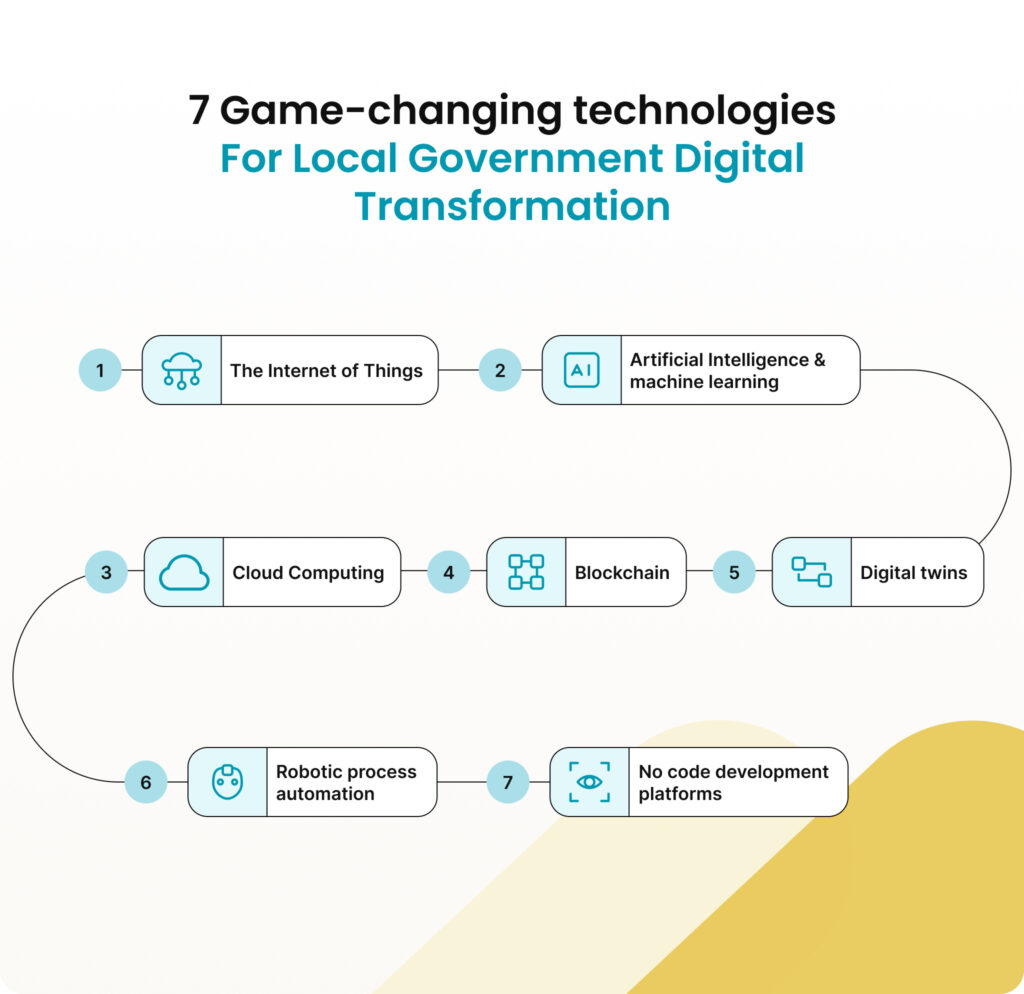
The Internet of Things (IoT)
If your local government is aiming to become a ‘smart city’, it’ll likely implement a network of interconnected devices. More commonly known as IoT.
The IoT helps to optimize the way infrastructure, services, and public administration is managed and delivered in real time. This technology can include things like monitoring air quality and delivering public transport updates. This can improve citizen engagement and participation by enabling them to more easily report issues, provide feedback, and access government services.
Real world example: Greenwich Council in SouthEast London, used IoT technologies to increase council tenant awareness around energy efficiency. The aim was to help people understand their energy usage and reduce it, easing tenant financial pain during the UK’s cost of living crisis.
Artificial Intelligence (AI) and Machine Learning (ML)
AI and ML can analyze huge data sets in a short amount of time. Local governments can use this to make decisions at speed, improving project completion and delivery times on real-world public services. But being fast isn’t AI’s only trick.
AI is good at spotting patterns in the data. When asked, it can deliver predictive insights, which help local governments plan future projects, streamline processes, and avoid potential barriers.
Real world example: Sydney city councils in Australia are trialling AI technology to help construction companies, developers, and homeowners with the planning application process. Once lodged, the application is analyzed by AI in a matter of seconds. Any errors that may cause the form to be rejected are highlighted. People can then return to the form and correct mistakes. The aim of the project is to increase planning application approval rates and fast-track developments.
Cloud Computing
Creating secure, cloud-based environments accessed through a portal delivers greater work flexibility. Government employees and contractors who may work outside the office or across locations will have a secure, centralized environment they can access from approved devices.
Similarly, cloud based computing can deliver secure portals for citizens who may need to complete forms, lodge applications, or access government-funded finances.
Real world example: A US-based state government shifted their bloated HR and payroll system to the cloud. The results included better access for stakeholders, increased data reliability, and streamlined HR processing. This dramatically cut down the amount of administrative work they needed to do, saving them the time equivalent of 70 working days per year.
Blockchain
Described as a ‘distributed ledger technology,’ blockchain securely records transactions and information across multiple technologies, collected in a decentralized environment and eventually delivered to a trusted central environment. Once data has been entered into blockchain it can’t be changed.
This layer of immutable security lends itself to private and confidential processes linked to local government, such as health care records and data, ID verification, contracts, and blockchain-based voting.
Real world example: Switzerland is considered one of the most democratic countries in the world. Citizens are called upon to vote in elections and referendums throughout the year. But this can be expensive for the local government to run and manage, and time-consuming for constituents.
To combat this, the city of Zug commissioned the building of a digital ID portal powered by blockchain technology.
Robotic Process Automation (RPA)
The hope with robots and AI is that they’ll take on the mundane tasks no one really wants to do. (Like cleaning the dishes and folding washing. Urgh.) This frees up our time to do more high-value, life-improving activities. And this is exactly what RPA in government achieves.
Organizations and governments use RPA for repetitive tasks, such as data entry, billing, financial management, and form processing. By writing process rules for the bots to follow, the workflow is automated, freeing up government employees to focus on high-value activities.
Real world example: Staffordshire County Council in the UK decided to use RPA as part of their schools admission appeals. Known for being a repetitive task, it was also a process prone to error.
By automating the appeal process, the council saved up to 329 hours of admin time per year, reduced the number of errors on appeal forms, and improved the service for parents and local education administrators.
Digital Twins
Often implemented alongside IoT and AI/LM, digital twin technology creates a virtual model of a physical system, process, or product within a town or city. For example, using real world data, digital replicas can be created of water systems or traffic patterns. The local government then uses the digital twin as a simulation environment for testing different possible scenarios or solutions.
Real world example: Chattanooga city in Tennessee ran a four year digital twin project. The aim: reducing transportation-based energy emissions and commuting delays. Using the digital twin environment, they delivered a 32% reduction in real world traffic delays, which in turn reduced emissions.
No Code Development Platforms
There’s an app for everything these days. Including local government services and departments. And it’s easy to understand why. The drag-and-drop block building format of low-code and no-code development platforms enables a low-risk, cost-effective, time-efficient way to build simple apps that answer the needs of citizens and employees.
Real world example: A team within the City of Austin’s Department of Transport, used a no code platform to create a data reporting and incident tracking app. Managing the city’s arterial roads relies on the handling of big data, coming from multiple teams and smart devices.
Using a no-code platform, the team built an application in a matter of weeks, trialling formats with minimal risk, and amending the app as they went so it was fit for purpose.

Successfully implementing your digital transformation will likely involve primary and secondary stakeholders across multiple government levels and departments, as well as stakeholders in the wider community. With so many different groups involved, you’ll need to anticipate challenges, concerns, and barriers so that you can save time, prepare for stakeholder conversations, and shape solutions within your digital transformation roadmap.
Here are some common challenges that you may encounter.
The “But We’ve Always Done it This Way” Argument
Long-running processes and systems, coupled with long-serving employees, can result in resistance to change. Some stakeholders will be afraid of something new, concerned about how long it will take, and considering the risk of systems breaking.
You can work with these stakeholders by:
- Encouraging feedback from employees and shape your process to be more collaborative so that they feel included in your decision-making
- Gathering feedback from the community to provide tangible evidence that supports the need for greater digitization
- Offering workshops and training so that internal stakeholders and community stakeholders can feel more comfortable with using the new technologies.
Technology and Skills Gaps
When employee stakeholders resist the adoption of changing technologies, this presents two challenges:
- You have a workforce without the technical skills or knowledge needed to implement or manage a digital transformation.
- You have technology gaps arising from systems that are out-of-date, haven’t been (or can’t be) centralized, and will struggle to integrate with new digital technologies.
Overcome these challenges by:
- Engaging with employee stakeholders to educate them on the importance of bridging this skills gap and get their ideas for how you can best support them to build the necessary skills
- Offering additional training and certifications to existing staff, to fill the skills and knowledge gap
- Outsourcing certain aspects of the projects to government contractors to keep the project on track.
Initial Cost Outlay
Communities expect their local government to spend wisely and transparently. Initial costs attached to digital transformation may cause some people to baulk and question the necessity of the change.
Project leaders can overcome this challenge by:
- Communicating with community stakeholders to highlight existing failures within the systems and their costs, while demonstrating how digital adoption will lead to improvements
- Providing all stakeholders with a roadmap of the digital transformation, showing what investment is needed at each phase
- Outlining the outcomes that are expected from adopting digital technologies, along with the long-term cost savings it will deliver.
Future-Proofing and Maintenance
Technology is built on an ever-changing landscape. Couple this with an increasingly hostile global environment, and some stakeholders may worry about the ongoing cost and maintenance involved in sustaining a secure and efficient digital platform. One that can keep up with the rapid development of AI and withstand repeated natural disasters.
Reassure these stakeholders and address their concerns by:
- Acknowledging that ongoing maintenance checks and reviews of any new digital systems will be needed
- Organizing townhalls for constituents and forums for employees to gather feedback regarding the technology’s functionality, and then sharing this feedback with stakeholders
- Regularly assessing the changing social, economic, and physical environments to evaluate the impact of floods, fires, adverse weather conditions, new technologies, security risks, and other evolving issues on your digital systems.
Online Security Risks and Data Breaches
Australian businesses and government agencies reported 1,113 data breaches to the Office of the Australian Information Commissioner (OAIC) in 2024. This is the highest number to date in a 12-month period.
In the US, the Identity Theft Resource Center (ITRC) found there were 3,158 data compromises in 2024, resulting in 1.3 billion victim notices.
Cyber criminals are using increasingly sophisticated methods to access supposedly secure environments. And despite the best efforts of AI programming and training, attackers are finding ways to use AI to expose vulnerabilities.
So, it’s not unreasonable for your stakeholders to be concerned about the potential risks associated with your digital transformation.
You can address their concerns by:
- Continually evaluating what sensitive data local government needs to hold
- Reassuring stakeholders that you’ll only use technologies with robust security guarantees
- Continually investing in penetration testing and system checks
- Keeping stakeholders up-to-date on all of the above measures and inviting them to share feedback on how you can further improve data security.
A successful digital transformation plan will acknowledge these pain points and concerns, and suggest ways to address them with stakeholders. Rather than seeing stakeholder concerns as a barrier to digital transformation, try to be open to stakeholder feedback — it will likely lead to a stronger, more collaborative, and more digitally switched on government.
Implementing Digital Transformation in Local Government
The Staffordshire County Council example showed us that implementing a digital transformation can take years. And while this is true for Staffordshire, it might not be the case for you. In the same way, the steps involved in digital transformation can look very different for each local government, too.
That said, there are some general phases and processes that most local authorities will have to take as part of that journey. Here’s what a very typical, very simple digital transformation process can look like.
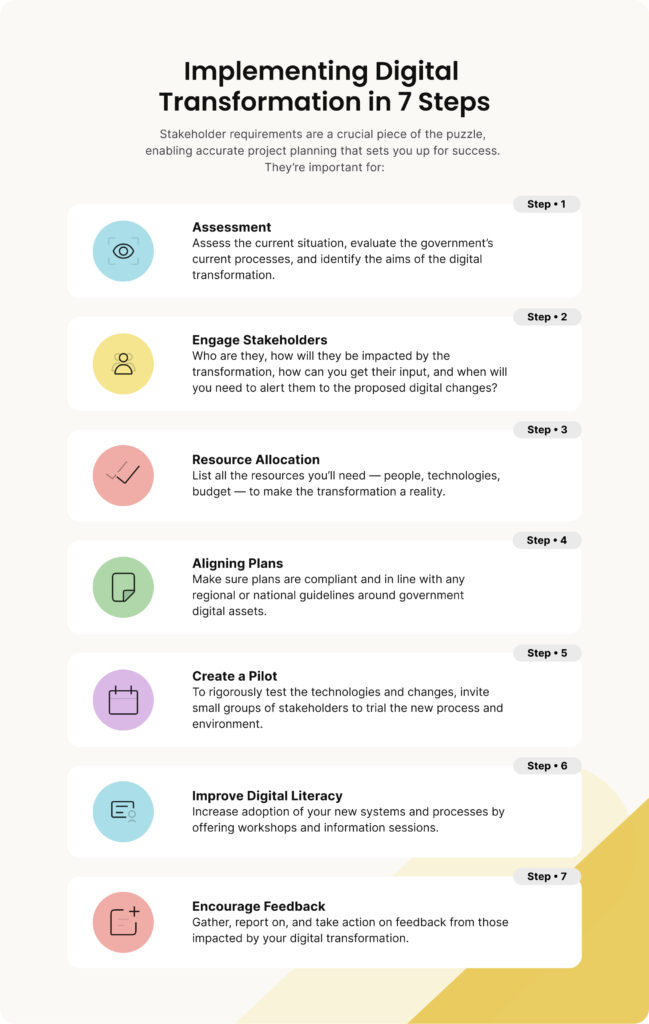
Step 1: Assess the Current Situation
Take a holistic view of the current local government processes, services, and deliverables. Evaluate your strengths, weaknesses, opportunities, and threats. Seek initial input from internal and external stakeholders to better understand risks, resources, opportunities, and concerns early on. Use this stocktake (of sorts) to identify the aims and outcomes that the digital transformation and potential technologies must deliver.
Step 2: Identify and Engage Stakeholders
Successful project management involves developing and maintaining good relationships with stakeholders and communities affected by the proposed digital transformation. Identify and record these stakeholders in your stakeholder management system, ready for engagement.
As a starting point, your stakeholders for this project might include:
- Representatives in local, regional, and national/state government
- Government employees and contractors who will use the new systems daily
- The teams and individuals heavily involved in implementing the transformation
- Community members, groups, and representatives
- Local business and commercial enterprises.
You’ll need to engage with stakeholders at each step in your transformation — but a good first step is to communicate your current aims and plans, and to invite their comments and feedback via email, phone, focus groups, or a survey.
Step 3: Resource Allocation
Consider this your digital transformation shopping list. It should include:
- The technologies and solutions you’ll need to achieve your aims (or think you need)
- The people, skills, and contractors that will implement the plan
- An estimate of the time needed for the changes to take place
- How much of the budget is needed to make the project happen.
Getting this right is key — if you miss important resources, you’ll slow down your digital transformation project, leading to frustration and confusion for employees, constituents, and other stakeholders. So, don’t be afraid to talk to your stakeholders to better understand the additional resources they might need, when they need them, and what (existing) resources they can contribute to the project.
Step 4: Aligning Plans with Regional and National Policies
Any digital switch must be done in line with broader regional and national policies. It’s a compliance thing, sure. But it’s also a consistency thing, bringing uniformity across all governance levels. This, in turn, can assist the community, especially for community members who move from one region to another.
And with some government services having a large and lasting impact on people’s day-to-day life, ensuring there’s usability and functional consistency across government platforms can bring comfort and reassurance.
Step 5: Create a Pilot
To minimize risk and make sure your digital transformation will work as planned, you need to test your new systems. Repeatedly. First by developers, then (ideally) a small number of employees and selected community members prior to a full rollout. This is known as a pilot run and should coincide with step six and seven.
Step 6: Improve Digital Literacy
It’s imperative that employees are willing and able to adopt the new systems. Likewise, for constituent-facing technologies, you’ll need to ensure the community is prepared for launch.
Support the rollout of your digital transformation initiatives by offering workshops and information sessions that improve digital literacy. Run awareness campaigns to promote these sessions and the new systems. These campaigns are also a great opportunity to invite and share stakeholder feedback more broadly.
Step 7: Encourage Feedback
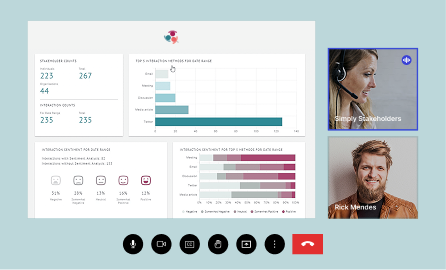
Stakeholder feedback is key to ensuring your implementation meets the needs of your stakeholders. Gather feedback from pilot scheme users that will help turn your initial implementation into a viable long-term solution. And invite feedback from a broader group of stakeholders — including any stakeholders affected by the digital transformation. Stakeholder Relationship Management software or SRMs like Simply Stakeholders can help make this process easier for local governments, by:
- Collecting survey feedback and comments, with these attached to the relevant stakeholder contact in your register
- Automatically analyzing stakeholder input, uncovering issues, and identifying stakeholder sentiment
- Generating reports that show stakeholder feedback and how it’s being used
- Tracking grievances, tasks, and commitments for easy followup
Digital Transformation Starts with Stakeholder Engagement
No matter how big or small the digital transformation you have in mind, you need to start with the stakeholders that are involved in making the change happen — and those affected by the changes that are coming.
Stakeholder engagement is one of the most important parts of this process. It starts with identifying who needs to be involved and at what point. Consider:
Who is the first stakeholder or group you need to talk to regarding a local government digital transformation?
And whether you plan to consult a handful of stakeholders or hundreds, an SRM can help. Easily manage stakeholders with tools like stakeholder registers, advanced stakeholder mapping, and issue analysis. And simplify the feedback process with surveys, analysis, and built-in communication tools.
If your local government is ready to embrace digital, we’re here for it.