From Social License to Social Value
For decades, the concept of a “social licence to operate” (SLO) has dominated the way organisations think about their relationship with communities and stakeholders. Born in the mining and extractive industries in the late 1990s, the term described the informal, unwritten permission that communities grant to organisations operating in their midst. It was always about trust, credibility, and legitimacy—the intangible currency that determines whether a project or business is tolerated, accepted, or genuinely welcomed.
But the language is shifting from social license to social value. Across government, industry, and the social sector, a growing number of organisations are moving away from the notion of “social licence” and embracing terminology like “Social Value” and “Social Legacy.” This isn’t just a cosmetic rebrand. It reflects a fundamental shift in how we think about the purpose of stakeholder engagement, from seeking permission to actively creating lasting, measurable positive change.
In this post, we’ll explore why this shift is happening, what Social Value actually means in practice, the frameworks that underpin it, and how organisations around the world are using this approach to redefine their contribution to communities and society.
The Limitations of “Social Licence”
The social licence to operate has served an important purpose. It forced organisations, particularly those in mining, energy, and infrastructure to acknowledge that regulatory compliance alone was not enough. A company might hold every formal permit and still face fierce community opposition, project delays, and reputational damage if it failed to earn the community’s trust.
However, the concept has attracted growing criticism. The biggest criticism is the transactional nature of social license, rather than a focus on long term impacts and benefits for the community. Another significant challenge is that in many countries, particularly those operating under civil law traditions, only a government authority can grant a “licence.” This creates confusion between the informal, relationship-based concept of social licence and the formal, regulatory meaning of the word. Communities and civil society see social licence as an ongoing dynamic relationship, while regulators and companies may interpret it as a one-off permission tied to specific events.
Beyond the legal ambiguity, the SLO framework carries several deeper limitations:
- It is inherently defensive. The language of “licence” frames the community relationship as something to be “obtained” or “maintained”, a hurdle to clear rather than a partnership to cultivate. This can lead organisations to treat engagement as a transactional exercise: “What’s the minimum we need to do to keep operating?”
- It centres the organisation, not the community. The concept revolves around whether the organisation has “permission.” The community’s wellbeing, aspirations, and development needs are secondary to the organisation’s operational continuity.
- It can be cynically co-opted. Too often, social licence has been treated as something that can be bought through community grants, sponsorships, or public relations campaigns, rather than earned through genuine, enduring relationships built on mutual respect.
- It is difficult to measure. Social licence exists in the realm of beliefs, perceptions, and opinions. While these can be gauged through sentiment analysis and survey work, the SLO concept provides no standardised framework for quantifying the positive or negative impact an organisation actually has on a community.
These shortcomings have prompted a rethink. If the goal is not merely to avoid opposition but to genuinely improve outcomes for people and places, then the conversation needs to move beyond “licence” and toward “value.”
Enter Social Value: A Proactive, Outcome-Focused Approach
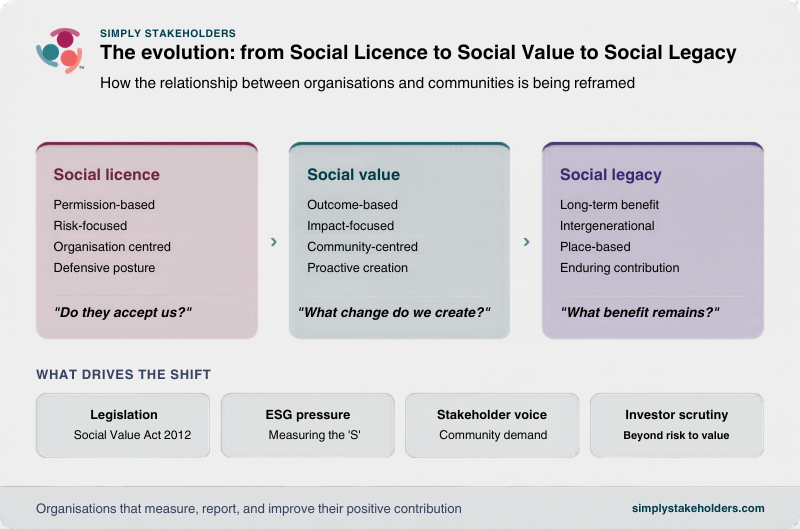
Social Value represents a philosophical and practical evolution from the social licence concept. Where social licence asks, “Do we have permission to operate?” Social Value asks a fundamentally different question: “What positive change are we creating for people, communities, and the environment?”
Social Value UK provides a widely cited definition: Social Value is “the quantification of the relative importance that people place on the changes they experience in their lives.” In other words, it goes beyond financial metrics to capture the broader social, economic, and environmental impact that an organisation’s activities have on the people and places around it.
The UK Government has adopted a similar framing, describing social value derived from procurement as “the positive legacy created through the performance of a contract.” That word “legacy” is telling. It shifts the emphasis from short-term acceptance to long-term, enduring benefit.
This reframing matters because it changes what organisations measure, what they aim for, and how they engage with communities. Instead of managing risk and seeking acquiescence, organisations pursuing Social Value are actively pursuing outcomes such as local employment, skills development, environmental improvement, health and wellbeing, and community resilience.
The Key Shift
Social Licence = “Do stakeholders accept us?” (permission-based, risk-focused, organisation-centred)
Social Value = “What lasting positive impact are we creating?” (outcome-based, impact-focused, community-centred)
Social Legacy = “What enduring benefit will remain after our project or contract is complete?” (long-term, intergenerational, place-based)
The Legislative Catalyst: The Social Value Act and Beyond
The shift from social licence to Social Value has not happened in a vacuum. Legislation has played a critical role in embedding social value thinking into mainstream practice.
In the UK, the Public Services (Social Value) Act 2012 was a landmark piece of legislation that required all public bodies in England and Wales to consider how the services they commission and procure might improve the social, economic, and environmental wellbeing of their area. This was the first time that “social value” was given formal legislative weight in the context of public spending. The UK Government published supporting guidance and resources to help public bodies implement the Act.
The Act was then significantly strengthened. From January 2021, central government departments were required to explicitly evaluate Social Value when awarding major contracts, applying a minimum 10% weighting to social value criteria. The Social Value Model that accompanied this change established priority themes including health and wellbeing, economic equality, fighting climate change, and supporting recovery from COVID-19.
Complementary legislation has reinforced this direction: the Procurement Reform (Scotland) Act 2014, the Well-being of Future Generations (Wales) Act 2015, and most recently the Procurement Act 2023 have collectively created an ecosystem where demonstrating positive social outcomes is not optional, it’s a competitive and legal necessity.
At the European level, the Corporate Sustainability Reporting Directive (CSRD) requires companies to publish detailed information on social impacts across their value chains, covering topics such as gender equality, fair pay, skills development, and working conditions. These regulatory developments are making it clear: understanding, measuring, and reporting social value is becoming table stakes for responsible business.
Social Value Frameworks: Building the Architecture of Impact
Moving from aspiration to action requires robust frameworks. Several have emerged to help organisations plan, measure, and report on their social value contributions.
Theory of Change
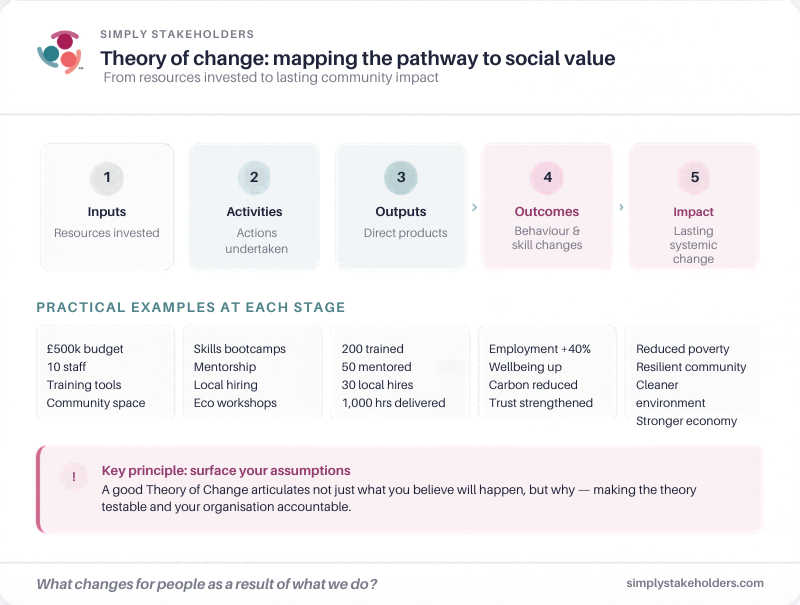
At the heart of most social value frameworks lies the Theory of Change (ToC), a methodology that maps the causal pathway from an organisation’s activities to its desired long-term impact. A Theory of Change works backwards from the ultimate goal, identifying all the conditions (outcomes) that must be in place for that goal to be achieved, and then mapping how the organisation’s activities contribute to each outcome.
The core components of a Theory of Change include:
- Inputs The resources invested (funding, staff, equipment, expertise).
- Activities The actions undertaken using those resources (training programmes, community engagement, environmental initiatives).
- Outputs The direct, measurable products of activities (number of people trained, workshops delivered, trees planted).
- Outcomes The changes in behaviour, skills, or conditions that result (increased employability, improved community health, reduced carbon emissions).
- Impact The long-term, systemic change that the organisation contributes to (reduced poverty, stronger community resilience, a healthier environment).
Crucially, a good Theory of Change also surfaces the assumptions that connect each step in the chain. It forces organisations to articulate not just what they believe will happen, but why they believe it, and what evidence supports that belief. This makes the theory testable and the organisation accountable.
Organisations like New Philanthropy Capital (NPC) in the UK have championed Theory of Change as the foundation of effective strategy and evaluation. NPC describes it as the bedrock of charity strategy, evaluation, and communication, a participatory process that helps organisations think rigorously about how their work leads to real-world impact.
For stakeholder-focused organisations, a Theory of Change is particularly powerful because it puts the stakeholder experience at the centre. It asks: What changes for people as a result of what we do? This is a fundamentally different question from “Do people accept what we do?”
The Social Value TOM System™
The most widely adopted tool for measuring social value is the Social Value TOM (Themes, Outcomes, and Measures) System™, developed collaboratively by over 40 organisations across the public, private, and third sectors. Built on a theory of change model, the TOM System provides a standardised way to measure social value across contracts, projects, and departments. It assigns proxy values, translating positive changes into financial terms, so that organisations can quantify, compare, and communicate their social contributions in a language that procurement teams, decision-makers, and community stakeholders can all understand.
Social Return on Investment (SROI)
SROI is a methodology designed to capture and monetise social, environmental, and economic outcomes as a ratio. For example, an SROI analysis might find that for every £1 invested, £3.50 is returned in social value. While powerful, SROI can be resource-intensive and bespoke, making it less scalable than standardised frameworks like the TOM System. It remains a valuable tool for deep-dive evaluations of specific programmes or interventions.
Other Key Frameworks
Several additional frameworks contribute to the Social Value landscape. The Social Value International Principles provide eight guiding principles for good practice, including involving stakeholders, understanding what changes, only claiming value that is attributable to your activities, and being responsive to findings. The UN Sustainable Development Goals (SDGs) offer a globally recognised benchmark against which organisations can align their social value activities. And the HM Treasury Green Book in the UK provides the value economics methodology that underpins much of current social value measurement practice. The Social Value Portal provides a comprehensive guide to the legislative landscape.
Measuring the ‘S’ in ESG: The Missing Piece
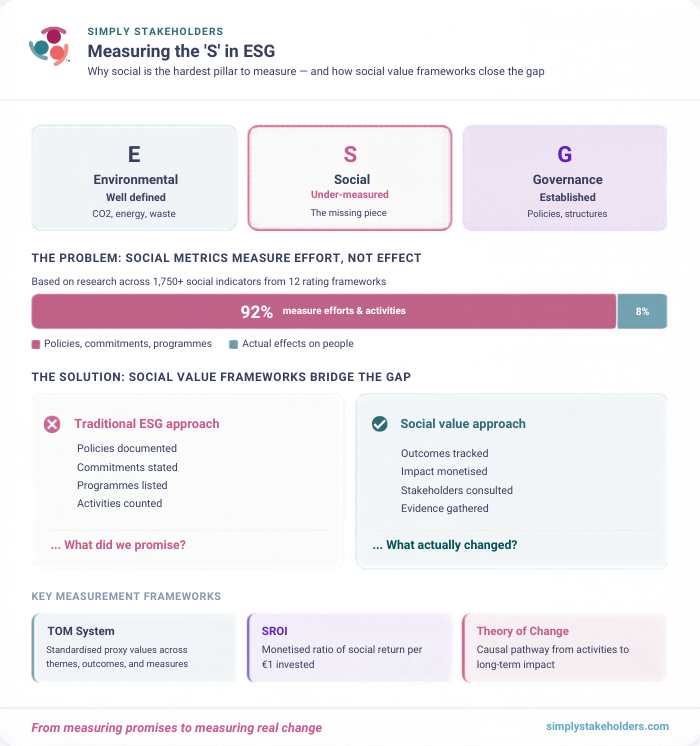
The rise of the shift from Social License to Social Value thinking is directly connected to one of the most significant challenges in the ESG (Environmental, Social, and Governance) landscape: the difficulty of measuring the “S.”
While environmental metrics have matured over the past decade, think carbon emissions, energy consumption, and waste reduction, and governance factors are relatively well-defined through corporate policies and structures, social performance has remained, in the words of many analysts, “an ambiguous minefield.” A significant majority of investors have acknowledged finding the social dimension the hardest area of ESG to analyse and integrate into investment strategies.
A telling finding from research highlighted by Harvard Law School reveals the depth of the problem: of more than 1,750 social metrics across 12 different ESG rating reveals the depth of the problem: of more than 1,750 social metrics across 12 different ESG rating frameworks, only a small fraction actually evaluated the effects of company social practices. The overwhelming majority measured efforts and activities—policies, commitments, and programmes—rather than the actual outcomes those initiatives produced. In other words, the ESG world has been measuring what organisations promise to do rather than what actually changes for people.
This is where social value frameworks offer a breakthrough. By adopting a theory of change approach and measuring actual outcomes, not just inputs and activities, organisations can provide investors, regulators, and communities with credible evidence of their social contribution. Several high-profile cases illustrate why this matters: companies like Tesla have been removed from ESG indices due to unresolved social issues, while others like Boohoo have suffered enormous market value losses after poor labour practices were exposed in their supply chains. Social Ventures Australia’s work with Australian Unity provides a good case study of how organisations can develop practical frameworks for measuring the “S.”
Governance Maturity in the Energy Transition How does your organisation stack up?
The emerging consensus is clear: the “S” in ESG cannot remain a box-ticking exercise focused on policies and commitments. It must evolve toward genuine, evidence-based measurement of social outcomes and impact. Social Value frameworks provide exactly the methodology needed to make this shift possible. For further reading, GRESB’s analysis and the Stanford Social Innovation Review both offer valuable perspectives on fixing the “S” in ESG.
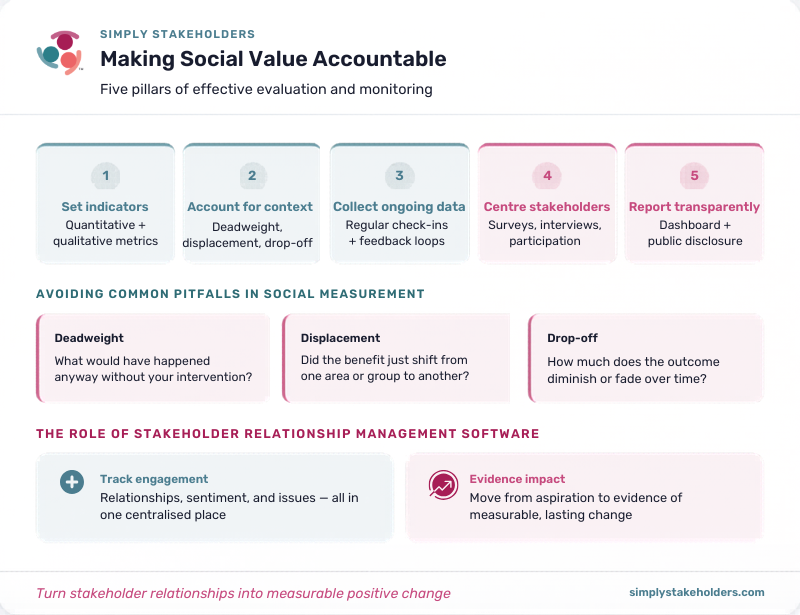
Evaluation and Monitoring: Making Social Value Accountable
Committing to making the transition from Social License to Social Value is one thing; demonstrating that it’s being delivered is another. Robust evaluation and monitoring are essential to ensure that social value commitments translate into real outcomes, and that organisations can learn, adapt, and continuously improve.
Effective social value monitoring typically involves several key practices:
- Setting clear, measurable indicators tied to each outcome in the Theory of Change. These indicators should capture both quantitative data (such as jobs created or training hours delivered) and qualitative insights (stakeholder perceptions, wellbeing changes, community feedback).
- Accounting for deadweight, displacement, and drop-off. Deadweight considers what would have happened anyway without the intervention. Displacement asks whether the benefit has simply been shifted from one area to another. Drop-off reflects how outcomes diminish over time. Good social value measurement accounts for all of these factors to avoid overstating impact.
- Regular, ongoing data collection, not just end-of-project evaluation. Monitoring should be built into the rhythm of project delivery, with scheduled check-ins, data reviews, and stakeholder feedback loops that allow for course corrections along the way.
- Stakeholder-centred evaluation. The people experiencing the changes are the most authoritative source of information about whether social value is actually being created. This means investing in meaningful engagement through surveys, interviews, focus groups, and participatory evaluation methods to capture the lived experience of impact.
- Transparent reporting. Social value data should be shared with stakeholders, communities, and decision-makers in accessible formats. Reporting dashboards, impact reports, and public disclosures all contribute to accountability and build the trust that underpins long-term relationships.
Stakeholder management platforms like Simply Stakeholders play a crucial role here. By tracking engagement, monitoring sentiment, qualitative analysis of discussions with communities, identifying emerging issues, and providing real-time analytics, these tools give organisations the infrastructure they need to move from aspiration to evidence. When social value commitments are tracked alongside stakeholder relationships, organisations can see not just whether they are doing the work, but whether the work is making a difference.
Organisations Leading the Way
Across sectors and geographies, a growing number of organisations are embedding Social Value into their core operations.
Rotherham Council (UK)
Since adopting its Social Value policy in 2019, Rotherham Council has increased local spending by 72% and secured £27.8 million in Social Value commitments from suppliers. This demonstrates how public sector procurement can be a powerful lever for community benefit when Social Value is embedded into decision-making.
Australian Unity (Australia)
Working with Social Ventures Australia, Australian Unity developed a groundbreaking framework to define, measure, and value the “S” in ESG through a community and social value lens. Their approach tested the hypothesis that for Australian Unity, the “S” in ESG could equal “wellbeing”, and they won the Australian Financial Review’s ESG Metrics Innovator award in 2022 for their efforts.
Mars, Compass Group, and Hays
Major international businesses including Mars, Compass Group, and Hays are now using Social Value frameworks. including the TOM System to track and improve their contributions across the pillars of people, place, and planet.
NHS England
Since 2022, the NHS has mandated a 10% Social Value weighting in all procurement decisions. This reflects a growing recognition that healthcare institutions are anchor institutions in their communities, and that procurement decisions have ripple effects on employment, skills, health equity, and local economies.
Salford Youth Zone
Using a Whole Life Value approach that incorporated the National TOMs framework, the Salford Youth Zone project demonstrated that its true social value during the construction phase was £14.5 million, far exceeding the initial estimate of £1.5 million. Over a 25-year operational period, the project is forecasted to generate £171 million in total social value, equating to £3.47 for every £1 invested.
WhatThis Means for Stakeholder Engagement
The shift from Social Licence to Social Value has profound implications for how organisations approach stakeholder engagement. It means engagement is no longer about managing opposition or securing acquiescence. Or even just publishing information about your projects or work on an online portal to “inform” stakeholders. It’s about understanding community needs, co-designing interventions, tracking outcomes, and continuously improving the contribution an organisation makes to the people and places it affects.
This requires tools and processes that go beyond basic consultation. Organisations need to:
- Map and understand stakeholder networks to identify who is affected and who can influence outcomes.
- Track engagement over time to build a longitudinal picture of relationships, sentiment, and emerging issues.
- Analyse qualitative data to understand the depth and nuance of stakeholder experience, not just quantitative metrics.
- Report transparently on what has been promised, what has been delivered, and what the evidence says about impact.
These are precisely the capabilities that platforms like Simply Stakeholders are designed to support. By providing a centralised, data-rich view of stakeholder relationships, engagement history, and sentiment trends, Simply Stakeholders helps organisations move from reactive engagement to strategic, evidence-based relationship management, the kind that underpins genuine Social Value delivery.
Conclusion: From Permission to Purpose
The movement from Social Licence to Social Value is more than a change in vocabulary. It represents a maturation in how organisations understand their role in society. Where the social licence model asked, “Are we allowed to operate here?” the social value model asks, “Are we making this place better?”
With frameworks like Theory of Change and the TOM System providing rigorous methodology; with legislation like the Social Value Act, CSRD, and the Procurement Act 2023 embedding social outcomes into procurement and reporting; and with organisations from Rotherham Council to Australian Unity demonstrating what’s possible, the pathway is clear.
The organisations that will thrive in this new landscape are those that go beyond compliance to genuinely pursue social value, and that have the tools, data, and relationships to prove it.
| Ready to track and demonstrate your Social Value?
Simply Stakeholders gives your team the tools to map stakeholders, track engagement, analyse sentiment, and report on impact. Whether you’re building a social value strategy, meeting regulatory reporting requirements, or reporting on the ‘S’ in ESG, we can help you turn stakeholder relationships into measurable, lasting positive change. We’re here to help you make the transition from social license to social value, and create true social legacy. |