7 Stakeholder Management Challenges Threatening Your Most Important Projects
Key stakeholders can make or break your most important projects. But managing those relationships — across teams, projects, and years — creates stakeholder management challenges that no spreadsheet, CRM, or good intentions can solve.
This isn’t a problem of an organisation’s commitment to its stakeholders. It’s a problem that exists when organisations don’t have systems in place to support the growing surface area of their stakeholder relationships and the ability to manage the influence and impact of those stakeholders on their importance critical projects.
Research from the CoST Infrastructure Transparency Initiative, analysing 480 major projects globally, found that 70% of infrastructure projects experience significant delays, with stakeholder and sustainability issues exceeding commercial delays (63%) and technical failures (21%) as the leading cause. In Australia alone, infrastructure opposition costs have reached an estimated $20 billion.
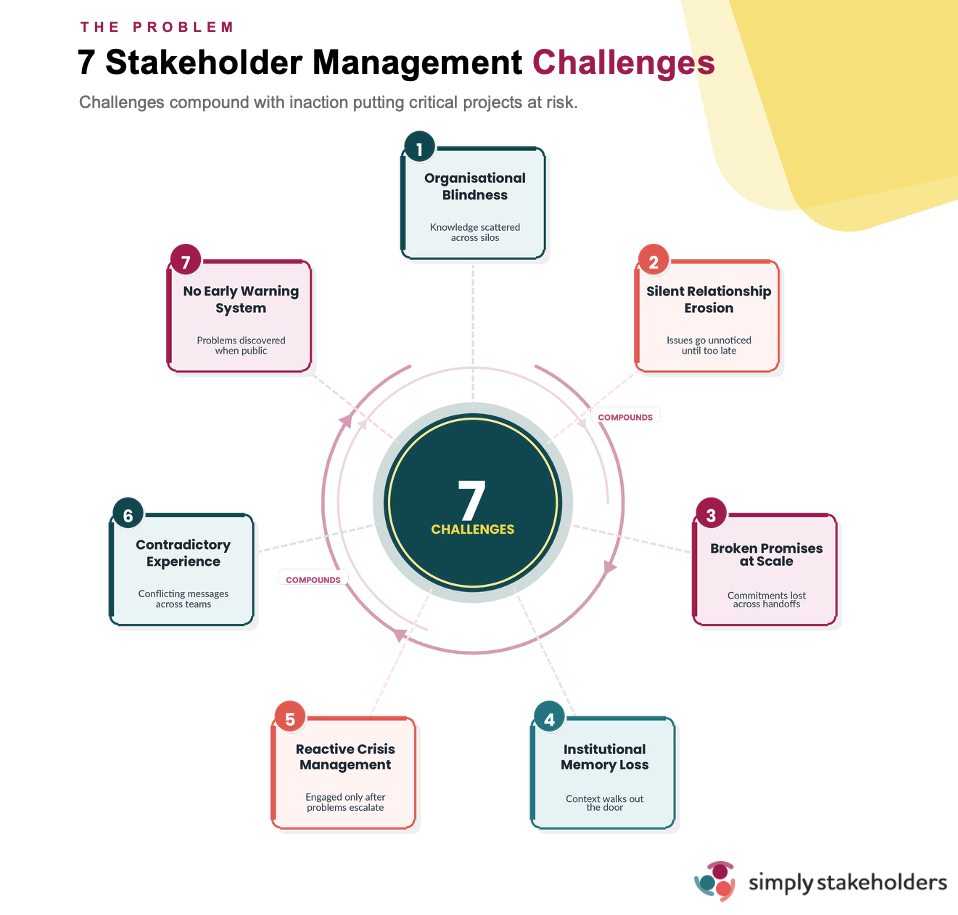
These aren’t isolated incidents. They’re symptoms of seven stakeholder management challenges that exist in every organisation which relies on managing complex stakeholder relationships for its success. Individually, each challenge is manageable. Collectively, they create project-threatening risk that compounds putting important projects at risk.
7 Stakeholder Management Challenges That Threaten Project Success
1. Organisational Blindness
Stakeholder knowledge is scattered across emails, spreadsheets, and the memories of individual team members. Or, one team has a system of record, the other team doesn’t have access to. Teams contact the same stakeholders without seeing each other’s history. The organisation has the information — it simply cannot see it.
You prepare for a meeting with a key stakeholder by asking colleagues: “Has anyone spoken to them recently?” Three people have. None of them knew about the others. The stakeholder arrives expecting a coordinated conversation. Your organisation delivers three separate ones.
2. Silent Relationship Erosion
Without a single view of stakeholder health, issues go unnoticed, needs go unmet, and opportunities to strengthen relationships pass by quietly. By the time erosion becomes visible, it has already cost you. Sentiment doesn’t deteriorate overnight — it compounds across dozens of small, untracked interactions until the relationship is beyond repair and your project hits delays, legal disputes or your company experiences hard to remedy reputational damage which has material impact on investments and public perception.
3. Broken Promises at Scale
Commitments made in meetings, calls, and emails get lost across handoffs and systems. What was promised in 2021 surfaces as a dispute in 2025. No one on the current team was there when the commitment was made. No one can prove what was agreed. The stakeholder remembers. Your organisation doesn’t. Projects that exist over long time horizons will have different incarnations in their project cycles that need to be remembered, managed and understood over the full project lifecycle.
4. Institutional Memory Loss
When key team members leave, years of relationship context, unwritten history, and hard-won stakeholder trust walk out the door. The organisation starts from zero. The stakeholders don’t. Research shows 67% of organisations report significant concern about knowledge loss, with an estimated $72 million annual productivity cost across large enterprises.
5. Reactive Crisis Management
Stakeholders are engaged only when problems have already escalated into formal opposition. By the time you’re managing a crisis, the cost of resolution has multiplied. The organisations that manage stakeholders well aren’t better at crisis management — they’re better at making crises unnecessary.
6. Contradictory Stakeholder Experience
Different departments deliver conflicting messages, making different commitments, and creating confusion with every interaction. The stakeholder sees one organisation. Your organisation behaves as six. Trust erodes not because anyone acts in bad faith, but because no one can see what anyone else is doing.
7. No Early Warning System
There is no mechanism to detect shifting sentiment or emerging opposition before it organises. Problems are discovered when they become public — not when they’re still manageable. Leadership finds out about stakeholder issues from media coverage, not from their own systems.
Why These Stakeholder Management Challenges Are Getting Worse
These seven challenges aren’t static. Five converging pressures are making them more acute with every passing quarter — and each one raises the cost of inaction.
1. Stakeholder engagement is now a compliance obligation.
EU CSRD and ISSB global disclosure standards (IFRS S1/S2) now require documented, auditable evidence of stakeholder consultation. Australia’s mandatory sustainability reporting started January 2025 (ASIC RG280). Queensland has legislated social licence requirements for renewable projects. It used to be best practice. Now it’s mandatory.
2. Community opposition now kills projects outright.
$64 billion in data centre projects have been blocked or delayed in two years. 498 contested renewable energy projects across 49 US states — up 32% year-on-year. In Australia, 70% of infrastructure projects experience significant delays, with stakeholder and sustainability issues exceeding commercial delays (63%) and technical failures (21%) as the leading cause. Opposition doesn’t slow projects down. It stops them.
3. Institutional memory loss is accelerating.
42% of institutional knowledge resides solely with individual employees — meaning every departure risks losing nearly half of what the organisation knew about its stakeholder relationships. 67% of organisations report significant concern about knowledge loss, and the problem is accelerating: average employee tenure has dropped from 4.5 years to 4.2 years in two years. In Australia, the infrastructure workforce gap is projected to reach 300,000 by 2027 — meaning more people leaving, more frequently, from more critical roles. The organisation starts from zero. The stakeholders don’t.
4. Project finance requires social risk evidence.
129 Equator Principles financial institutions across 38 countries commit to applying social and environmental risk assessment frameworks to projects above $10 million. ESG-linked lending has passed $500 billion globally. The capital your projects need now comes with conditions your current approach can’t satisfy. Governance maturity now needs to include serious considerations stakeholder impacts on projects.
5. Stakeholder complexity is outpacing management capability.
55% of CEOs have increased stakeholder engagement in the past six months alone, recognising it as a critical priority. Companies that take a long-term view of stakeholder relationships outperform their peers by 47% in cumulative revenue growth. Local issues become national campaigns overnight — 142 activist groups coordinate across 24 US states on data centre opposition alone. Stakeholder complexity is growing exponentially. Management capability is stuck in the 90s.
These pressures compound each other. Regulatory mandates create documentation requirements that informal processes can’t meet. Community opposition triggers financing conditions that demand auditable evidence. Staff turnover destroys the institutional memory needed to maintain relationships over multi-year timelines.
The question isn’t whether your organisation faces these stakeholder management challenges. It’s whether your organisation is setup to manage the realities of the complexity and importance of stakeholder relationships to your projects.
Universal Stakeholder Management Challenges Across Sectors
The stakeholder management challenges are universal. How they manifest is sector-specific. Simply Stakeholders serves organisations across mining, transport, utilities, local government, healthcare, and renewables — proven cross-sector, configured for each sector’s specific stakeholder landscape.
Mining and Resources
Social licence to operate is now the number one risk facing mining and metals companies globally. Stakeholder relationships span decades, cross Traditional Owner groups, regulatory bodies, and community organisations simultaneously, and a single coordination failure can halt operations. SRM provides the relationship visibility infrastructure to track every commitment, every interaction, and every sentiment shift across a portfolio of projects — preserving organisational memory across the workforce turnover cycles that define the resources sector.
Renewable Energy
Renewable energy projects face approval timelines stretching to 4–7 years, driven primarily by community resistance — not technical complexity. A single wind or solar farm may require engagement with 40 or more individual property owners, each with different concerns, timelines, and relationships to manage. SRM gives development teams the ability to track every property owner interaction, map community sentiment in real time, and demonstrate auditable engagement evidence to regulators and financing bodies.
Local Government
Councils manage stakeholder relationships across multiple departments simultaneously — economic development, planning, community services, infrastructure — often engaging the same organisational stakeholders without any visibility into each other’s conversations. The result is contradictory messaging, duplicated effort, and stakeholders who know more about the council’s activities than the council does. SRM provides the shared visibility layer that makes coordination possible across departmental boundaries.
Transport Infrastructure
Major transport projects span years, cross multiple jurisdictions, and transition through planning, procurement, construction, and operations phases — each with different teams, different stakeholders, and different political contexts. The institutional memory loss between phases is staggering. SRM preserves relationship continuity across every phase transition, ensuring commitments made during planning are honoured during construction and stakeholder trust built early survives personnel changes.
Utilities
Utilities manage concurrent infrastructure programs across vast network footprints, engaging thousands of stakeholders simultaneously across overlapping project boundaries. The complexity of coordinating engagement when multiple projects affect the same communities at the same time exceeds what any manual process can manage. SRM provides the network-wide visibility to coordinate engagement across programs, track cumulative impact on communities, and ensure no stakeholder falls through the gaps between projects.
How Simply Stakeholders Resolves Each Stakeholder Management Challenge
Stakeholder relationship management (SRM) is not a better spreadsheet. It’s a commitment to managing stakeholder relationships to ensure your organisation and projects have the history, evidence and visibility they need for project success. The evidence is clear that stakeholder relationships make or break critical projects and only a purpose-built system can resolve the structural challenges that CRMs, spreadsheets, and shared drives were never designed to address. Simply Stakeholders is an intelligent platform that focusses on the essential components that make managing stakeholders unique.
Stakeholder Register: A centralised living database of your critical relationships
Resolves: Organisational Blindness (#1) and Institutional Memory Loss (#4)
A centralised record of every stakeholder — contacts, segments, relationships, interaction history — linked across projects and teams. Every team member sees the same stakeholder, the same history, the same context. When key people leave, relationship context stays. The organisation never starts from zero again.
Stakeholder Mapping: Strategic Clarity on Who Matters Most
Resolves: Organisational Blindness (#1) and Contradictory Stakeholder Experience (#6)
Multi-dimensional mapping — influence, impact, interest, criticality — combined with network visualisation that reveals how stakeholders connect to each other. You don’t just see who your stakeholders are. You see how the network is structured, who matters most right now, and where coordination is failing or opportunities exist.
Interaction Tracking: A Complete Record That Belongs to the Organisation
Resolves: Broken Promises at Scale (#3) and Contradictory Stakeholder Experience (#6)
Every interaction — meetings, calls, emails, site visits — recorded and linked to the stakeholders involved, the commitments made, and the projects they relate to. Built-in email capture from Outlook and Gmail, communication logging, and file attachments ensure nothing stays trapped in someone’s inbox. When a new team member asks “what did we promise this group?” the answer isn’t “ask Sarah, she was there” — it’s in the system.
Monitoring & Insights: Early Warning Before Opposition Organises
Resolves: Silent Relationship Erosion (#2), Reactive Crisis Management (#5), and No Early Warning System (#7)
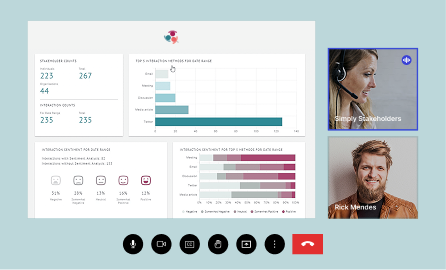
AI-powered sentiment analysis across every interaction, with automatic issue tagging, theme identification, and trend tracking. Relationship health scores per stakeholder, measurable and trackable over time. Workflow automations that trigger alerts when sentiment drops, issues escalate, or interaction gaps emerge. The system watches for erosion signals continuously — so you’re acting three months before a formal objection, not three days after.
Reporting & Insights: Leadership Visibility Without Chasing Reports
Resolves: No Early Warning System (#7) and Organisational Blindness (#1)
Dashboards, scheduled reports, and compliance-ready documentation that gives leadership real-time visibility into stakeholder engagement quality across every project and team. No more chasing spreadsheet updates before board meetings. No more relying on anecdotal briefings that miss the relationships that matter most. Auditable evidence of engagement maturity, produced continuously — not assembled retrospectively under deadline pressure.
Collaboration & Team Features: Cross-Team Visibility That Ends Information Silos
Resolves: Contradictory Stakeholder Experience (#6) and Organisational Blindness (#1)
Shared access, multiple project views, and complete interaction history visible across teams. Every team member sees what every other team member has done, promised, and heard. The stakeholder gets one coordinated experience. Your organisation behaves as one — because, for the first time, it can actually see itself as one.
The Cost of Waiting
Every month without organisation-wide visibility, these stakeholder management challenges compound as relationship debt. Commitments are forgotten. Sentiment deteriorates undetected. Institutional memory erodes with every departure. And the gap between the complexity of your stakeholder environment and the capability of your current tools widens.
Simply Stakeholders is stakeholder relationship management (SRM) software — purpose-built for organisations where stakeholders determine whether projects succeed or fail. Not a CRM adapted for stakeholders. Not a consultation tool with a database attached. A systematic response that solves the stakeholder management challenges that no spreadsheet, CRM, or good intentions can solve.